


iPhone Accessories for Repair Technicians
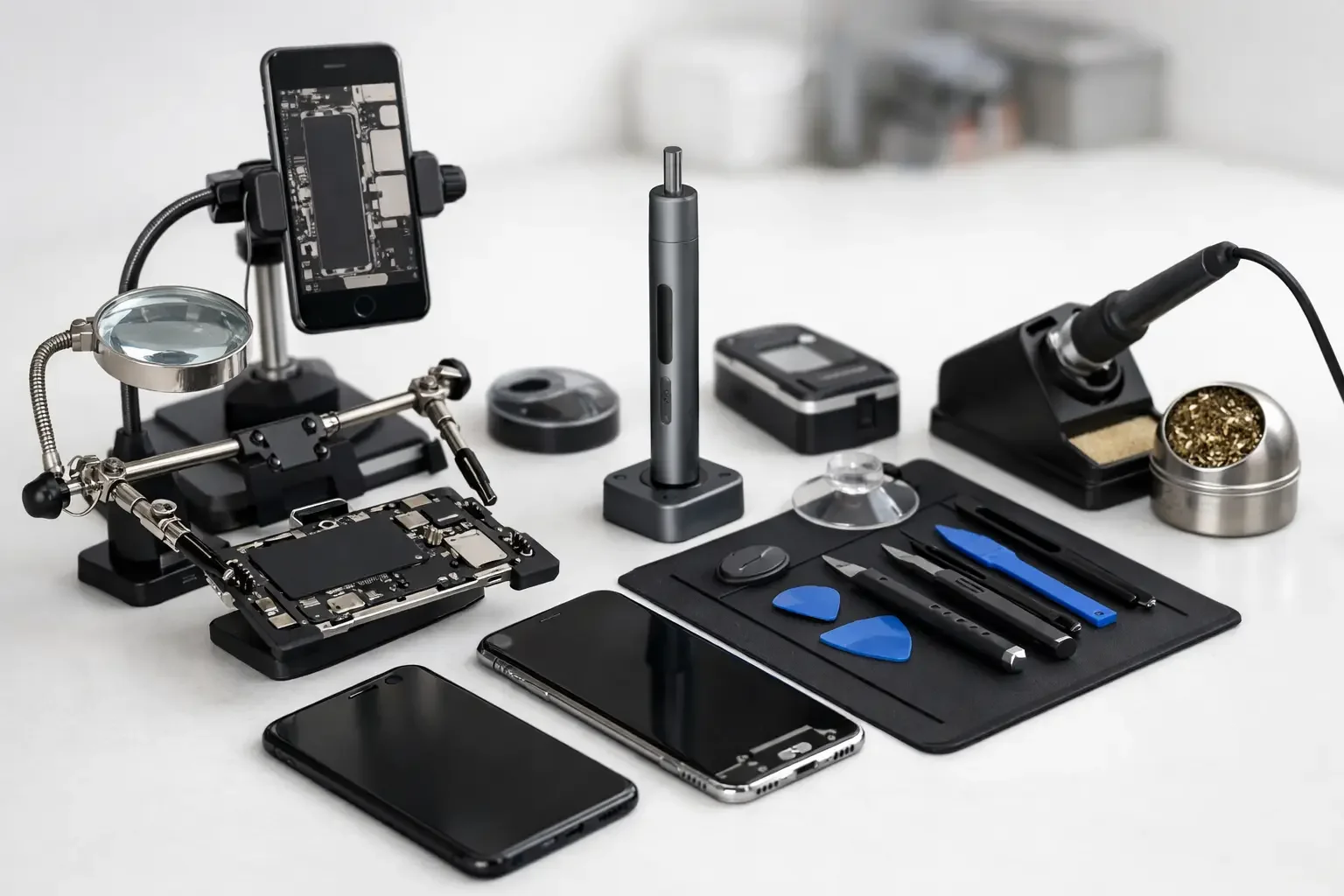
When a repair takes longer than expected, it's rarely just about the replacement parts. More often, it’s missing one of the essential iPhone accessories that makes the difference between smooth processing and a stalled workstation during testing, assembly, or final checks. For those working daily on Apple devices, accessories are not an afterthought: they are an integral part of the technical process.
The key is in how they are chosen. An efficient workshop doesn’t stock generic products. It selects accessories that align with the models being serviced, the volume of work, and the most common faults. This is especially true for iPhones, where tolerances, connectors, adhesives, power sources, and post-repair testing demand tools and materials compatible with precise procedures.
Which iPhone Accessories Are Truly Needed for Repair Technicians
The first useful distinction is between repair support accessories and verification accessories. The former assist in disassembly, assembly, and secure fitting. The latter confirm that the device leaves the workstation in proper condition. Confusing these two categories often results in having a stocked inventory that is not functional.
In daily work, the most useful accessories are those that reduce the number of critical steps. A good magnetic screw holder, a model-specific adhesive set, reliable testing cables, bench power supplies, and tools for temporarily connecting components matter much more than generic accessories designed for consumer use. The goal is not to have everything but to have what prevents repetitive mistakes.
Bench Accessories and Operational Organization
With iPhones, losing a screw or mixing positions between two internal components can turn a simple repair into a return. That's why bench tools, technical mats, and organizational systems are not secondary elements. They help maintain order during the phases of opening, component separation, and reassembly.
A well-equipped workstation reduces the risk of collateral damage. This is especially important when working on multiple devices in parallel or on models with minimal differences between variants. Proper management of screws and small shielding elements is a practical quality control measure, not just a convenience issue.
Cables, Adapters, and Functional Test Accessories
Many issues arise after reassembly, not during replacement. That’s why essential accessories include testing cables, Lightning adapters, temporary connectors, and tools that allow verification of charging, absorption, communication, and response of certain modules before final closure.
Here, quality matters more than price. An unstable testing cable skews diagnostics, wastes time, and leads to unnecessary replacements. The same applies to adapters with poor tolerances or unreliable contacts. In the workshop, the real cost is not the individual accessory, but the machine time and technician time consumed when it introduces doubts instead of clarifying them.
Accessories for Opening, Closing, and Re-Adhering
Anyone repairing iPhones knows that the job doesn't end with component replacement. A crucial part of the outcome depends on the closing phase. Therefore, pre-cut adhesives, compatible gaskets, tools for controlled pressure, and cleaning materials for the frame are all essential accessories.
On some models, using the incorrect adhesive compromises the display alignment or the screen assembly's seal. On others, a rough re-adhesion leads to lifting over time, dust ingress, or returns for issues that the customer perceives as defects in the repair. The trade-off is simple: saving on closure materials might increase the margin on a single repair, but it deteriorates reliability and reputation.
Essential Consumable Materials
In real work, consumable materials have a more significant impact than it seems. Specific double-sided tapes, temporary protective films, technical tape, electronic cleaning liquids, and residue removal tools determine how quickly the workstation remains operational. When they’re missing, the repair slows down even if the main replacement is available.
A workshop that regularly handles iPhones should manage these accessories as recurring supplies, not as occasional purchases. The reason is practical: they are fast-moving items that directly affect delivery times. Running out of compatible adhesives for a highly requested model means halting a nearly completed repair.
iPhone Accessories for Repair Technicians and Diagnostics
The less visible, but often more profitable, aspect is diagnostics. Not all lab accessories are for disassembly. Some serve to determine whether it’s worth taking apart. Stabilized power supplies, tools for reading absorption, battery test accessories, and quick-check components allow differentiation between a charging issue and a board defect, or a degraded battery versus anomalous absorption.
This step is also crucial in managing estimates. More accurate diagnostics reduce the chances of the workshop ordering the wrong part or initiating a process that later proves unnecessary. Especially with Apple devices, where many symptoms can have different but similar causes, testing accessories shorten the path to the real cause.
When to Choose Model-Specific Accessories
Not everything needs to be universal. Some accessories work well across multiple generations of iPhones, others do not. Adhesives, mounting supports, temporary connection cables, and some testing tools perform best when designed for a specific model or family.
The choice depends on the mix of repairs at the workshop. If the flow focuses on a few high-rotation models, it makes sense to keep dedicated accessories. If the workstation receives highly varied devices, it’s better to balance with more universal tools. A common mistake is to force a universal accessory on a procedure that requires specific precision: it saves in cataloging but loses in execution.
How to Select the Right Accessories for the Workshop
The selection should be made based on three variables: frequency of interventions, criticality of the step, and lost time in the absence of the accessory. If a product is used daily, even a minimal difference in quality pays off quickly. However, if it’s only needed occasionally, a more essential, yet reliable solution may suffice.
A useful criterion is to observe where errors or slowdowns concentrate. If the problem lies in testing before closure, better verification accessories are needed. If the bottleneck is re-adhesion, stocks of adhesives and finishing materials should be boosted. If the workstation loses time managing microcomponents, the physical organization of the workstation should be treated as a technical purchase, not just an accessory detail.
The supplier's assortment also matters. For those working on Apple, finding a single catalog with replacement parts, consumables, tools, and testing accessories reduces compatibility errors and procurement times. In this regard, a specialized structure like iPhoneHospital.it is valuable, especially when the workshop must purchase routinely for specific models, without scattering research and orders across multiple channels.
The Most Common Mistake: Buying “Universal” Accessories to Save
In the repair sector, the concept of universal accessories must be approached with caution. Some products are genuinely versatile and make sense in any workshop. Others are marketed as compatible with everything, but in practice, they introduce tolerances, instability, or additional steps that nullify the initial advantage.
The point is not to avoid universal accessories, but to understand where they work well. For organizing the workstation and some support tools, they are often a valid choice. For adhesives, specific tests, and temporary connections, precision in compatibility weighs much more. An efficiency-oriented workshop does not buy by generic category, but by real-use scenario.
Accessories and Margins: A Direct Relationship
Often, replacement parts are viewed as the sole source of revenue, but accessories directly impact margins. If a correct adhesive prevents a return, it has generated value. If a reliable testing cable reduces diagnostics by 15 minutes, it has generated value. If a bench support prevents reassembly errors, it has generated value.
This is why iPhone accessories for repair technicians should be viewed as productivity tools. They are not invisible costs to minimize but elements that stabilize the process. The larger the workshop grows, the more this logic becomes evident: the margin does not only depend on what is sold, but on how well each intervention is executed.
Those who work on iPhones consistently understand this well. The workstation performs better when each component, every consumable material, and every accessory is selected to avoid uncertainties. This is where repair ceases to be improvisation and becomes a controlled technical process.