


Antistatic Tools Comparison for the Lab
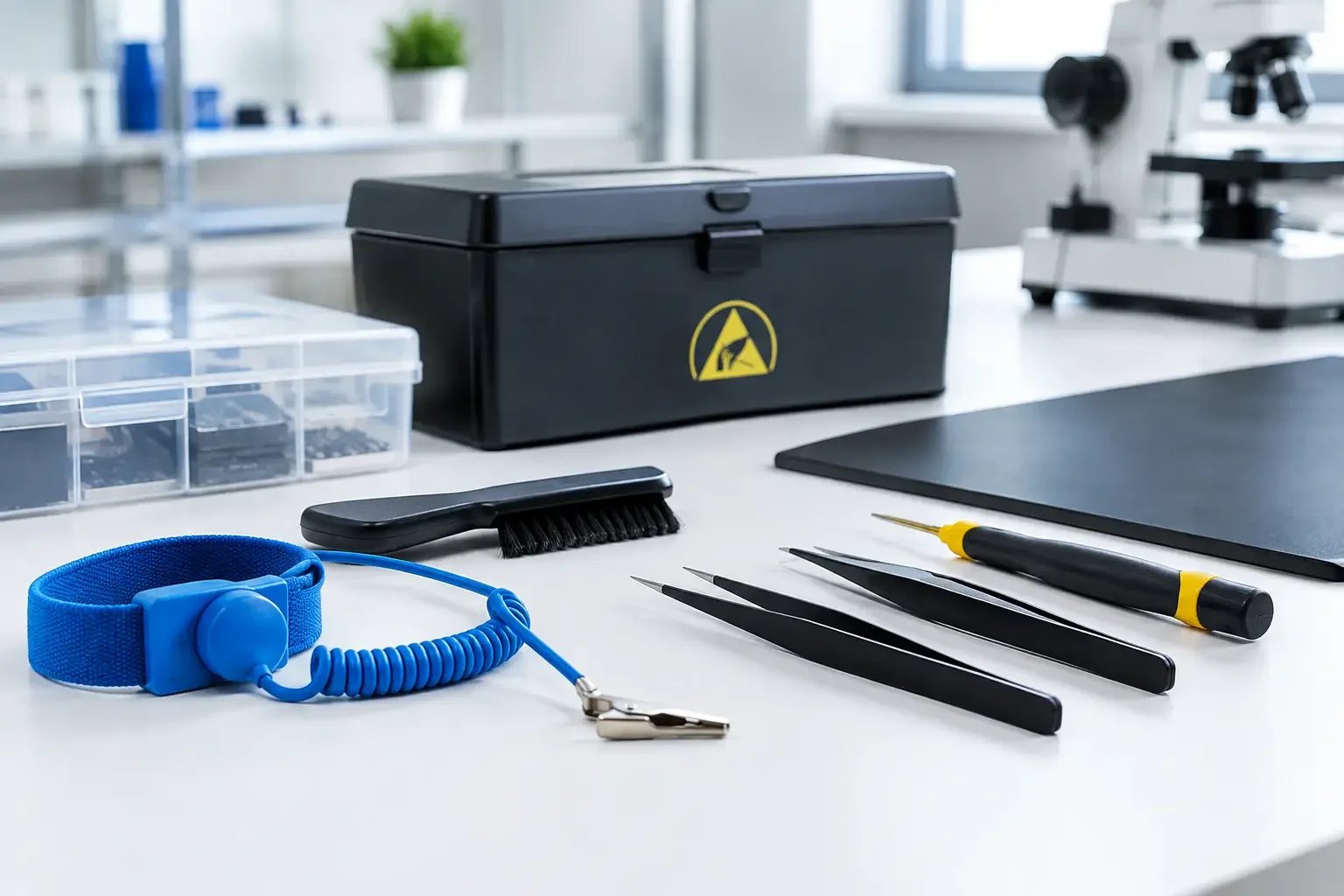
A component can be damaged without showing any visible signs. This is the most insidious problem with electrostatic discharges: the device may power on after repair but develop intermittent faults, abnormal power consumption, or subsequent failures. This antistatic tools comparison is designed for technicians working on logic boards, displays, connectors, flat cables, ICs, and modules of iPhones, iPads, MacBooks, Samsung devices, and other precision electronics.
ESD protection cannot be achieved by simply purchasing a single accessory. Wrist straps, mats, grounding, clothing, and environmental control form a system. The proper choice depends on the volume of interventions, the types of boards handled, and the level of traceability required by the lab.
Why ESD is a Real Risk in Repair
An electrostatic discharge occurs when two bodies with different electrical potentials come into contact or get close enough to generate a discharge. The technician may not feel or see it: the human perception threshold is much higher than the sensitivity of many semiconductors.
During repair, the risk increases with dry air, insulated surfaces, synthetic clothing, and repetitive handling of electronic parts. A power management chip, a sensor, an RF circuit, or a data line can suffer immediate damage or latent degradation. In the latter case, the defect manifests after days or weeks, with consequences hard to attribute to the intervention performed.
An organized workstation with appropriate equipment reduces exposure but does not eliminate the need for correct procedures. Removing the wrist strap for convenience, placing a board on an unsuitable bag, or using a mat without grounding undermines a significant part of the protection.
Antistatic Tools: Comparison of Main Solutions
Not all antistatic tools perform the same task. Some control the charge generated by the operator's body, others provide a dissipative surface; ionizers intervene on insulating objects that cannot be grounded.
ESD Wrist Strap: Essential for the Technician at the Bench
The antistatic wrist strap connects the operator to the ground point via a safety-resistance cord. It is the most direct tool for keeping the body at the same potential as the workstation and limiting discharges when touching boards and components.
For occasional activities on devices with non-exposed components, a good-quality wrist strap can represent the first level of protection. However, for a professional lab, it should be considered part of a broader system. It must be worn in contact with the skin, connected to the correct ground point, and periodically checked.
The operational limit is evident: it protects the technician, not the workspace or insulating objects on the bench. Moreover, a worn strap, with oxidized contact or broken cord, offers only apparent protection.
Dissipative Mat: The Base of the ESD Workstation
The ESD mat is the most useful solution for creating a controlled surface to place boards, displays, screws, connectors, and equipment. Unlike a regular workbench mat, a dissipative model slowly discharges static electricity when properly connected to ground.
For those performing disassemblies and micro-interventions daily, the mat should cover the actual working area, not just a small portion in front of the microscope. Space is needed for the board, for spare parts in progress, and for tools. A crowded bench forces continuous movement of components on unprotected surfaces.
The distinction between conductive and dissipative materials matters. Highly conductive surfaces can discharge too rapidly and are not always suitable near powered circuits or sensitive components. In electronic repair benches, the most common choice is a dissipative mat, combined with a ground connection and a dedicated ESD socket.
Tweezers, Spudgers, and ESD-Safe Tools
Antistatic tools do not replace mats and wrist straps but reduce the risk at the point where the technician contacts the component. ESD-safe tweezers, spudgers, brushes, and suitable containers are particularly useful when handling ICs, flex cables, cameras, FPC connectors, and small modules.
Tweezers deserve specific attention. A standard metal tweezer may be suitable for many mechanical operations, but it is not automatically suitable for the safe handling of sensitive components. ESD models are designed to reduce charge accumulation and often offer more precise tips for microscope work.
The choice depends on the task. Thin, curved tips improve grip on capacitors, resistors, and jumpers; straight, wider tips are preferable for flex and small connectors. ESD protection should not sacrifice precision, ergonomics, and visibility at the point of intervention.
Ionizer: When Grounding Isn't Enough
The ionizer emits positive and negative ions to neutralize charges present on insulating materials. It is useful on plastics, films, displays, containers, spare parts, and objects that cannot be directly grounded.
It is especially suitable for workstations with high turnover of sensitive components, display regeneration activities, BGA work, or very dry environments. It does not replace the wrist strap or mat: it addresses a different problem. If the technician is not grounded, the ionizer alone does not make the workstation compliant with proper ESD management.
The investment should be evaluated based on real cases. For a bench dedicated to battery and display replacements, it may not be a priority; for those working daily on logic boards, RF modules, and micro-soldering, it can become a tangible support to reduce latent defects.
How to Compose an Effective Antistatic Workstation
A functional configuration starts from four distinct elements: a grounded dissipative mat, an ESD wrist strap with a resistive cord, a controlled ground point, and suitable containers for handling components. To these, add ESD-safe tools and, if necessary, an ionizer.
Grounding requires attention. Do not improvise connections to pipes, metal structures, or unverified masses. The bench must use a suitable ground point, and devices must include the necessary resistances to limit current. An incorrect connection is not only ineffective: it can pose a risk to the operator and the equipment.
Order at the workstation also matters. Spare parts removed from packaging should be placed immediately on the mat or stored in shielding containers. Boards and modules should not be left on cardboard, common plastic, synthetic cloth, or painted surfaces without knowing their electrical characteristics.
ESD Testers and Periodic Checks
The antistatic system is reliable only if verified. ESD wrist strap and footwear testers check that resistance falls within the expected range, signaling damaged cords, dirty contacts, or incorrect connections. In a lab with multiple technicians, a check at the beginning of the shift prevents reliance on visual inspection alone.
The mat should be cleaned with compatible products. Aggressive cleaners, waxes, unsuitable solvents, and glue residues can alter its surface. Also, the maintenance of tools is important: tweezers should remain clean, free of flux residues, and with intact tips to ensure a precise grip.
When working with soldering stations, bench power supplies, and microscopes, each piece of equipment must have a stable placement. The ESD surface should not become a dumping ground for hot tools, open containers, and disorganized cords. Electrostatic protection and workstation organization go hand in hand: fewer unnecessary movements mean less chance of damaging the component.
Which Solution to Choose Based on the Type of Intervention
For a technician performing standard smartphone repairs, the minimum sensible combination is a dissipative mat, an ESD wrist strap, and appropriate tools for manipulating components. It is an accessible configuration that already offers concrete protection during disassembly, connector replacements, batteries, displays, and internal modules.
For those working on logic boards, performing micro-soldering, reballing, or advanced diagnostics, it is advisable to add verification tools, shielding containers, and consider the ionization of the workspace. In these activities, the cost of a compromised board or a repair returning for intermittent defects quickly surpasses the cost of prevention.
The comparison between antistatic tools should not be seen as a choice between alternative products. Wrist straps, mats, tools, testers, and ionizers operate at different levels. The correct solution is one proportional to the performed tasks, properly installed, and maintained over time: an effective ESD bench protects the component even before the failure becomes visible.