


Electronic Lab Accessories: What You Need
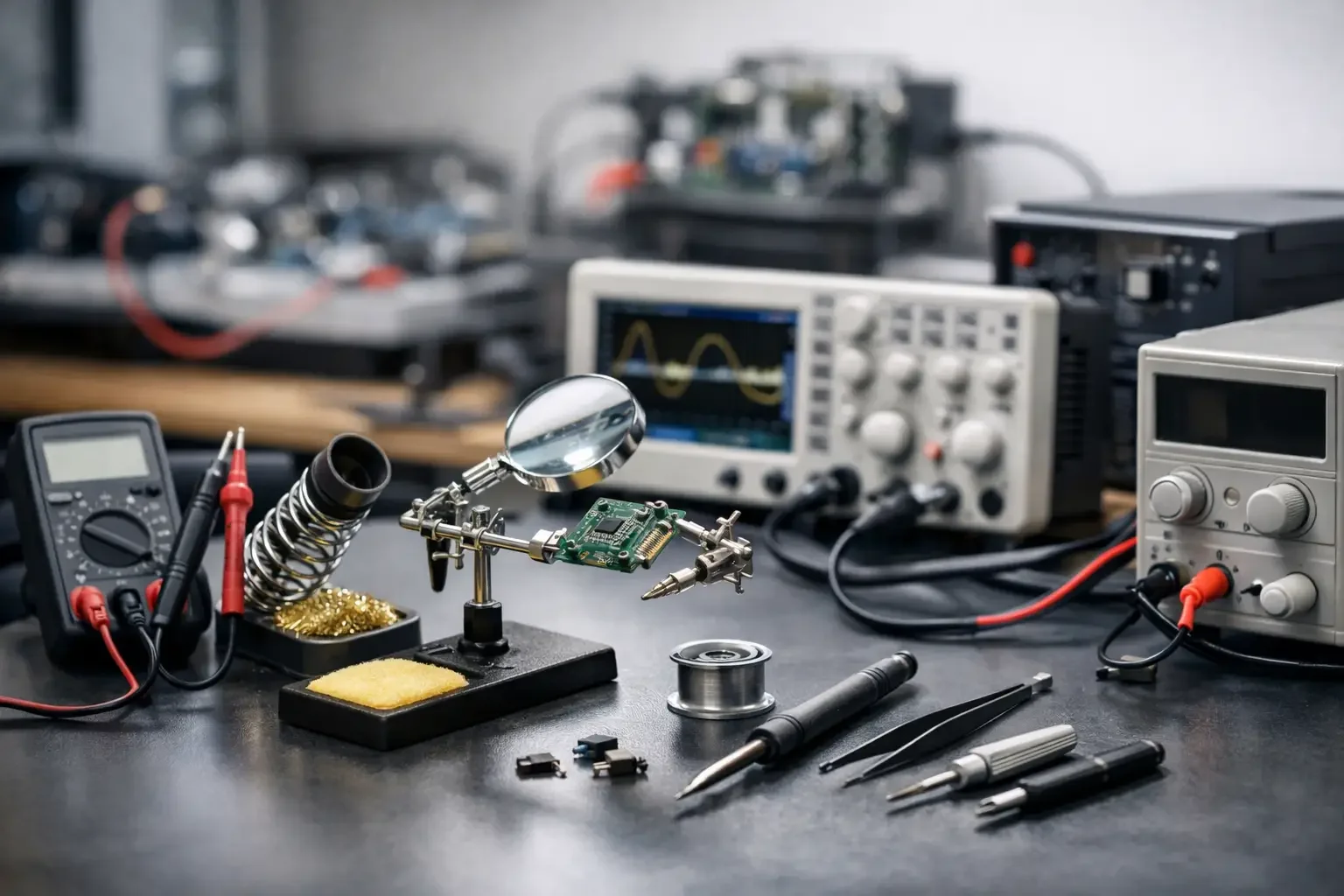
A lab that wastes time searching for a tip, replacing an inadequate mat, or working under poor lighting doesn’t have a minor issue; it has an operational problem. When we talk about electronic lab accessories, we are not referring to a set of secondary items, but rather everything that makes the workbench more precise, organized, and productive during daily repairs.
For those working on iPhones, iPads, MacBooks, Apple Watches, AirPods, or on the electronic boards of other devices, the difference between an improvised workstation and a well-configured one is immediately apparent. Processing times change, errors decrease, component management improves, and the risk of avoidable damage is reduced. It’s not about filling the lab with redundant equipment. It’s about choosing the right accessories based on the types of repairs performed.
Electronic Lab Accessories: Why They Matter
In the repair work, the main equipment draws almost all the attention. Soldering station, power supply, microscope, display separator, diagnostic tools. However, in practice, much of the efficiency depends on the accessories that surround this equipment.
A stable PCB support, for instance, prevents movement during soldering or reworking. A well-organized antistatic mat limits errors in managing screws and small modules. Proper lighting reduces eye strain and inaccuracies on flats, connectors, pads, and tracks. Even seemingly simple materials, such as Kapton tape, flux, desoldering braid, or containers for microcomponents, have a direct impact on the quality of the work.
The key point is operational. If the lab handles high volumes, every unnecessary step adds up. If, on the other hand, you’re dealing with complex low-volume interventions, stability, control, and repeatability become essential. In both cases, workbench accessories are not an optional addition.
How to Choose Accessories Based on Lab Type
Not all labs have the same needs. A service center focused on quick display and battery replacements operates differently than one that performs micro-soldering, data recovery, or motherboard repairs. That’s why purchasing electronic lab accessories should be done with a usage strategy in mind, not for accumulation.
If the focus is on smartphone and tablet repairs, it’s wise to prioritize accessories that speed up disassembly, organize screws, offer ESD protection, and facilitate bench cleaning. In this scenario, technical mats, precision tweezers, magnetic organizers, supply dispensers, antistatic brushes, and workbench lamps are essential.
If the lab works on boards, rework, and SMD components, priority shifts to PCB supports, locking tools, heat management accessories, nozzles, dedicated tips, thermal shielding materials, and magnifying systems paired with good lighting.
Then there are mixed labs, which are increasingly common. Here, the most sensible choice is to create a cross-functional base and then add specific accessories for each type of intervention. This approach is more efficient than randomly purchasing similar products that end up overlapping.
Workbench Accessories That Make a Difference
The first area to consider is protecting the workstation. Antistatic mats, ESD wrist straps, heat-resistant surfaces, and dedicated containers not only serve to maintain order but also protect sensitive boards, delicate flats, and exposed components from discharges, shocks, and loss of screws or small parts.
The next aspect is the mechanical management of work. Board supports, lightweight clamps, magnetic bases, and positioning systems improve stability during soldering, desoldering, and inspection. Working on a board that moves a few millimeters may seem acceptable until you rip a pad or compromise a connector.
The third area is lighting. In many labs, it is still undervalued, but with compact components and high-density devices, an appropriate workbench lamp can drastically change the margin of error. It’s not enough to just have light; you need uniform, adjustable lighting with a color temperature suitable for clearly distinguishing residues, traces, cold solders, and surface damage.
Finally, there are precision accessories. ESD tweezers, technical spatulas, opening tools, probes, needles, spudgers, and supporting tools should be selected based on actual use. A generic kit may suffice for beginners, but a lab that works every day needs specific, replaceable tools that are consistent with the devices handled.
Consumables and Supporting Materials: A Department Not to Be Underestimated
Many bench hold-ups don’t stem from a lack of an expensive machine but from the absence of the right material at the right moment. Flux, pastes, desoldering braids, technical tapes, isopropyl alcohol, wipes, adhesives, double-sided tapes, brushes, and technical cloths are all essential components of electronic lab accessories.
Here, the choice criterion is not only compatibility but also operational continuity. If a lab frequently performs display replacements, assembly, and closures, it needs materials with consistent performance and recurring availability. If, however, it deals with more delicate board operations, the quality of the flux or thermal shielding can directly impact the final result.
It’s also beneficial to distinguish between universal materials and specific ones. Some consumables are cross-functional and always useful, while others only make sense when linked to certain types of repairs. Stockpiling without this distinction often leads to immobilizing budgets on rarely used items.
Workstation Organization and Error Reduction
A disorganized bench also slows down even the experienced technician. In labs that handle multiple devices every day, organization is part of quality service. Accessories dedicated to classification, containment, and identification are thus more relevant than they might seem.
Trays, compartment containers, mats with support areas, screw boxes, technical labels, and supports for small components help keep parts, processing phases, and spare parts separate. This is particularly useful when managing multiple repairs of the same brand or model simultaneously, a common scenario in labs working within the Apple ecosystem.
There’s also a less obvious but tangible advantage. An organized workstation makes it easier to standardize the operational flow among multiple technicians. When accessories are always in the same place and consumables follow a precise logic, idle time, interruptions, and avoidable steps are reduced.
Universal or Device-Specific Accessories?
The answer depends on the level of specialization of the lab. Universal accessories cover most basic activities and have the advantage of being reusable across different models. They are the most rational choice for building a solid workstation without fragmenting purchases too much.
Specific accessories, however, become useful when working repeatedly with certain product families. Think of jigs, supports, dedicated opening tools, masks, or accessories compatible with particular components. In these cases, the advantage is not just technical but also productive—work gets done faster with less uncertainty.
For a lab focused on Apple repairs and recurring work on iPhones, iPads, and MacBooks, the best combination is often a well-selected universal base, supplemented by specific accessories for the most frequently handled models. This approach maintains flexibility without sacrificing efficiency.
When to Upgrade Your Lab Equipment
It doesn’t always make sense to redo the bench from scratch. More often, it makes sense to intervene on critical areas. If handling errors are increasing, there is probably an issue with organization or tool precision. If work slows down during cleaning, shielding, or screw management, the weak point lies in consumables or supporting accessories. If technician fatigue increases, it may be time to rethink lighting, ergonomics, and the layout of the bench.
The type of devices handled also makes a difference. Products are becoming more compact, components more sensitive, and tolerances tighter. Accessories that were adequate five years ago may now be limiting. Upgrading the equipment doesn’t mean chasing every novelty but rather eliminating real bottlenecks.
For this reason, it’s beneficial to purchase from a supplier that not only deals with spare parts but also offers equipment, consumables, and professional tools in a structured manner. A broad assortment allows building the workstation coherently without fragmenting the supply. This is the type of approach that companies like iPhoneHospital.it make particularly practical for those working daily in the repair sector.
Choosing the right accessories doesn’t make a lab spectacular; it makes it reliable, fast, and predictable. And it’s this difference, in daily work, that allows handling more interventions with fewer errors and keeps a bench always ready to work.