


Hot Air or Soldering Iron: What to Choose
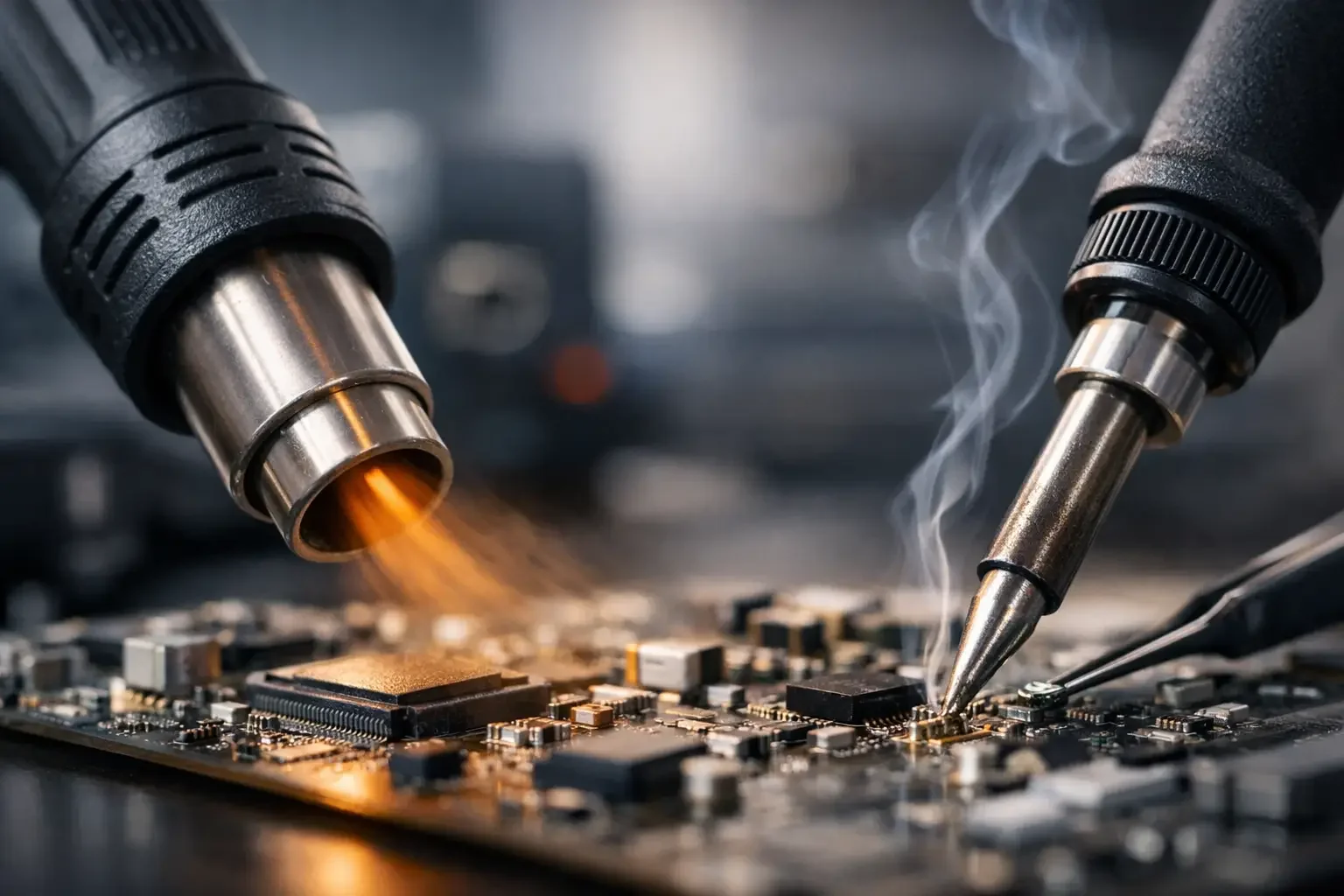
If you are considering hot air or a soldering iron, the right question isn't which is definitively "better," but which tool allows you to finish the job with less risk, less wasted time, and more control. In the lab, this choice directly impacts the quality of work, especially when moving from charging connectors and flat FPCs to shields, small SMD components, or multilayer board interventions.
Those who repair smartphones, tablets, and notebooks know this well: using the wrong tool not only slows down work but also increases the risk of lifting pads, warping plastics, overheating sensitive areas, or achieving unreliable solder joints. Therefore, it's wise to consider application, thermal mass of the component, accessibility of the area, and required precision.
Hot Air or Soldering Iron: Real Difference in the Lab
The practical difference between the two tools lies in how they transfer heat. The soldering iron works by direct contact: the tip delivers heat to a precise point and allows for very controlled management of the alloy, flux, and time of exposure. Hot air, on the other hand, transfers heat by blowing warmed air over a larger area. This makes it useful when the component has multiple terminals, when it's inconvenient to reach solder points with the tip, or when uniform heating is required.
Operationally, the soldering iron is often the first choice for spot soldering, touch-ups, precision tinning, and work where the surrounding area should not be affected. Hot air becomes preferable for desoldering SMD components, removing shields, working on connectors with many pins, or managing glued or mounted parts with distributed thermal mass.
This is not a theoretical distinction. On a smartphone board, the difference between a well-sized tip and the correct nozzle is evident in the final result, not in the tool's technical specifications.
When to Use the Soldering Iron
The soldering iron remains the most intuitive tool and, for many repairs, the most efficient. If you need to redo a pad, restore a contact point, tin thin wires, work on small through-hole components, or make micro-corrections on a connector, tip control is hard to replace.
On Apple devices and compact electronics in general, the soldering iron is useful when access is limited but localized. A typical example is the fixing of pins, small localized shields, coaxial cables, battery contacts, or components where the risk is not so much melting the alloy, but protecting the surrounding materials.
There's also an often-overlooked advantage: the soldering iron reduces heat involvement in adjacent areas. If you have plastics, flats, adhesives, or connectors very close together, an appropriate tip and correct temperature allow for tighter, more predictable work. Given the same technical skill, this translates to less collateral damage.
The limitation arises when the solder joint is not easily reachable or when the component has many points that need to be uniformly melted. In that case, forcing the soldering iron can mean mechanical stress, prolonged times, and the risk of tearing.
Jobs Where the Soldering Iron is Often the Right Choice
The soldering iron excels with small to medium-sized connectors, jumpers, trace repair, replacing accessible single components, pre-tinning, and finishing. It's also the logical choice for anyone needing to maintain a steady hand on micro-work with a strong manual component.
If your goal is precision point by point, the soldering iron is almost always ahead.
When to Use Hot Air
Hot air comes into play when it's necessary to distribute heat more evenly or work without direct contact. In desoldering, this is an obvious advantage. An SMD component with multiple terminals, a metal shield, a board-to-board connector, or an area with strong thermal absorption is often better managed with hot air than with a traditional tip.
In real-world work, hot air is also very useful for softening adhesives, facilitating the separation of assembled parts, preparing the area before removal, and reducing localized stress on individual terminals. This does not mean it is simpler to use. It means it distributes risk differently.
Where the soldering iron can stress a pad by pulling the component before complete melting, hot air can overheat areas you did not intend to touch. Therefore, the nozzle, set temperature, airflow, and shielding of sensitive areas are very important.
Jobs Where Hot Air Makes More Sense
Replacing connectors with many pins, removing shields, desoldering non-coated ICs, reworking SMD components, and localized preheating are typical cases. Even on complex boards, where the thermal mass quickly absorbs the heat from the tip, hot air can work more effectively.
When the component needs to heat up uniformly, hot air provides a tangible advantage.
Hot Air or Soldering Iron in Apple Devices and Mobile Repair
In the context of smartphones and tablets, the choice heavily depends on the component. For a charging connector with anchoring points and closely spaced pins, you often work with both: hot air for removal and soldering iron for cleaning, finishing, and repositioning. For small passive components, the soldering iron may be sufficient. For shields or high-density connectors, hot air becomes more practical.
On Apple boards, density is high, spaces are tight, and sensitive areas are close together. This makes thermal management critical. It's not enough to just ask hot air or soldering iron: you need to consider whether the area requires isolation with Kapton, whether to use low-activity flux or a more aggressive one, whether the board needs to be preheated, and whether the existing alloy is lead-free or already reworked.
The experienced technician chooses based on the outcome, not habit. And often the best response is to combine both tools in the same procedure.
How to Truly Choose Between Hot Air and Soldering Iron
The correct choice starts from four operational variables. The first is the type of component. The more terminals it has, the more important uniform heating becomes. The second is the sensitivity of the surrounding area. The more plastics, flats, and vulnerable components there are, the more point control from the soldering iron becomes useful.
The third variable is the thermal mass. Mass pads, shields, and areas with significant heat dispersion absorb a lot of heat and challenge less efficient stations. The fourth is the phase of the work. Removal, pad cleaning, positioning, final soldering, and inspection do not always require the same tool.
If you primarily perform micro-repairs, jumpers, targeted rework, and finishing, investing in a good soldering iron with the right tips makes a lot of sense. If you regularly tackle SMD desoldering, complex connectors, and shields, a well-adjustable hot air station becomes almost essential.
For many labs, the most productive answer is not to choose one or the other but to have both with a logic of complementarity. This is the most realistic approach economically as it reduces errors, work times, and the likelihood of having to redo the intervention.
Common Mistakes in Tool Selection
The most frequent mistake is relying solely on the declared temperature. A station may show a high value but have poor thermal stability or slow recovery. In real work, consistency, the quality of the tip or nozzle, and the response when the component absorbs heat matter.
Another common error is using hot air as a universal solution. It's useful but not neutral. If the airflow is excessive, you can displace nearby components; if the temperature is too high, you can carbonize flux, warp plastics, or stress the board. Similarly, insisting on an undersized soldering iron leads to keeping the tip on the point too long, with a worse thermal effect than a well-executed hot air removal.
Then there's the topic of accessories. A valid tool without suitable tips, correct nozzles, appropriate flux, desoldering braid, and stable work support underperforms. In an organized lab, productivity relies on the complete system, not just the handle.
Which Tool to Buy First
If you are setting up a basic workstation and mainly work on entry-to-mid-level repairs, the soldering iron is often the first sensible purchase. It costs less, covers many daily operations, and allows you to practice managing alloy and heat with a high margin of control.
However, if your workflow already includes frequent replacements of connectors, shields, and SMD components, starting with just the soldering iron may limit you. In that case, it makes more sense to immediately plan for a hot air station as well. For a technical supplier like iPhoneHospital.it, the correct logic is to select equipment based on the type of interventions you need to complete daily, not based on a generic preference.
The best choice is not the most versatile tool on paper, but the one that reduces errors at your workbench. When deciding between hot air and soldering iron, look at the component you repair most often: there's your answer.
Useful spare parts and tools: iPhone Spare Parts · Batteries