


Original vs Compatible iPad Battery
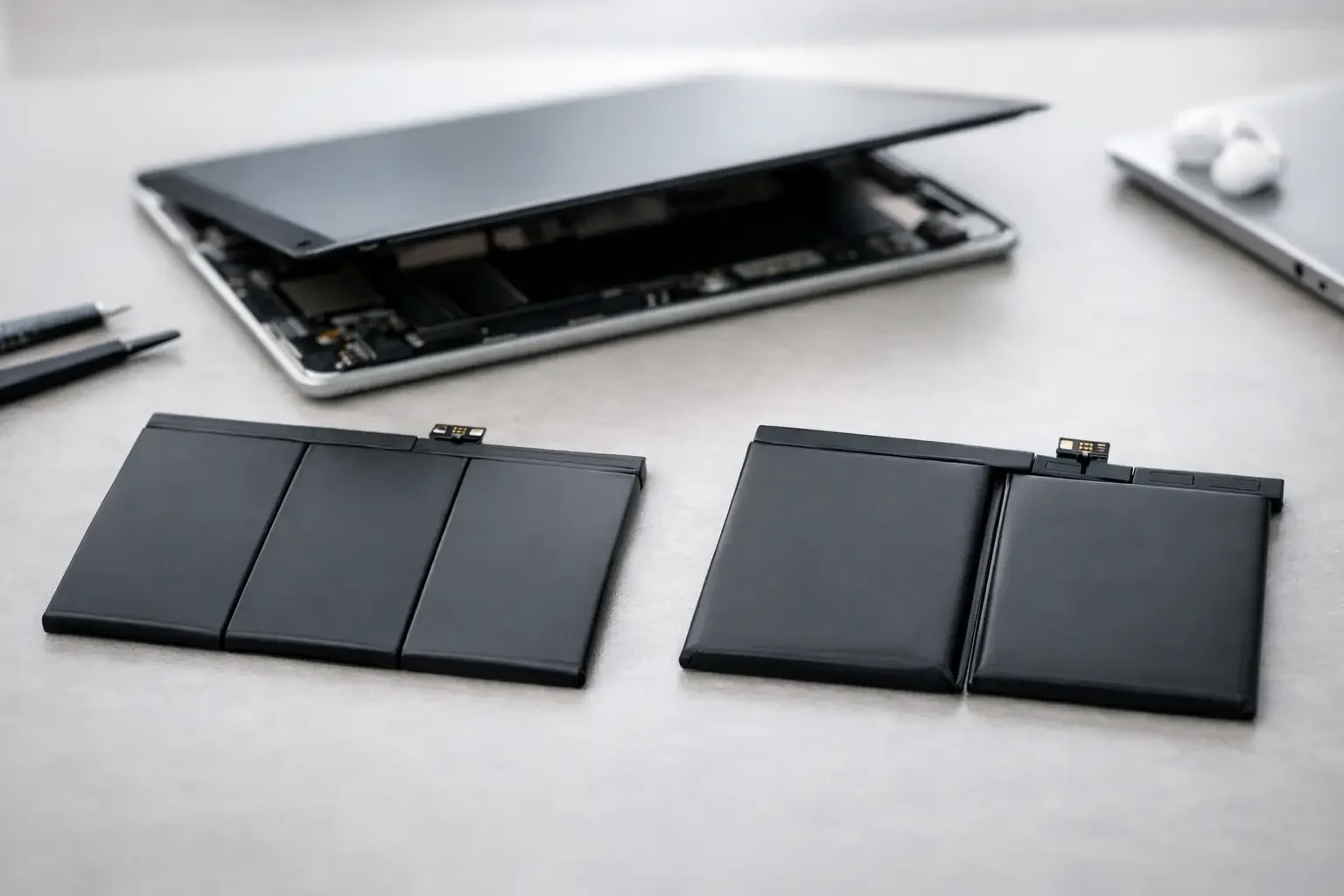
When an iPad arrives at the shop with a significantly reduced battery life, random shutdowns, or swollen cells, the real question is not just which battery to install. The key is understanding, in practical terms, original iPad battery vs compatible: where does the final result really change, how does it impact the repair success, and what choice makes sense based on the model, the customer, and the operational margin.
Original vs Compatible iPad Battery: The Difference is More Than Just a Name
In the repair industry, the term "original" is often used generically, but for iPads, it must be interpreted precisely. An original battery is one that has specifications, materials, and electrical behavior that adhere to the first-party component or its quality standard. A compatible battery, on the other hand, is an aftermarket replacement designed to work on the same model, but not always built with the same level of cells, protections, flexible connectors, and adhesives.
This does not mean that every compatible battery should be discarded. It means that the comparison should be made on real technical parameters. Nominal capacity, load stability, quality of the protection circuit, dimensional tolerance, and adhesive strength matter much more than the label printed on the battery.
For those who work daily with Apple tablets, the difference becomes particularly evident after installation. A mediocre battery may seem adequate during a quick test, but can show issues after just a few cycles: unstable percentage, inconsistent charging times, overheating, or lower-than-expected customer autonomy.
What to Expect from an Original Battery
An original or high-quality equivalent battery generally offers greater consistency. The discharge curve is more stable, the voltage remains within predictable parameters, and the standby behavior is closer to that of the factory-installed component.
This aspect weighs more on iPads than on other devices. The large display, the consumption of touch lines, the always-active Wi-Fi, and prolonged use for streaming or productivity place real stress on the battery. If the cells are not well selected, degradation becomes visible sooner.
Another critical point is the assembly. A high-end battery tends to have more reliable connections, cleaner soldering, and a double-sided adhesive specifically designed for proper fixation within the frame. In an iPad, where future reassembly should remain manageable and internal pressure should be avoided, this detail is not secondary.
The known limit is the cost. For some repairs, especially on older models or those with low commercial value, choosing a premium replacement may dramatically reduce the margin or raise the quote beyond what the customer will accept.
When a Compatible Battery Really Makes Sense
A compatible battery makes sense when the replacement is well-selected and economically justified. For a non-recent iPad, used for browsing, POS systems, teaching, or internal tasks, a high-quality compatible battery can be a sound solution.
The problem is not compatibility itself. The issue lies with generic compatibles, lacking quality traceability, with aggressive but uncredible declared specifications. If a product sheet promises significantly higher capacity than the original with the same volume, an experienced technician already knows there’s something to verify.
A good compatible battery must guarantee at least three things: correct dimensions, a reliable protection circuit, and realistic performance. If these three points are met, the replacement can perform well and reduce the repair cost without leading to a warranty return.
Technical Parameters to Check Before Purchase
Capacity in mAh alone is not enough. It must be read alongside nominal voltage, cell quality, and discharge stability. Two batteries with similar label numbers can behave quite differently on the bench.
The production date or the freshness of the batch also matters. A battery that has been stored poorly for too long loses technical value even before installation. Therefore, warehouse rotation is a practical factor in choosing a supplier, not just a commercial detail.
On the mechanical side, thickness, connector position, and adhesive quality should be considered. In various iPad models, even a minimal out-of-spec tolerance can complicate display reassembly or create unwanted tension on the panel.
Finally, there’s the issue of testing. A reliable replacement should come with consistent tests and predictable performance. For those purchasing parts frequently, having a well-classified range by model is essential. In this regard, the iPad Parts section helps reduce selection errors and speeds up ordering the correct part.
Real Autonomy, Not Declared
In the original vs compatible iPad battery comparison, real autonomy is the data that customers immediately perceive. But it does not always match the nominal capacity. An iPad with a well-calibrated battery, stable voltage, and low standby leakage can provide a better experience than a theoretically higher-capacity battery that is less consistent.
For a repair shop, this changes the way testing is managed. It’s not enough to check power-up, charging, and a linear percentage drop in the first minutes. It’s wise to observe performance under load, retention during standby, and temperature during charging.
If the iPad is intended for continuous professional use, such as in retail, warehouses, or technical consultations, predictability is the top priority. In these cases, a battery that maintains stable performance over time is more valuable than a budget-friendly replacement that offers initially acceptable yields but quickly declines after a few months.
Safety and Risk of Returns
Saving on a battery can have twice the cost. A low-quality cell can lead to early swelling, instability during charging, or shutdowns at still-high residual percentages. For iPads, where opening involves displays and structural adhesives, a return due to a defective battery incurs a greater technical cost than for devices that come apart more easily.
This is why the purchase price should always be considered alongside post-sale costs. If a very cheap compatible battery even slightly increases the return rate, the initial advantage is nullified. For those managing volumes, this is a matter of margin before it becomes a reputational issue.
There’s also a less visible but real aspect: the quality of the protection circuit. Overload, temperature, and current management must remain within safe ranges. A serious replacement does not just "work" but operates within reliable parameters.
How to Choose Based on the Customer Type
Not all repairs require the same tier of replacement parts. If the customer uses the iPad as their primary device, takes it offsite, works remotely, and expects performance close to original, the safest choice remains a high-quality battery.
If, on the other hand, the tablet serves a secondary function, is used in controlled environments, or budget is the deciding factor, a well-selected compatible battery can be perfectly sensible. The key is to clearly declare the proper positioning of the part without promising first-party performance when the conditions do not exist.
For repair shops, a simple rule applies: it’s better to have a clear range with understandable quality differences than to offer a single indistinct option. This helps both with quotes and with managing expectations.
The Supplier's Role in Part Selection
Between original and compatible, often the decisive variable is not the abstract category but the concrete supplier. Clear technical sheets, classification by model, constant availability, and professional assortment directly impact processing time.
For those working across multiple Apple families, using an organized technical catalog reduces steps and errors. If, in addition to batteries, adhesives, tools, displays, or bench materials are needed, having everything within the same purchasing flow is a real operational advantage. In this regard, a structure like iPhoneHospital.it meets the needs of labs and technicians seeking supply continuity rather than occasional purchases.
The same applies to equipment. A good battery installed with inadequate tools can still lead to problematic interventions. When working with adhesives, glass opening, and frame cleaning, the quality of laboratory accessories affects the outcome as much as the replacement part.
So, Is Original or Compatible Better?
The useful answer for a technician is this: it depends on the level of the replacement and the goal of the repair. If high reliability, predictable performance, and lower return risks are needed, the choice should lean towards an original battery or a high-quality equivalent. If, however, budget is the primary constraint and the device holds lower residual value, a well-selected compatible may be the correct solution.
The real difference is not in the commercial slogan, but in the verifiable quality of the component, the consistency of the supplier, and the type of final use of the iPad. When these three elements are aligned, the decision between original and compatible becomes much simpler.
When in doubt, it’s wise to think like a good workshop: choose the replacement that reduces problems after installation, not the one that seems cheap only before ordering.
Useful parts and tools: iPhone Parts · Batteries