


iPhone Incell Display: Comparison with OLED and LCD
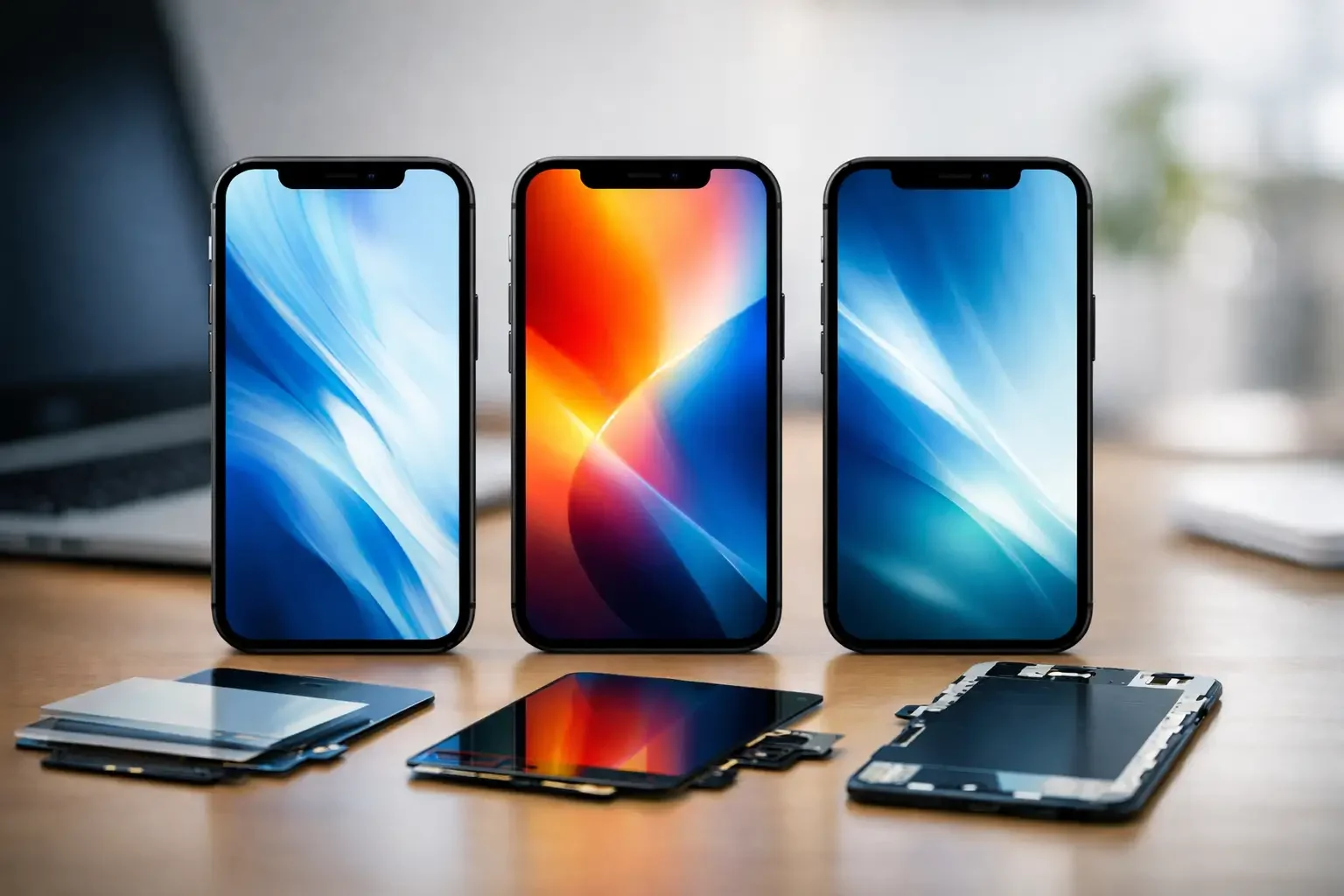
A broken display not only requires a compatible replacement; it requires the right panel for the model, intended use, and the quality level demanded by the customer. In the Incell iPhone display comparison with original LCDs and OLEDs, the most common mistake is to consider the term Incell as an absolute quality. In reality, it describes a touch construction technology and does not inherently guarantee color rendering, brightness, reliability, or performance after installation.
For a workshop, choosing correctly means avoiding returns, disputes over colors and brightness, touch issues, and repeated repairs. The first check is always the native compatibility of the model: an iPhone designed with an LCD should not be evaluated using the same criteria as an iPhone designed with an OLED.
What is an Incell display for iPhone
In a traditional LCD display, the panel that generates the image and the touch layer are distinct elements. The Incell technology integrates touch sensors within the structure of the display, reducing the necessary layers. The result is a module that is potentially thinner, with a more direct touch response compared to cheaper, layered aftermarket LCD solutions.
In the iPhone replacement market, the term Incell is usually used to identify replacement LCD displays primarily intended for models originally equipped with LCDs or, in some cases, offered as a cost-effective alternative to OLEDs. This distinction must be communicated clearly: an Incell is still a backlit LCD. It cannot reproduce the native contrast, absolute black, or pixel management of an OLED.
The presence of Incell technology does not automatically make the component equivalent to an original display. Two displays labeled as Incell can differ significantly in terms of panel, polarizer, backlighting, front glass, touch circuit, and frame quality. For this reason, selection should not be based solely on the brand name.
Inc Cell iPhone display: comparison between LCD and OLED
The correct comparison starts from the originally installed technology. iPhones with LCD panels, like various generations with Retina HD displays, can use a good quality Incell as a technically consistent replacement. On the other hand, iPhones with OLEDs require a more thoughtful choice: installing an Incell is possible only if the replacement is intended for that model, but it involves a switch from OLED to LCD with visible and functional differences.
Contrast, blacks, and color rendering
An OLED turns each individual pixel on and off. When the image needs to display black, the pixel remains off. This enables deep blacks, high contrast, and particularly effective rendering in dark interfaces, videos, and high-contrast images.
An Incell LCD uses constant backlighting behind the panel. Black is achieved by filtering light, making it appear generally more gray, especially in dim lighting. Moreover, saturation, color temperature, and image depth may differ compared to an original OLED.
On an iPhone originally equipped with an LCD, the difference from the original component may be minimal if the replacement is of adequate quality. On an OLED model, however, a customer accustomed to the original display will more easily notice the variation. For a repair aimed at cost containment, an Incell may be a solution; for those seeking performance close to the original, the choice should remain on a suitable quality OLED.
Brightness and outdoor visibility
Declared brightness alone is not sufficient to judge a display. Real readability under direct light, backlighting uniformity, and color stability at the edges matter. A low-cost Incell may seem adequate on the bench, but may show darker areas, a color bias, or loss of readability outside.
For a technician, the check after installation must include a white background, gray background, dark images, and brightness adjustment at multiple levels. This is the quickest way to spot halos, uneven backlighting, defective pixels, and color temperature variations.
Touch and smoothness in daily use
The touch response of a good Incell is generally precise for calls, messaging, navigation, and general use. However, sensitivity at the edges, multitouch management, and consistency of response under pressure may differ from an original module or higher-end OLED.
During testing, it’s insufficient to verify that the touch responds at the center of the screen. The entire grid, edges, keyboard, fast scrolling, and pinch-to-zoom need to be tested. On models with thin bezels, a partially inactive touch area may only become apparent during actual usage.
Thickness, frame, and assembly quality
Incell technology allows for reduced layering, but the final result depends on the entire module. A display may have a valid panel but still present issues due to a warped frame, non-planar glass, insufficient seals, or poorly finished flexures.
Before final adhesion, it’s advisable to check alignment within the frame, pressure on connectors, and the absence of interference with sensors, front camera, and receiver. Forcing a display into the frame can cause halos, premature breakage, or loss of touch response in the hours following delivery.
When to choose Incell, OLED, or equivalent LCD
The choice depends on the model and the agreement with the customer, not a rigid hierarchy. For an iPhone originally equipped with an LCD, a well-selected Incell display often represents a practical balance between cost, thickness, and quality of use. In this case, it is essential to compare it with the model specifications and verify that the replacement correctly supports the expected resolution.
For an iPhone originally equipped with an OLED, the OLED solution remains the most consistent with the native experience of the device. It is recommended when the customer requests high visual quality, often uses multimedia content, works with photos and videos, or wants to maintain the original display behavior.
Using Incell for OLED models may make sense on older, secondary devices, or those intended for essential use when the budget is the priority. However, it should be presented unequivocally: it is not a discounted OLED but a compatible LCD with different characteristics. Clear communication before the repair reduces misunderstandings and subsequent replacement requests.
Functions to preserve during replacement
The quality of the panel is only part of the intervention. Some functions depend on components transferred from the original display or specific procedures. The sensor and upper speaker assembly, where applicable, must be disassembled and reinstalled carefully: an error can compromise Face ID or other services associated with the front.
True Tone also deserves attention. In many models, without programming or transferring data from the original display, the function may not be available after replacement. This is not an intrinsic defect of the Incell or OLED display, but a consequence of the device's hardware and software management.
After the intervention, the testing should include image, touch, automatic brightness, proximity, front camera, receiver, and charging. If the model reports a message related to the display, the technician must distinguish between a system warning and an actual functional anomaly, clearly explaining the behavior to the customer.
Practical checks before ordering the replacement
Before ordering, accurately identify the model via code and not just by screen size or trade name. Aesthetically similar models may have displays with different connectors, resolutions, notches, and sensor groups.
Also, verify the original technology of the device, the type of proposed replacement, and any variants with or without a frame. A module with a frame can speed up the repair of a damaged chassis, while the display without a frame is suitable when the frame is intact and the necessary equipment for transfer is available.
For workshops, it is useful to maintain an internal standard for testing and classification. Separating replacements by technology and quality tier allows for transparent estimates and reduces the differences between one repair and another. Even opening tools, thermal mats, adhesives, seals, and precision tools impact the results as much as the chosen display.
The best choice is not the most expensive display or the cheapest one; it is the one that is compatible with the model, consistent with the customer's expectations, and installed with a thorough testing procedure. When technology, replacement quality, and workmanship are aligned, the repair remains reliable even after the bench test.