


Hot Air Station vs Soldering Iron: What's the Difference
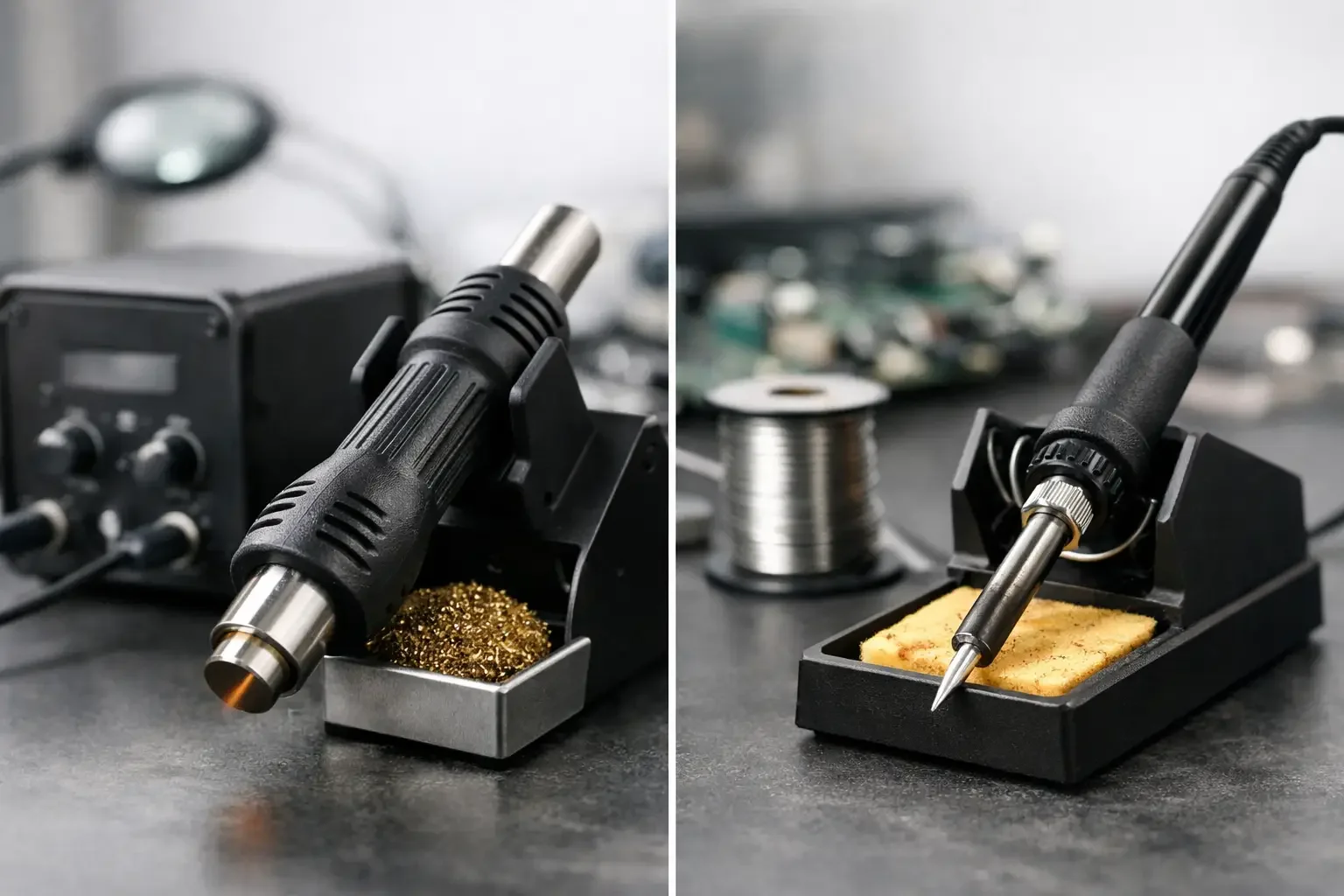
When evaluating a hot air station vs a soldering iron, the right question is not which is the best overall. In the lab, it’s crucial to understand which tool is really needed for that component, PCB layout, and type of intervention. A wrong choice slows down work, increases the risk of damage to pads and traces, and often leads to avoidable rework.
In the repair industry, especially on compact boards like those of iPhone, iPad, Apple Watch, or AirPods, hot air and soldering irons are not pure alternatives. They are different tools, with different thermal behaviors and results. Knowing when to use one, when to use the other, and when to use both is an operational, not a theoretical, distinction.
Hot Air Station vs Soldering Iron: The Real Difference
The soldering iron transfers heat through direct contact. The tip works in a localized manner, with very high precision at the soldering point. This makes it suitable for tasks like tinning pads, soldering thin wires, replacing connectors under certain conditions, retouching through-hole components, and micro-manipulations where control over the individual joint is needed.
The hot air station, on the other hand, heats through a controlled airflow. The heat does not come from a physical contact point but rather envelops an area. This changes everything: it is the correct tool when desoldering SMD components, softening technical adhesives, working on shields, performing rework on connectors, or removing elements attached at multiple points simultaneously.
The practical difference is simple. If you need to melt solder on a specific point with maximum localization, the soldering iron is often the better choice. If you need to distribute heat across multiple terminals or an entire area without acting pin by pin, the hot air station is generally more efficient.
Where the Soldering Iron Remains Indispensable
In daily work, the soldering iron continues to be the basic tool at the bench. Not only for cost or habit but because it offers the best balance between precision, speed, and control for many tasks.
For flat connections, wires, small bridges, battery connectors, test pads, and micro-rework, the tip allows for immediate action. If the hand is stable and the temperature is correct, the risk of heating nearby areas remains contained. This aspect is crucial on very dense boards, where around the work point, there are plastics, resins, sockets, or sensitive components.
The soldering iron is also preferable when the problem is not removing a component but refining the solder joint. For example, in fixing a misaligned pin or reworking a pad, hot air can become too diffuse. In these cases, direct contact remains cleaner.
However, a concrete limit must be considered: when a component has many anchor points or significant thermal mass, working only with the soldering iron can become slow and more stressful for the board. Think of shielded connectors, sockets, or modules with closely spaced terminals. Heating everything uniformly with just the tip is not always the safest method.
When the Hot Air Station Makes a Real Difference
The hot air station comes into play whenever controlled thermal distribution over an area is needed. This is the classic situation for SMD rework, but not only.
In many Apple and mobile electronic repairs, hot air is useful for removing chips, coils, secondary ICs, metal shields, and connectors fixed with multiple solder points. It is also useful for softening double-sided adhesives and technical glues during certain stages of opening or component replacement, as long as temperature, nozzle, and distance are managed correctly.
The greatest advantage is the ability to bring the entire area to the useful temperature without having to individually chase each terminal. This reduces time in many complex desoldering tasks. The downside is that heat spreads beyond the target. If the airflow is excessive or the temperature is poorly managed, there is a risk of displacing nearby components, deforming plastics, or compromising sensitive parts.
This is why a hot air station is not evaluated solely based on the stated degrees. Real stability, quality of airflow, availability of suitable nozzles, and predictability of behavior during repeated cycles matter.
Hot Air Station vs Soldering Iron in Smartphone and Apple Repairs
On compact devices, the comparison of hot air stations vs soldering irons becomes more delicate. The boards are dense, components are close, materials vary significantly, and the margin for error is slim.
For iPhones and iPads, for example, the soldering iron is often the most controllable choice for micro-soldering, jumper wires, and localized repair tasks. The hot air station, however, becomes more useful in removing shields, small ICs, multi-pin connectors, and in some stages of preparation or thermal cleaning of the work area.
On AirPods and Apple Watches, the operational margin tightens even further. The masses are reduced, plastics are close, and the risk of damaging the surroundings is high. Here, having the right tool is not enough: correct nozzle, consistent pre-heating, and short times are also required. In many cases, the error is not in choosing hot air or a soldering iron but in using a generic setting on unforgiving hardware.
If the lab manages interventions across multiple product families, from phones to notebooks, having access to specific model parts and a full section of lab accessories helps standardize workflow and reduce downtime between diagnosis and intervention.
It’s Not a Clear Choice: Often, Both are Needed
In professional practice, hot air and soldering irons often work in sequence. A typical case is removing a component with hot air followed by cleaning the pads with a soldering iron, desoldering braid, and flux. Or the opposite: precise pre-tinning with the tip and controlled reflow with hot air.
This is especially true in processes where the final quality depends on both thermal distribution and joint finishing. Relying on just one tool by principle often leads to less clean results. The experienced technician doesn’t reason by abstract preferences but by the stage of work.
The type of solder, the flux used, the size of the component, and the presence of ground planes also play a role. A motherboard with high thermal dispersion requires a different approach than a small accessory board. Claiming that a hot air station replaces a soldering iron, or vice versa, does not reflect the real work at the bench.
How to Choose Based on the Type of Lab
If the bench is focused on basic repairs, simple replacements, and occasional interventions on cables, connectors, and small touch-ups, a good soldering iron remains the priority purchase. It offers a more direct entry point, a more manageable learning curve, and covers a wide range of operational needs.
If, however, the lab regularly performs rework on boards, removes shields, replaces SMD components, and intervenes on glued or high-density devices, the hot air station stops being an accessory. It becomes a structural tool of the bench.
The decisive point is the volume of actual work. Buying hot air just because “it’s needed by professionals” makes little sense if the workflow doesn’t require it. Similarly, sticking only with the soldering iron when facing multi-pin desolderings daily means wasting time and increasing operational risk.
The Technical Criteria to Really Consider
When choosing a soldering iron, thermal stability, tip quality, temperature recovery speed, and grip ergonomics matter the most. An imprecise tip or a station that drops off as soon as it touches thermal mass makes work less repeatable.
For the hot air station, one should look at airflow stability, real temperature control, noise levels, availability of nozzles, and consistency during continuous work. On small components, a minimal difference in airflow can change much more than a few nominal degrees.
Maintenance also counts. Worn tips, deformed nozzles, inadequate flux, and uncalibrated tools compromise the result just as much as improper technique. For those working continuously, having access to compatible consumables and accessories is not a secondary detail but part of productivity.
The Most Common Mistake: Using the Right Tool in the Wrong Way
Many problems arise not from choosing between hot air and a soldering iron but from inconsistent settings. Temperatures that are too high to compensate for uncertain techniques, excessive airflow to speed up removal, or the wrong tip for the type of pad: these are frequent mistakes, especially on modern boards.
A well-adjusted soldering iron, with the correct tip and good flux, works better than an oversized station used hastily. Similarly, a well-managed hot air station reduces thermal stress compared to repeated attempts with a tip on components that require distributed heat.
For this reason, the comparison between hot air station vs soldering iron should be read as a process choice. First, evaluate the component, then the board context, then the thermal risk around, and only then decide on the tool.
In serious repair work, success does not go to those who have more equipment on the bench. It goes to those who use the right tool at the right moment, with parameters consistent with the component in front of them.