


Laboratory Supplies for Smartphone Repair: What You Need
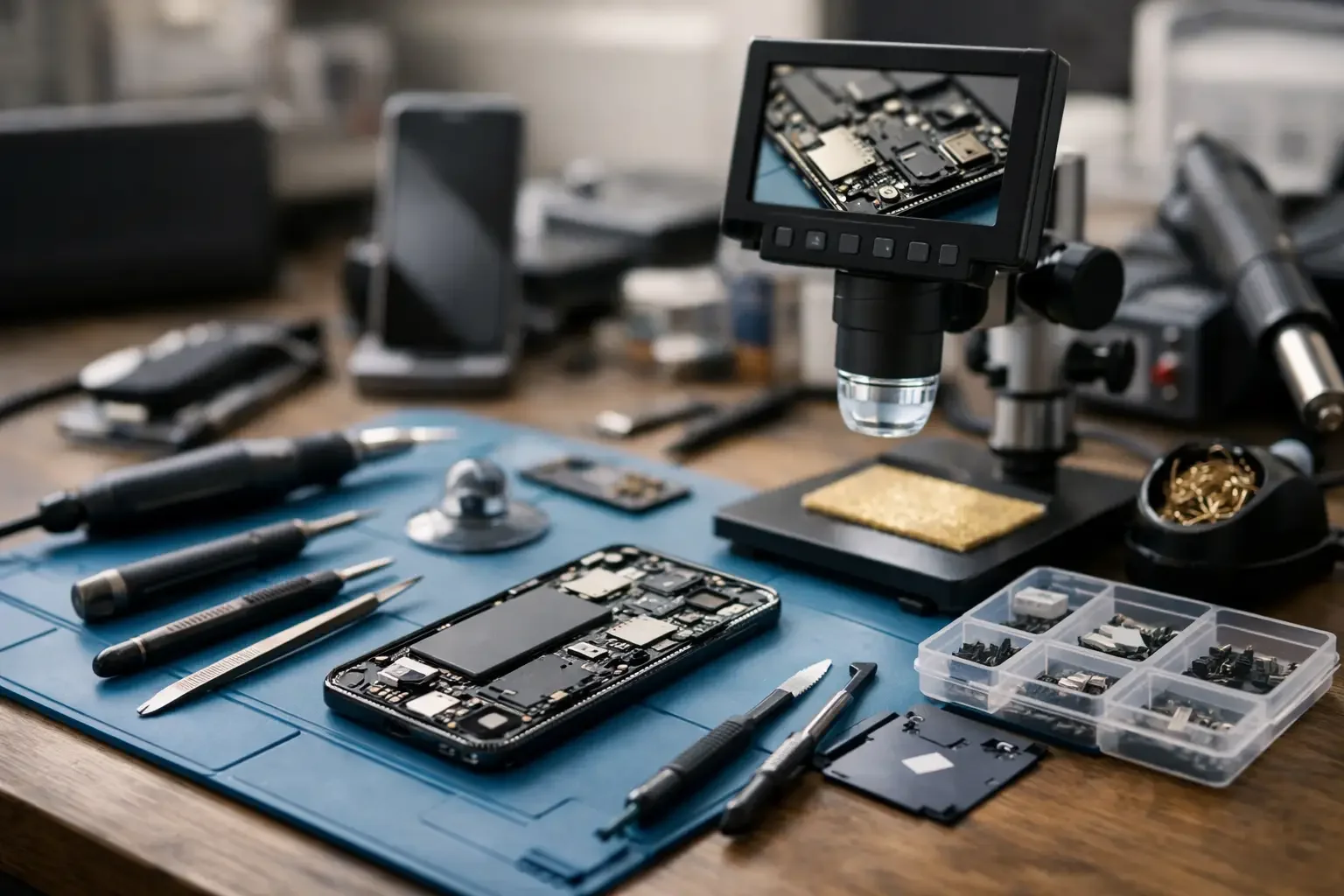
A poorly mounted display, a battery replaced without a final test, a misplaced screw on an iPhone or Samsung: often it's not a manual dexterity issue, but an organization problem at the bench. When discussing supplies for smartphone repair labs, the goal isn't to buy "more equipment," but to have the correct tools for the types of repairs that come into the lab every day.
For a service center, the difference between a generic bench and a truly productive workstation is evident in three areas: processing times, error reduction, and the ability to handle different models without stopping the operational flow. This is why supplies should not be seen as accessory purchases but as part of the technical structure of the service.
Laboratory Supplies for Smartphone Repair: Where to Start
The first common mistake is to build the lab starting with the most visible tools, like soldering stations or separation tools, while neglecting everything necessary for executing repeatable and clean repairs. A smartphone lab works well when tools, spare parts, and consumables align with the level of repair offered.
If the core business is rapid replacement of displays, batteries, back covers, connectors, and cameras, a setup designed for modular and high-volume interventions is needed. Conversely, if the lab performs micro-soldering, board recovery, and complex repairs on power or data lines, the requirements change significantly. In such cases, the importance of optics, thermal control, shielding, and diagnostic tools increases.
The correct logic is simple: start with the types of tickets that come in most often, identify bottlenecks, and only then build the assortment. Smart purchasing means avoiding unnecessary duplicates while ensuring no shortage of materials consumed weekly.
Essential Categories for the Bench
In a smartphone repair lab, supplies are divided into four operational groups. The first is hand tools: sets of precision screwdrivers, anti-static tweezers, prying tools, spatulas, suction cups, and opening and positioning tools. These may seem straightforward, but they directly impact the risk of cosmetic damage and disassembly speed.
The second group comprises electric and thermal equipment, such as soldering stations, hot air guns, heating plates, bench power supplies, and testing tools. Here, the criterion is not just power but stability of use. Poorly controlled temperatures or irregular airflow can compromise flex cables, connectors, and sensitive components.
The third group includes consumables. Flux, solder, desoldering braid, technical tapes, adhesives, isopropyl alcohol, gloves, brushes, and cleaning products are involved in nearly every repair. These are often undervalued, but a lab remains operational thanks to the continuity of these supplies.
The fourth group consists of spare parts, which represent the true commercial continuity line for many labs. Having a supplier that provides displays, batteries, docks, cameras, speakers, glass, buttons, and model-specific modules allows for reduced wait times, returns, and manual compatibility checks.
Spare Parts and Equipment: Why It's Wise to Integrate Them in One Order
For a technician or repair shop, separating purchases between multiple suppliers may seem cost-effective on paper. In practice, it means multiplying search times, indirect costs, misaligned stock, and the risk of bench downtime. By managing spare parts, tools, and lab accessories in the same order, daily operations become more streamlined.
This is especially true for those working within the Apple ecosystem, where compatibility precision is crucial. Having categories organized by product family enables quicker purchase of the correct component, from display modules to more specific device parts. For those working on iPhones, the iPhone Spare Parts section is the natural reference point, while iPads, MacBook, and iMac Spare Parts become central for tablet, notebook, and desktop interventions. The same principle applies to repairs for accessories and wearables, where the availability of AirPods and Apple Watch Spare Parts reduces procurement times for products that require high precision.
When the lab also handles other brands, having a dedicated Samsung Spare Parts section prevents fragmented purchases and makes it easier to standardize bench work.
Lab Accessories: A Department That Matters More Than It Seems
Many technicians focus their budget on primary equipment and spare parts, but lab accessories often sustain productivity. ESD mats, magnetic screw organizers, PCB supports, dispensers, technical containers, lenses, lamps, and solutions for orderly workflow management are not details. These are tools that reduce errors, improve the traceability of disassembled parts, and standardize the operational rhythm.
Thus, a category like Lab Accessories should not be viewed as a secondary department. It houses components that won't show up on the final invoice to the end customer but determine the overall quality of the service. A well-organized bench is not just for better work; it also helps train new technicians with cleaner procedures and less reliance on improvisation.
How to Choose Supplies Based on the Type of Lab
Not all service centers have the same needs. A shop primarily working on quick front office replacements will need rapid access to the most requested spare parts, reliable tools, and always-available consumables. Here, rotation matters greatly: a focused and consistent assortment is better than a large but irrational stock.
A more technical in-house lab, focused on board repair or data recovery, will have different priorities. Specialist tools, greater control over working parameters, and more precise management of the workstation are necessary. In this context, initial costs may be higher, but it's justified only if the volume and margin of advanced operations truly support it.
Then there are mixed labs, which are quite common today, handling smartphones, tablets, notebooks, and Apple devices at different complexity levels. The best choice here is to build a modular bench. Start with essential supplies for high-frequency repairs and expand specialized equipment only when the number of interventions makes it economically sensible.
Common Mistakes to Avoid When Purchasing Smartphone Repair Lab Supplies
The most common mistake is chasing the lowest price without considering the continuity and consistency of the assortment. An economical tool may suffice for occasional use, but in a professional lab, repeatability counts. If a screwdriver loses tolerance, if the tweezers don’t hold, or if adhesive usage is irregular, the real cost emerges in rework.
A second mistake is purchasing spare parts without a strict compatibility logic. This issue especially amplifies with Apple models, where variants, revisions, and technical differences require attention. A structured catalog by model significantly reduces the margin for error.
The third mistake involves inventory. Keeping low stock on high-rotation products can halt the lab's workflow. Holding too much on slow-moving items immobilizes resources. The solution isn’t just to stock up but to work with a supplier that comprehensively covers both spare parts and consumables, making orders more frequent and smarter.
A More Effective Operational Approach
Anyone managing a lab knows that any downtime, even minor, affects delivery times, waiting customers, and reduced margins. Thus, supplies should be viewed as part of the process, not just a simple shopping list. The bench quality depends on the balance between compatible spare parts, tools consistent with the required technical level, and accessories that keep work organized.
For an operator seeking a wide assortment classified by product families, iPhoneHospital.it makes sense as an operational supplier because it combines components, spare parts, and lab equipment in a structure designed for those who work daily on real devices with real needs.
Ultimately, the right choice isn’t to have more items on the bench. It’s to have the ones that prevent interruptions, reduce errors, and allow you to complete the right intervention on the first try.