


Future of Apple Silicon Board Repair
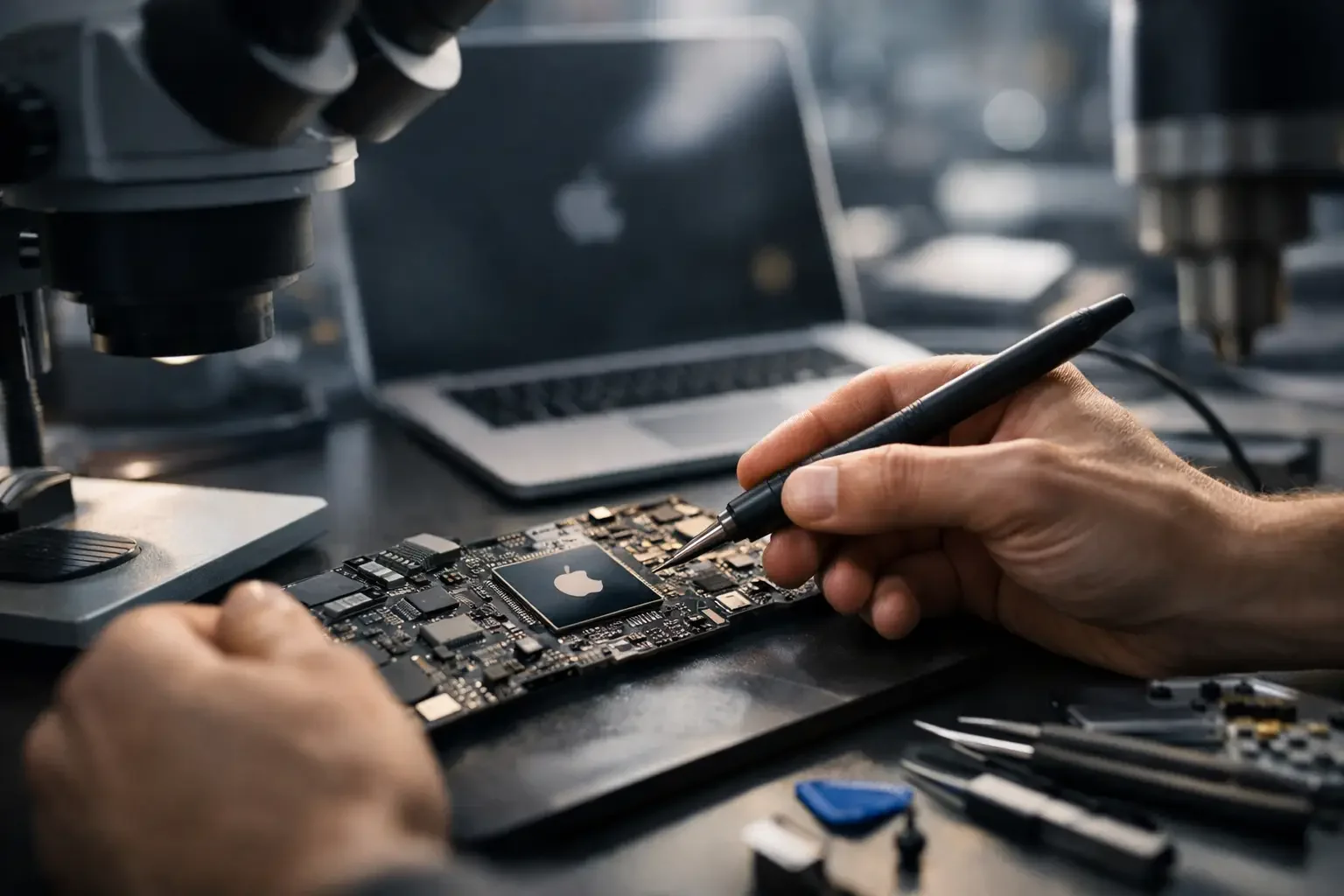
An Apple Silicon MacBook that won’t turn on, draws minimal current, or experiences random reboots isn’t approached the same way as an Intel board from a few years ago. The future of Apple Silicon board repair relies on more precise diagnostics, appropriate tools, and the ability to distinguish a repairable defect from damage that makes intervention economically unfeasible.
For a lab, the difference is not just technical; it's organizational: more precise acceptance procedures, a prior check of customer data, and careful management of compatibility, donors, and components are essential. The goal remains clear: reduce Mac downtime and offer reliable repairs without unnecessary replacements.
Why Apple Silicon Boards Change Lab Work
In Macs with Apple Silicon processors, the CPU, GPU, unified memory, and other subsystems are concentrated within a system on a chip. This integration brings performance, power consumption, and space advantages on the logic board, but it also narrows the margins for intervention compared to a more modular architecture.
RAM is not a replaceable memory; it’s integrated into the chip package. Additionally, storage, depending on the model, may involve soldered NAND and controllers tightly linked to the system logic. When a Mac fails to start due to a memory defect, SoC, or storage subsystem, the repair may require advanced skills and may not always allow for data recovery.
This doesn’t mean an Apple Silicon board is “unrepairable.” It means it’s essential to methodically identify which section is faulty. Many defects still involve power circuits, communication lines, connectors, protections, capacitors, MOSFETs, USB-C charging circuits, display backlights, and liquid damage. These issues, if diagnosed correctly, can be addressed with micro-soldering and selected components.
Integration Increases Required Precision
On these platforms, a short circuit on a secondary line can prevent the entire boot sequence. An anomaly on the charging circuit can mimic a battery failure. An oxidized connector, a damaged flat cable, or a shorted internal peripheral may produce symptoms seemingly related to the motherboard.
Thus, preventive board replacement isn’t a diagnosis. Before reaching that conclusion, the technician must isolate the power supply, check current draws, verify main voltages, and evaluate behavior with essential peripherals disconnected. Correct defect reading determines both the estimate and the likelihood of a successful intervention.
The Future of Apple Silicon Board Repair: Diagnostics Before Rework
Micro-soldering will remain central, but it’s not enough on its own. In the future of Apple Silicon board repair, a lab's value primarily hinges on the quality of diagnostics. Working on high-density packages without identifying the faulty line increases the risk of damaging traces, pads, or nearby components.
An effective procedure starts with a visual inspection, especially in the presence of liquid or impacts. Corrosion under shields, residues around connectors, and color changes can immediately direct the search. This is followed by measuring resistance to ground on suspicious lines, controlled bench power supply, and thermal analysis to identify abnormal components.
The use of schematics, board views, and reliable measurement points reduces trial and error. The technician must not only search for the component that’s hot; they must understand why it receives voltage, which rail powers it, and whether the short is internal to the component or downstream on the line. It’s the difference between a stable repair and a Mac that returns to the lab within days.
Tools: What You Really Need
To consistently work on modern boards, a microscope, adjustable bench power supply, precise multimeter, soldering station, and hot air tool with actual temperature control are necessary. A thermal camera or thermal detection method supports short circuit searches, while ultrasonic cleaning tools and suitable remediation products are essential after liquid contact.
Equally important are tweezers, correct soldering tips, quality flux, desoldering braid, appropriate solder for the type of work, and thermal protections. The Laboratory Accessories section of iPhoneHospital.it is useful when a lab needs to integrate consumables and bench equipment alongside replacement parts.
Not always is the most expensive equipment necessary. However, a workbench that aligns with the level of proposed interventions is crucial. A lab that only performs battery, display, and connector replacements might send board-level repairs elsewhere; those offering micro-soldering must standardize tools, procedures, and quality control.
Parts, Donors, and Compatibility for Modern Macs
The availability of spare parts remains a decisive factor. In logic board repair, it’s not just about ICs: connectors, flats, sensors, USB-C ports, charging modules, keyboards, batteries, displays, and heat sink assemblies come into play. A defective external component can indeed cause a misdiagnosis of the motherboard.
Before placing an order, it’s crucial to accurately identify the model, year, variant, and code of the machine. Two aesthetically similar MacBook models may have non-interchangeable flex cables, batteries, or displays. For interventions involving notebook parts, cataloging by model avoids downtime and returns due to approximate compatibilities. The MacBook Parts category is the go-to reference for sourcing specific components for the platform to be repaired.
Donor boards still play an important role, but they require traceability. A recovered component must be checked, cleaned, and verified before rework. Uncertain provenance, hidden oxidation, and damage from previous work can transform an apparently economical spare part into a new source of failure.
When Repairing Makes Sense and When It Doesn’t
There’s no one-size-fits-all answer for every Apple Silicon issue. If the problem involves a power line, port, connector, or localized liquid damage, a targeted repair can be technically and economically viable. However, if SoC, integrated memory, or storage is involved, with implications for security and data, the case should be evaluated more cautiously.
The estimate should clearly indicate the type of defect found, residual risk, and any impossibility of guaranteeing data recovery. For professional clients, machine downtime may cost more than the repair itself. For a private individual, though, comparing the value of the Mac with the cost of a replacement board may lead to a different choice.
Data and Security: The Aspect That Cannot Be Left to Chance
With soldered storage and security architectures in modern Macs, data recovery cannot be promised without a technical assessment. A board that doesn’t start doesn’t automatically mean lost data, but a complete logic board replacement can render data on the original medium inaccessible.
During the acceptance phase, it’s useful to verify if a backup exists, whether the user has the necessary credentials, and if the priority is restoring the Mac or preserving the content. The technician must avoid invasive procedures before clarifying this point. An intervention performed to get the device operational may not be the best route when the true goal is data recovery.
Even after the repair, testing and validation should go beyond merely booting up. Power supply, charging, USB-C ports, Wi-Fi, Bluetooth, audio, keyboard, trackpad, display, and thermal management must be verified based on the initial defect and the areas involved in the work.
A More Technical Market, Not a Closed Market
Apple Silicon raises the entry threshold for board-level repair but doesn’t eliminate the work of independent labs. It shifts the value from generic replacement to diagnostic expertise, from the availability of individual pieces to the ability to manage a complete intervention: correct component, appropriate tool, clean procedure, and documented testing.
To remain competitive, it’s advisable to build a repeatable operational flow, upgrade equipment when necessary, and avoid accepting work outside the designated technical perimeter. An honest and well-reasoned diagnosis is already a valuable service. On Apple Silicon boards, it often is the step that separates a genuinely worthwhile repair from an expensive attempt.