


Consumables for Smartphone Repair Lab
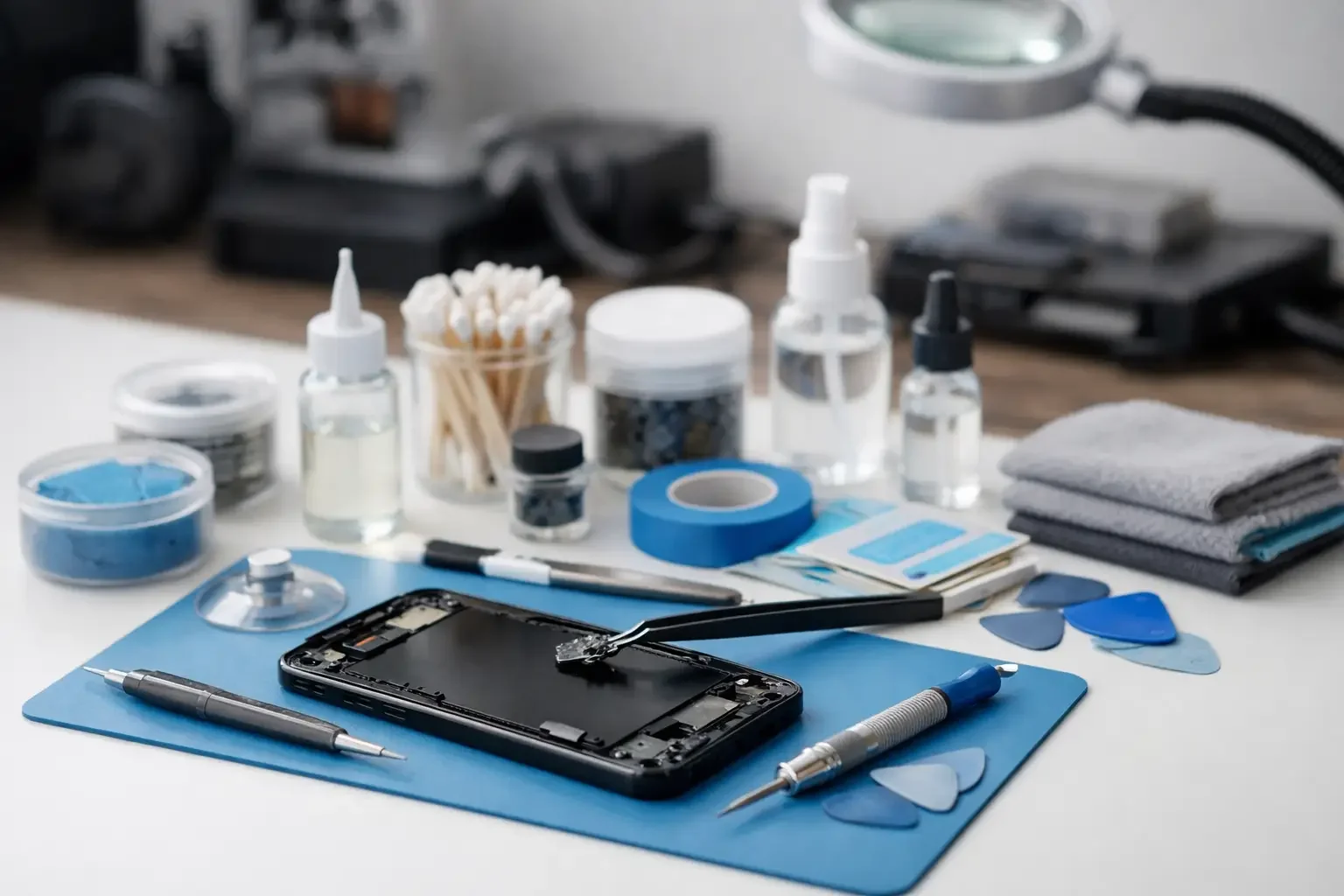
A display that pops up shortly after being closed, a poorly secured battery, a connector contaminated during rework: often the issue isn't the technician's skill, but the quality and consistency of the consumables used in smartphone repair labs every day. In a busy workbench, consumables affect intervention time, outcome quality, return rates, and process cleanliness.
Those who manage a repair lab know well: just buying spare parts and equipment isn't enough. A consistent base of consumables that are used, replaced, reordered, and chosen based on the type of work is essential. The difference between a makeshift workbench and a professional setup starts here.
What Counts as Consumables for Smartphone Repair Lab
When discussing consumables, people often think only of isopropyl alcohol, double-sided tapes, and flux. In reality, the category is broader and includes all recurring operations in the lab: opening, cleaning, desoldering, re-gluing, battery securing, shielding, protection, and finishing.
This includes pre-cut and universal adhesives, double-sided tapes suitable for displays and batteries, technical solvents, cleaning liquids, flux for micro soldering, desoldering braid, solder, thermal paste for more complex devices, anti-static cloths, cleaning swabs, gloves, protective films, and disposable ESD materials. Even seemingly secondary products like lint-free wipes or temporary adhesive supports impact the final outcome.
The right approach is not to accumulate generic materials but to build an assortment consistent with the actual repairs performed. A center that primarily works on iPhones and iPads will have different needs compared to one that frequently deals with reworking boards or often intervenes on Samsung devices with structurally glued displays.
Why Consumables in Smartphone Repair Labs Matter More Than They Seem
The correct replacement can be undermined by the wrong consumable. An adhesive with improper thickness alters the device's closure. An overly aggressive flux leaves difficult-to-remove residues. Low-quality or improperly used isopropyl alcohol doesn’t truly clean the area but redistributes contaminants.
Economic aspects are often overlooked. The cheapest consumable isn't always the most cost-effective in the long run. If it increases handling time, necessitates repeated fixing, dirties the board, or leads to returns, the real cost escalates. For a lab, the correct parameter is the cost per well-completed intervention, not the unit price of individual products.
Standardization is also central. If each technician uses a different adhesive, flux, or personal procedure for the same operation, the lab loses qualitative control. Consumables must be chosen to make the process repeatable.
Adhesives and Tapes: The Critical Point in Many Repairs
In daily work, adhesives and tapes are often the most sensitive consumables. The primary distinction is between model-specific adhesives and universal solutions. Pre-cut options save time and reduce variability, but require availability for each device. Universal tapes are more flexible in stock, yet heavily depend on the technician's precision and the frame geometry.
For displays, adhesion and thickness matter. A tape that's too thick can create tension on the panel or compromise a proper closure. For batteries, the issue is twofold: stable securing and future removability. Using overly aggressive adhesives can complicate future interventions and increase removal risk.
Compatibility with the type of operation should also be considered. On some models, the adhesive primarily serves as mechanical bonding. On others, it contributes to the overall integrity of the display assembly or protection from dust and moisture. This doesn't mean automatically restoring factory conditions, but rather coming as close as possible to a correct assembly.
Technical Cleaning: Solvents, IPA, and Residue-Free Materials
Cleaning isn't an ancillary phase. It's part of the repair process. Before re-gluing, previous residues must be eliminated. After micro-soldering, the flux needs to be removed. Following contact with liquids, appropriate products and tools must be used—improvisation is not an option.
Isopropyl alcohol remains a reference standard for many operations, but it must be selected carefully and used in the correct context. It doesn’t replace every technical cleaner and doesn't solve all contaminations by itself. Product purity matters, but so does the application support: cloth, swab, anti-static brush, or technical wipe.
Cleaning materials must leave minimal residues, not release fibers, and allow precision. On boards, using too generic products can worsen the situation. On frames, incomplete cleaning compromises the adhesion of new displays. Essentially, the quality of adhesion starts with perfect removal of the old adhesive.
Consumables for Micro-Soldering and Rework
For those working on motherboards, the consumables chapter is even more delicate. Flux, solder, and desoldering braid are not interchangeable. Their thermal behavior, final cleaning, wetting speed, and control during processing vary.
A flux suitable for smartphone rework must assist soldering without creating excess, carbonization, or difficult residues to manage under microscopy. Again, there's no single absolute choice that fits all situations. It depends on the technician's skill, the component type, working temperature, and the need for post-intervention cleaning.
The desoldering braid must be selected based on the quality of the braid and absorption capabilities. Poorly consistent solder makes the work less predictable. The final outcome depends not just on the soldering station or hot air, but on the behavior of the consumable during the intervention.
How to Choose the Right Consumables for Your Lab
The best choice doesn’t start from the catalog, but from the lab's actual flow. First, distinguish high-turnover interventions from occasional ones. If the lab replaces many displays and batteries each week, adhesives, battery strips, cleaners, and technical cloths must always be continuously available. If micro-soldering is marginal, maintaining a reliable yet essential selection without overstocking makes more sense.
A second criterion is compatibility by product family. In the Apple ecosystem, segmentation by model is crucial. It’s not enough to know it's an iPhone: materials must be consistent with structure, dimensions, type of adhesion, and disassembly procedure of the specific model. A specialized supplier like iPhoneHospital.it is valuable precisely when it helps cover parts, tools, and consumables in the same compatibility logic.
The third point: it's advisable to avoid a random mix of brands and specifications without internal testing. Better to test, standardize, and maintain a stable line for every critical category. This reduces errors, simplifies technician training, and leads to more consistent outcomes.
Stock Management: The Real Issue is Not Halting Operations
In the lab, consumption weighs not just in value but also in operational continuity. Running out of battery adhesive, solvent, or flux halts interventions as surely as the lack of a spare part. This is why consumable stock management should have different criteria compared to less-frequent components.
It makes sense to work with minimum reorder levels for high-turnover categories and appropriate packaging for actual volume. Purchasing too little can lead to stockouts. Buying too much of materials that degrade, dry out, or change performance over time is not a good strategy. Storage conditions also matter: temperature, proper container sealing, and cleanliness of the retrieval area.
Another practical aspect involves internal traceability. If a certain adhesive or flux creates recurring defects, the lab must be able to link the problem to the batch or at least the product line used. This is a technical workshop approach, not a casual buying one.
The Most Common Mistake: Treating Consumables as Secondary Accessories
Many labs rightly invest in soldering stations, separators, power supplies, and ESD equipment, but then neglect consumables. This is an operational error. The workbench functions well when tools, spare parts, and consumables work together.
A glass closed with unsuitable adhesive, a board cleaned with incorrect material, or a battery secured with an improvised solution generates rework. And rework, besides its cost, erodes trust. For a service center, this weighs more than the price of a well-chosen package of consumables from the outset.
The correct choice is to build a set of consumables for a smartphone repair lab suited to your workload, updated based on the models dealt with, and consistent with the bench procedures. When the consumable material is right, the technician works faster, the assembly is cleaner, and the lab reduces unforeseen issues that should never reach the customer.