


Best Professional iPhone Opening Kits
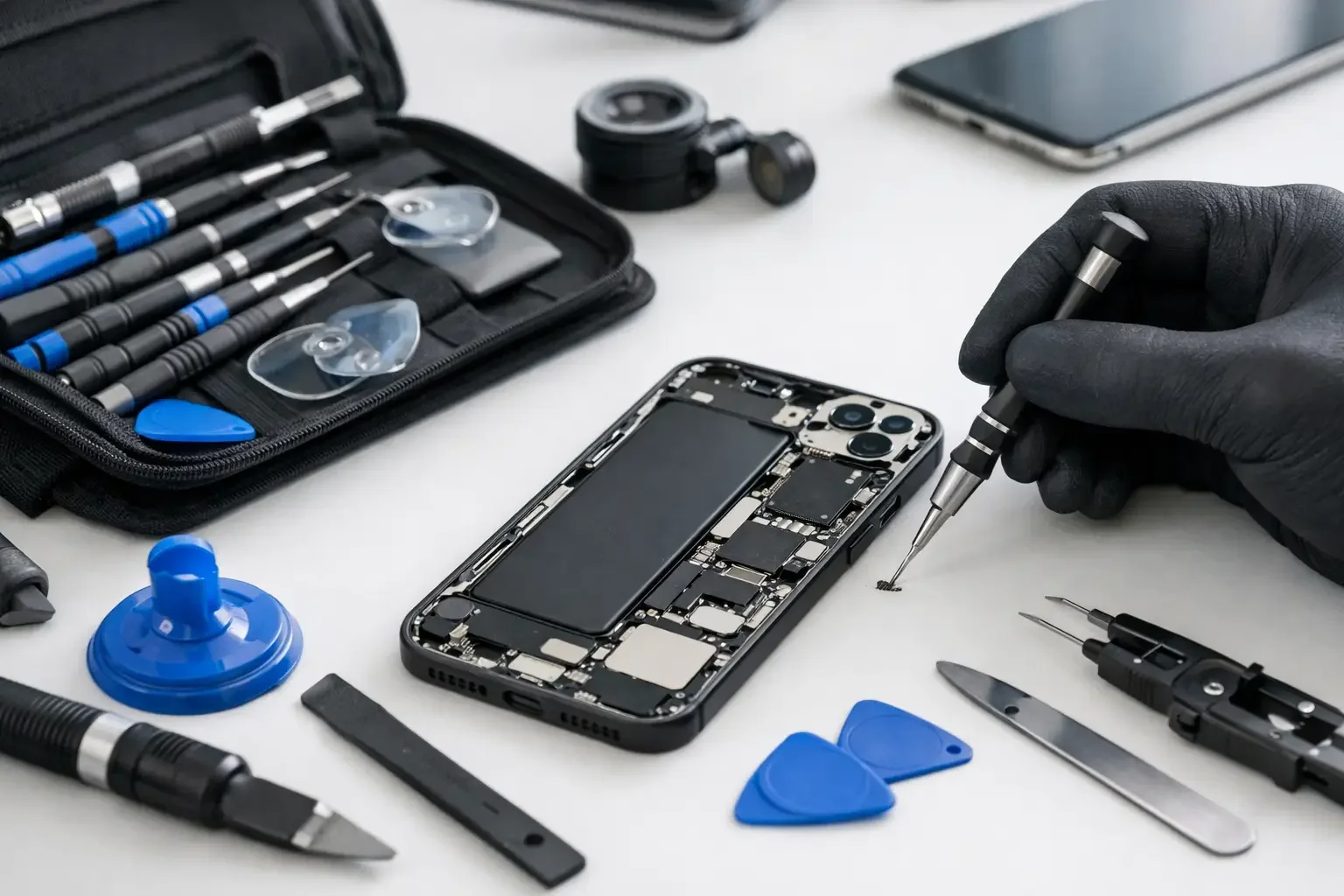
Opening an iPhone without the right kit means wasting time, increasing the risk of aesthetic damage, and complicating even the simplest repairs. When discussing the best professional iPhone opening kits, it's not about having 'more tools,' but rather having the right ones for the type of casing, adhesive, screw, and display at hand.
For a workshop or anyone consistently performing repairs, the opening kit is not a secondary accessory. It serves as an operational foundation. If the initial phase is poorly managed, the risk extends to the entire intervention: stressed flex cables, marked frames, cracked glass, longer service times, and reduced margins.
How to Evaluate the Best Professional iPhone Opening Kits
The difference between a cheap kit and a professional one is immediately evident in three areas: precision of the bits, quality of lever materials, and reasoned completeness of the set. A container full of marginal accessories is unnecessary. What’s needed is a selection tailored to real opening cases across various iPhone models.
The screwdriver bits must ensure a proper fit with the Pentalobe, Tri-Point, and Phillips screws found in different models and disassembly stages. An imprecise bit damages the screw head, and from that moment, a standard job can turn into a slow and unprofitable extraction.
Even the lever tools matter more than often considered. Spudgers, opening picks, technical picks, suction cups, and levers made from plastic or metal must be chosen based on the component being manipulated. On paper, many kits appear similar. In practice, the tool's rigidity, edge thickness, and flex control make the difference.
Essential Items in a Professional Kit
A truly useful iPhone opening kit should cover at least the initial phase of accessing the display and the subsequent controlled separation of components. The minimum requirements are fairly clear.
iPhone Specific Screwdrivers
The first item includes precision screwdrivers or bits. External Pentalobe for the bottom screws, Tri-Point for Apple internal components, Phillips where applicable. If the kit only includes generic bits, it is not a professional set but rather a compromise.
Even better if the handle is swivel and offers good torque sensitivity. On small screws, especially after thermal cycles or on devices previously opened, the quality of the handle affects the actual tightening and loosening control.
Display Separation Tools
Suction cups, opening pliers, or a double suction cup system are crucial, especially on models with strong adhesive and tight tolerances. A practical rule applies: the more intact the device appears aesthetically, the cleaner and more progressive the opening needs to be.
Thin picks are used to enter without deforming the frame, while spudgers allow for safe work around flex cables and connectors. A serious kit must offer more than one geometry for leverage because not all areas of the phone respond the same way.
Heat Support and Adhesive Management
Many underestimate this point, but a truly professional opening kit only makes sense if integrated with tools to soften adhesives. On various iPhones, relying solely on mechanical force is not the most efficient approach. A controlled heat source reduces stress on displays and frames.
This is why structured buyers usually pair the opening kit with dedicated laboratory accessories. The operational logic is clear: the kit opens, but the correct workspace reduces errors, time, and risk.
Best Professional iPhone Opening Kits: Basic or Complete Kit?
It depends on your workload volume and the type of repairs you perform. For a technician primarily replacing displays and batteries on recent models, a well-built basic kit can be sufficient. However, if the workshop also works on housings, cameras, internal modules, connectors, or recovering already tampered devices, a complete set becomes more economical.
The basic kit has a clear advantage: lower costs and reduced dispersion. It’s a sensible choice for multiple workstations or for technicians who want to replicate the essential equipment across more benches. The limitation is that as soon as the job deviates from the standard, integrations begin.
The complete kit is better suited for those who want continuity. It typically includes a wider range of levers, tweezers, bits, antistatic tools, and handling supports. Not all accessories are used every day, but in unusual cases, they save real time.
Differences Between Cheap Kits and Laboratory Kits
Price alone isn’t enough, but certain recurring differences exist. In cheap kits, the bits tend to wear out quickly, the inserts have less precise tolerances, and the plastic tools deform rapidly. They may seem usable at first. However, after a few repairs, the margin of precision decreases.
In laboratory kits, quality is evident in consistency. The bits hold better, the picks maintain useful flexibility, the suction cups provide a more stable grip, and the tweezers retain alignment. For a professional, value lies not just in durability, but in the repeatability of the result.
There’s another aspect: overly cheap kits often include irrelevant accessories to inflate the number of declared pieces. A professional set, on the other hand, is credible when each item serves a precise function in the opening or controlled disassembly phase.
When Would You Need a Different Kit Based on iPhone Model?
Not all iPhones open the same way. Internal layout, adhesive strength, display sensitivity, edge geometry, and frame response to leverage can vary. Thus, the concept of a universal kit must be interpreted correctly: universal does not mean identical approaches across every model, but instrumental compatibility with different procedures.
On older models, opening can be relatively straightforward, but repairs often involve devices that have previously undergone interventions with poorly replaced screws or non-original components. On newer models, however, the difficulty shifts to the precision of the initial opening and the management of adhesives and flex cables in tighter spaces.
If you also need to plan the subsequent intervention alongside opening tools, it’s wise to work with a supplier that organizes by product family and model. In this respect, having access to both tools and iPhone spare parts, as well as lab accessories within the same purchasing chain, greatly simplifies daily work.
The Right Kit Reduces Indirect Damage
When evaluating a kit, focus often remains on the opening itself. In reality, the greatest benefit is the reduction of indirect damage. A proper tool prevents marks on the frame, reduces the risk of breaking the display during separation, limits casing twisting, and allows for more precise interventions around battery and display connectors.
This aspect is particularly crucial for devices with high residual value or in jobs where the customer expects unchanged aesthetics. Even a technically successful intervention loses perceived quality if the edge is marked or if the opening leaves micro-deformations.
For anyone managing a workshop, the issue is not just technical but also commercial. Fewer collateral damages mean fewer disputes, less time lost on rework, and greater operational reliability.
How to Choose Based on Your Operational Profile
If you are an independent technician or an advanced user who works on a few devices each month, it is advisable to start with a basic kit but with good quality screwdrivers and lever tools. Here, the priority is to avoid false savings. Fewer pieces are preferable, but truly usable ones.
If you work in a service center or in a high-volume lab, your choice should consider wear, workstation standardization, and tool replacement speed. In this scenario, opting for modular kits or those easily integrable with other professional tools is wise.
For those operating across multiple Apple categories, having a consistent set of tools offers an additional advantage. Many precision, handling, and screw management logics are found in tablets, notebooks, and wearables as well. Having an organized technical supply facilitates managing not only iPhones but also work on other devices in the Apple catalog.
A Common Mistake: Buying the Kit Without Considering the Workstation
The opening kit works well only within a suitable workstation. If proper lighting, organizational systems for screws, a technical mat, ESD tools, and device support are lacking, even the best kit will underperform.
For this reason, the choice should not be made in isolation. It makes more sense to think in terms of workflow: opening, disassembly, component replacement, reassembly, and testing. When the kit is integrated into this logic, the gain is not theoretical. It translates to more predictable times and a smaller margin for error.
On iPhoneHospital.it, this approach feels particularly natural because the structure of the assortment already speaks the laboratory language: spare parts by model, technical tools, and bench accessories designed for those who truly work on devices.
Choosing among the best professional iPhone opening kits, therefore, does not mean finding the set with the most pieces or the lowest price. It means identifying the tool that opens well, wears slowly, and integrates seamlessly into your repair method. This is what sets apart a generic purchase from equipment that withstands the daily grind.
https://www.iphonehospital.it/en/laboratory/kit-strumenti-professionale-per-aprire-tablet-telefoni-cellulari-e-molto-altro