


Best Professional iPhone Parts for Technicians
A display that won’t hold brightness, an erratic battery, or a flat that isn’t perfectly compatible can turn a routine repair into another trip to the lab. Therefore, selecting the best professional iPhone parts cannot depend solely on price or current availability; it must begin with precisely identifying the model, the type of defect, and the standard of outcome the technician aims to deliver.
For a service center, purchasing the correct component means reducing diagnosis time, returns, and rework. For the advanced user, it means avoiding incompatibilities that can affect essential functions like Face ID, True Tone, wireless charging, cameras, or proximity sensors. Professional replacements should therefore be evaluated as part of a complete repair, not as isolated parts.
How to Identify the Best Professional iPhone Parts
The actual quality of a replacement shows during installation and subsequent testing. A component may seem correct at first glance but have imprecise tolerances, fragile connectors, insufficient adhesives, or inconsistent performance. A professional purchase requires verifying compatibility, quality grade, and technical specifications before opening the device.
The first check concerns the exact model. The commercial name of the iPhone isn’t always sufficient: generation, diagonal size, variant, and release year can change the layout of flats, connectors, modules, and component codes. Before ordering, it’s helpful to compare the device model code, the removed component, and the technical data sheet of the replacement. This procedure is particularly useful for recent models, where many elements are tightly integrated with the system.
The second factor is the type of quality. In the parts market, you’ll find recovered original components, various grades of compatible parts, refurbished ones, and aftermarket versions. There isn’t a one-size-fits-all choice for every repair. A lab working on high-end devices or for customers demanding maximum performance might prefer components that closely resemble the original. For repairs on older devices, a selected compatible part can provide a better cost-performance ratio.
Consistency of supply is also crucial. Purchasing parts, adhesives, gaskets, screws, and tools from a specialized supplier allows the technician to prepare for the repair without interrupting workflow to search for a missing accessory. This is an operational aspect, not secondary: often the delay in the workbench depends on a display adhesive, a waterproof gasket, or a correct tip screwdriver.
Display: The Component that Defines Repair Perception
The display is the most visible replacement and, for many customers, the parameter by which the entire repair is judged. The verification shouldn’t stop at simply turning on the panel. It’s essential to check brightness, color uniformity, touch response, edge sensitivity, scrolling smoothness, and correct alignment within the frame.
In LCD and OLED models, quality differences can impact black depth, brightness management, energy consumption, and color rendering. An insufficient level panel can lead to a less sharp perception, irregular touch response, or lower longevity. Therefore, it's useful to select the replacement based on the model and customer expectations, clearly explaining the quality level being installed.
During replacement, it’s also important to preserve, when possible and as outlined in the procedure, the original components associated with the display group. Transferring the earpiece module and sensors requires caution: damage to the flat cable can compromise sensitive functions. Before the final closure, the test must include touch response, automatic brightness, earpiece, proximity, front camera, and facial recognition, if present.
Batteries: Declared Capacity and Real Stability
A professional battery isn’t just evaluated in milliamp hours. Stability of voltage, quality of electronic protection, charging behavior, and mechanical fitting directly affect the outcome. A battery with unreliable values can cause shutdowns, abnormal percentage drops, overheating, or lower than expected autonomy.
Before replacement, the condition of the connector, the internal seat, and any deformations must be checked. Adhesive tabs should be applied correctly to prevent the battery from shifting and to make future removal safer. The post-repair test also deserves time: powering on, wired charging, wireless charging if supported, absorption, and temperature control help catch problems before delivery.
In recent models, messages regarding component verification or unavailable information in the battery section may appear. The technician must consider these aspects before intervention and communicate clearly what depends on software management and matching the device components. Transparency prevents disputes and properly defines the scope of the repair.
Internal Components: Compatibility Before Replacement
Charging docks, speakers, vibration units, cameras, microphones, side flats, and antenna modules need even more precise checks. Often the symptom doesn’t automatically identify the faulty part. An iPhone that won’t charge, for example, may have problems with the connector, cable, power supply, battery, a line on the logic board, or contamination in the port. Replacing the dock without diagnosis can solve the case but can also unnecessarily increase costs and time.
The professional procedure starts with inspection: presence of oxidation, bent pins, incorrect screws, missing shields, damaged gaskets, and signs of previous repairs. After diagnosis, the replacement must be compared to the removed one, verifying the position of contacts, length of flats, and model references.
Special attention should be given to components associated with biometric and security functions. Face ID and Touch ID shouldn’t be treated as interchangeable modules without evaluating the technical implications. An improper operation can lead to loss of functionality. In cases involving these systems, specific skills, appropriate procedures, and a more thorough preliminary diagnosis are required.
Tools and Materials That Make a Difference
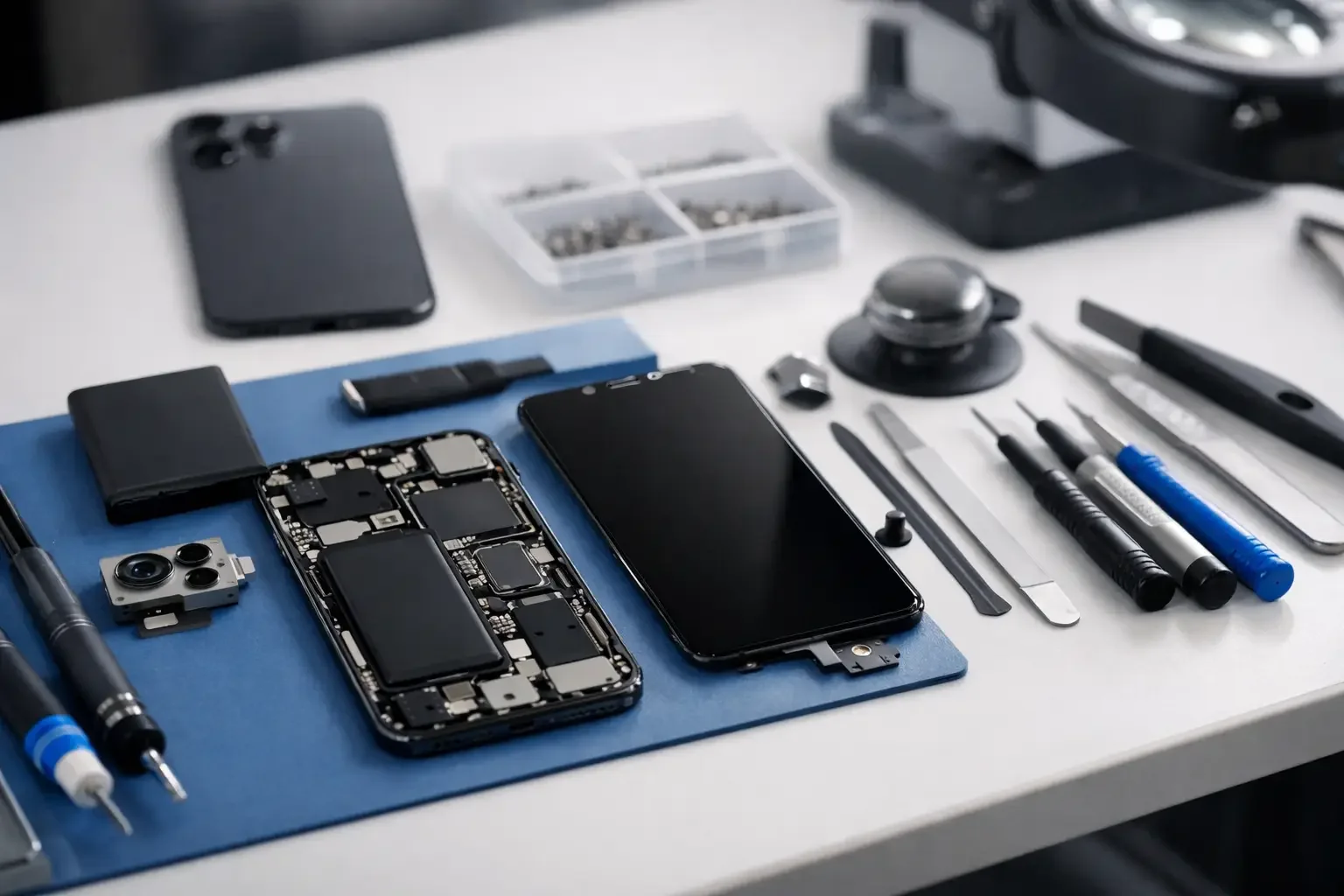
Even the best parts can yield mediocre results if installed with unsuitable tools. A professional kit must include equipment suitable for the type of intervention, not just generic tools. To work in an organized and repeatable manner, four categories are essential: precision screwdrivers with correct tips, opening and separation tools, thermal control systems, and materials for restoring assembly.
The screws of the iPhone have specific lengths and positions. Mixing them up or tightening them in the wrong spot can damage internal layers or the logic board. Using an organized magnetic mat and a screw map reduces this risk. Similarly, controlled opening with moderate heat and thin tools limits damage to the frame, display, and gaskets.
After any intervention involving opening the device, restoring adhesives and gaskets should be considered part of the process. This doesn’t automatically recreate the factory certification of water resistance but helps rebuild a closure that is tidier and protected from dust and infiltration. It is right to inform the customer of this difference, especially when the device has already been opened or shows frame deformations.
A Purchasing Method Designed for the Laboratory
For a business performing recurring repairs, the most efficient purchasing is organized around frequently repaired models, rotation of components, and average procurement times. Displays, batteries, docks, and consumables for the most widely used generations can be managed as operational stock; less common components, such as specific modules or aesthetic parts, can be ordered as needed.
It’s wise to separate high-turnover parts from those tied to precise diagnosis. This way, the lab maintains availability for quick interventions without immobilizing budget on parts with limited demand. A catalog structured by iPhone family and model also reduces selection errors, especially when multiple technicians are working on the same bench or system.
iPhoneHospital.it is designed precisely for this need: parts for specific models, complementary components, and lab equipment in the same assortment. For the technician, the tangible advantage is preparing an order consistent with the repair, including everything needed to mount, test, and properly close the device.
A well-chosen replacement isn’t necessarily the cheapest, but the one that reduces uncertainty of the intervention and keeps the device reliable after delivery. Before confirming a purchase, verifying model, defect, required quality, and assembly materials remains the most direct way to work with fewer surprises and greater continuity.