


Best Service Bench Accessories: 10 Essentials
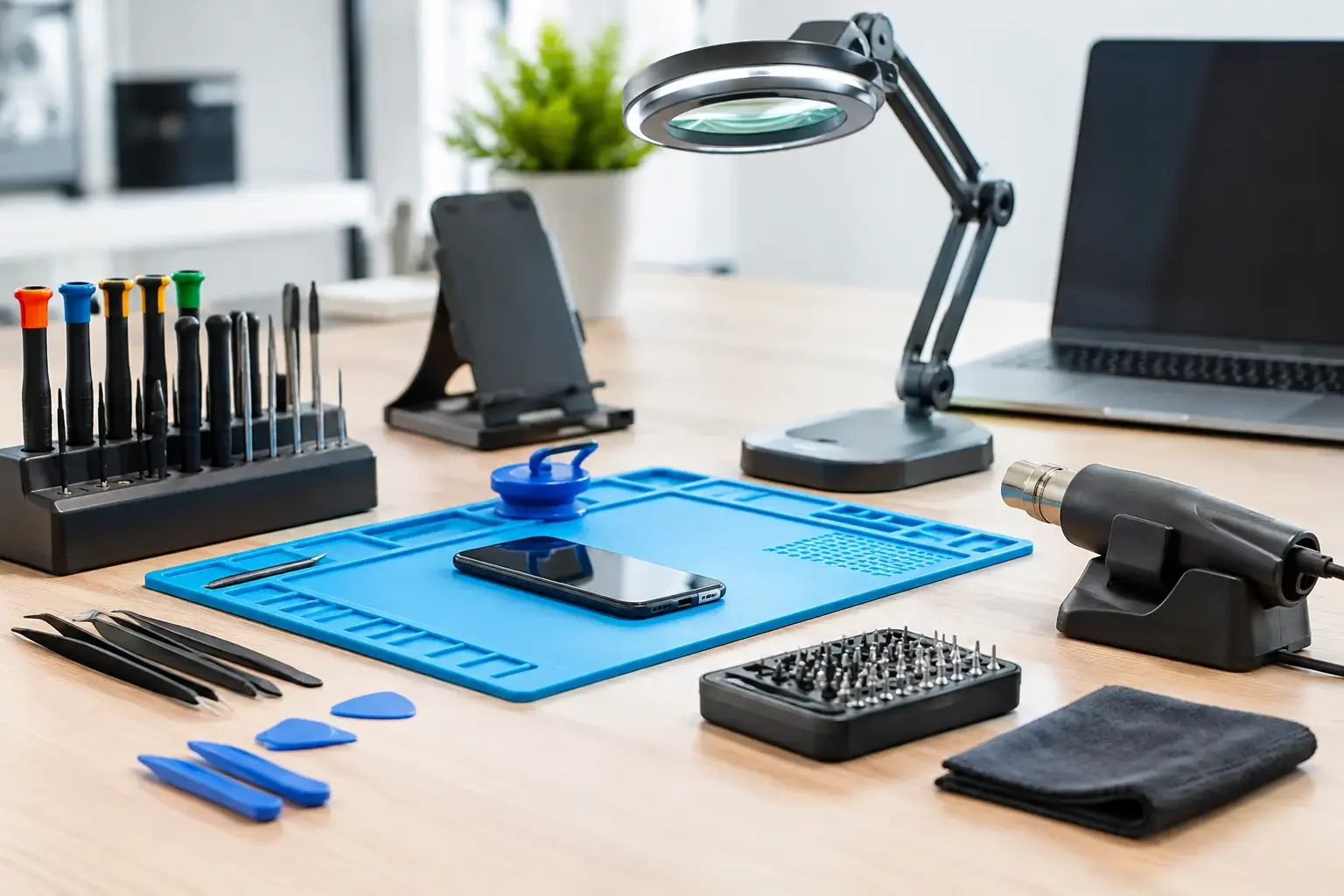
A bench can have great tools and the right spare parts, but it can still become slow, uncomfortable, and risky if lacking support equipment. The best service bench accessories are not just simple additions: they help protect devices, separate screws, manage sensitive electronics, and reduce errors during repairs on iPhones, iPads, MacBooks, and Android smartphones.
For a workshop handling recurring repairs, the priority is not to buy many accessories indiscriminately. It is to build a workspace consistent with the type of interventions carried out, daily volumes, and the level of precision required. A technician replacing displays and batteries has different needs compared to someone performing microsoldering, diagnosing motherboards, or data recovery.
The best service bench accessories for better work
1. Magnetic Mat and Anti-Static Surface
The magnetic mat is one of the most useful accessories for orderly disassembly. It holds screws, metal plates, and small components, preventing them from falling onto the bench or mixing together. In Apple devices, where the length and pitch of screws can change even within the same module, maintaining order reduces the risk of incorrect reassemblies and damage to the board.
For interventions on electronic components, the mat should be paired with an ESD surface. Anti-static protection does not replace proper procedures, but it limits exposure to electrostatic discharges that can compromise connectors, integrated circuits, and motherboards. The choice depends on the work being done: for simple display replacements, a large magnetic mat is useful; for board-level work, a complete ESD workstation is preferable.
2. ESD Wrist Strap and Grounding Cable
An anti-static bench is incomplete without grounding the technician. The ESD wrist strap, used together with a cable and verified grounding point, helps dissipate charges accumulated from the body. It is an economical accessory but particularly wise when working on motherboards, Face ID modules, cameras, connectors, and charging circuits.
Consider it as part of a procedure, not as absolute protection. The strap must be worn correctly against the skin, and the entire workspace must be properly set up. If the workshop only performs quick repairs, it may seem like an additional step; however, for high-value interventions, it is a concrete precaution.
3. Heat-Resistant Silicone Mat
The silicone mat protects the work surface from heat, adhesives, solvents, and minor impacts. Models with integrated compartments help organize screws, tweezers, spudgers, and removed modules, while areas resistant to high temperatures are practical during the use of hot air or soldering.
Not all silicone mats offer anti-static functions. If working on exposed electronics, always verify the product's features and do not confuse heat resistance with ESD protection. The most effective solution often combines an ESD mat on the bench and a silicone support for dirtier or hotter jobs.
4. Screw Organizer and Modular Containers
A misplaced screw can turn a standard repair into a return for service. Containers with compartments, magnetic trays, and transparent organizers allow for separating small parts by device, disassembly phase, or technician in charge. These are simple accessories, but they directly impact reassembly times.
For workshops with multiple workstations, adopting a uniform system is useful: containers labeled with practice number, model, and repair status. There’s no need to clutter the bench with various boxes. Stackable and easy-to-clean modules, sized appropriately for screws, connectors, flat cables, and temporarily removed parts are sufficient.
5. Universal Stand for Smartphones and Tablets
During display replacements, functional tests, or adhesive applications, the device must remain stable. An adjustable bench stand limits accidental movements and frees both hands. It is also useful for checking touch, camera, charging, and sensors before final closure.
The ideal stand should not exert pressure on side buttons, back glass, or camera modules. For tablets and larger devices, sturdier arms and padded surfaces are required. For smartphones, the speed of adjustment is often more important than the clamping force.
6. Bench Clamp for Boards and PCB Holder
When working on a logic board, holding it steady with one hand is not a professional solution. A PCB holder or adjustable clamp stabilizes the board during microsoldering, pad cleaning, connector removal, and inspection under a microscope. It reduces the risk of slipping and allows for maintaining a constant position relative to the heat source.
Compatibility is the decisive factor. Some holders are universal, while others are designed for specific shapes and sizes. Before purchasing, consider whether the workshop mainly works on iPhones, also manages MacBooks and iPads, or requires a broad solution for devices from different brands.
7. Lamp with Lens and Adjustable Lighting
Insufficient light leads to assessment errors: improperly inserted connectors, barely visible oxidation, damaged traces, or adhesive residues not removed. A bench lamp with adjustable light improves visual control without unnecessarily straining the eyes.
The magnifying lens is useful for preliminary inspections, small connectors, and simple soldering. It does not replace a microscope for SMD component work, but it is a functional accessory in workstations dedicated to displays, batteries, cameras, and flat cables. A light with a neutral temperature and a stable arm is preferred to avoid altering the perception of details or occupying operational space.
8. Controlled USB Charging and Power Station
Many diagnostics start from seemingly trivial behavior: the device does not charge, does not start, or shows abnormal absorption. An organized power station with reliable cables and USB ports dedicated to testing avoids using random chargers present on the bench.
For more advanced checks, a lab power supply with voltage and current reading allows for monitoring absorptions and identifying anomalies before replacing components. It is not essential for every repair, but it becomes central in a lab that manages power issues, blocked startups, and motherboard diagnostics. Test cables should be treated as work materials: if worn or unstable, they can distort controls and waste time.
9. Fume Extractor and Bench Cleaning System
Flux, solder, dust, and adhesive residues are not details to ignore. A properly positioned fume extractor improves air quality in the soldering area and keeps the workstation cleaner. It does not replace a professional ventilation system, but it is a useful support for localized work.
Alongside extraction, cleaning tools are needed: anti-static brushes, lint-free cloths, waste containers, and dispensers for technical liquids. Keeping the bench clean is not an aesthetic issue. It reduces contamination, prevents small parts from ending up in open devices, and makes it easier to inspect components.
10. Labels, Thermal Printer, and Practice Traceability
An efficient workshop does not just manage components: it manages practices. Thermal labels for devices, anti-static bags, removed modules, and containers reduce exchanges between similar repairs. They are particularly useful when multiple technicians are working on the same flow or when a device is waiting for a replacement.
The label should include at least the practice number, model, declared defect, and intervention status. For spare parts ordered for a specific model, clear traceability prevents mounting the correct component on the wrong device. It is an organizational accessory but has a direct effect on service quality.
How to Choose Accessories for Your Laboratory
The choice must start from the repairs actually performed. For a bench dedicated to screen, battery, and connector replacements, priority accessories include a magnetic mat, silicone, device support, lighting, and organizers. For those working on logic boards, ESD protection, PCB holders, fume extraction, and power tools for diagnostics become necessary.
The layout also matters. A narrow bench requires compact, movable, and easy-to-store accessories; a workstation dedicated to microsoldering benefits from fixed equipment and organized wiring. Avoiding clutter is essential: each accessory must have a precise function and a defined position.
One last criterion is operational continuity. Mats, wrist straps, brushes, cables, and containers are elements subject to wear or consumption. Keeping a small stock ensures that a seemingly secondary component does not delay a pre-scheduled intervention.
A well-equipped bench does not automatically make a technician better, but it allows them to work methodically, protect the device, and close each repair with fewer open variables.