


iPhone Display Soft OLED vs Incell: What to Know
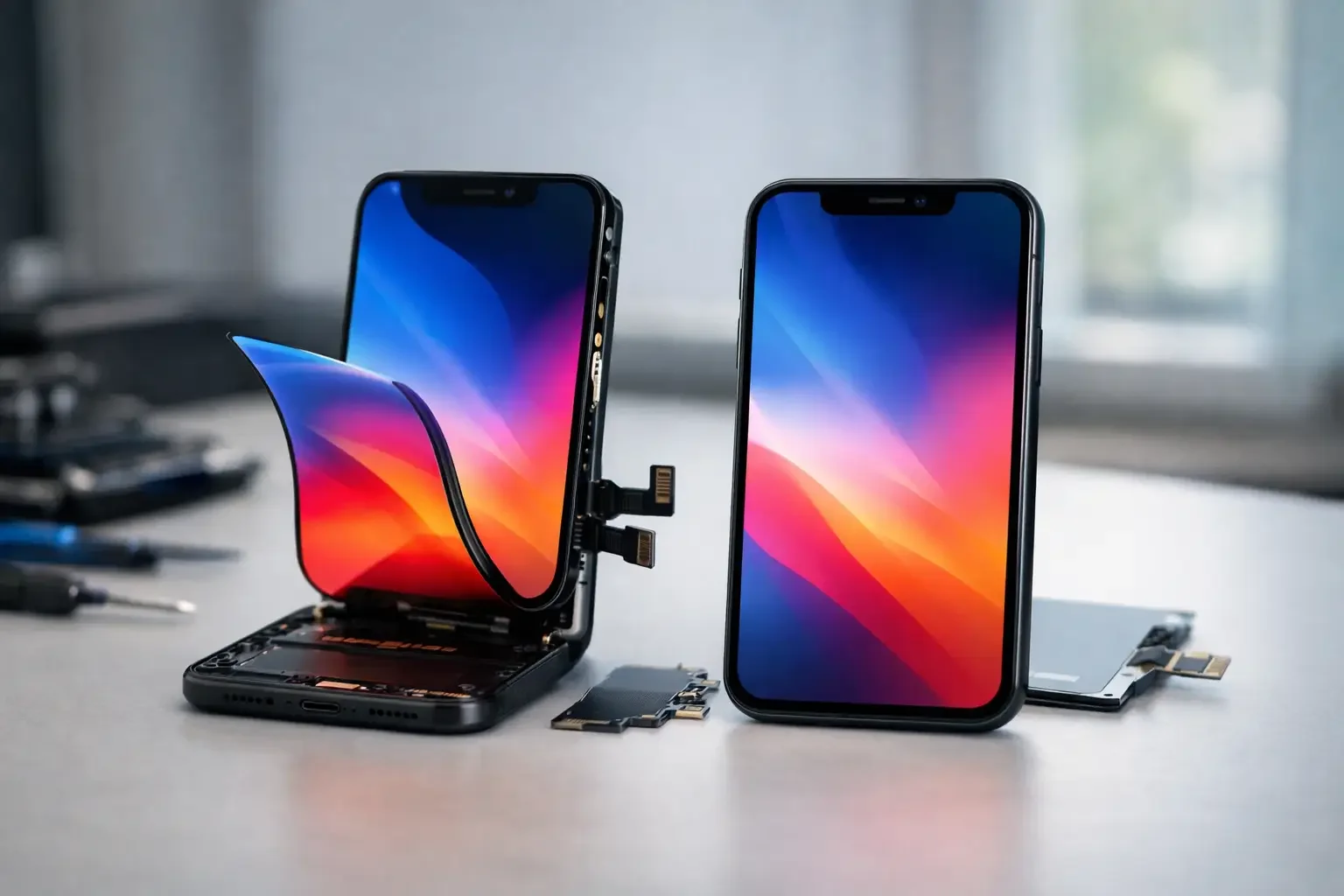
When a customer asks for a screen estimate and the real question is "I want it to look good, but how much does it really change?", the comparison between iPhone displays soft OLED vs Incell becomes immediately relevant. This distinction is not just a technical specification; it affects image quality, consumption, touch response, panel thickness, and the overall perception of the repair.
For those purchasing parts or managing a workshop, the choice should not be made abstractly. It should be based on the iPhone model, customer budget, required quality level, and the type of use after the intervention. A well-mounted display that is poorly chosen can lead to disputes even when the component is fully functional.
iPhone Soft OLED vs Incell: What Really Changes
The main difference lies in the panel technology. A soft OLED uses a flexible substrate, structurally and behaviorally closer to the OLED displays found in many high-end iPhones. An Incell, on the other hand, is generally an LCD panel where the touch layer is integrated into the display structure, aimed at containing costs and thickness compared to more traditional LCDs.
In practical terms, the soft OLED offers deeper blacks, superior contrast, and a visual output closer to the original in models designed with OLED technology. The Incell primarily aims at an economical compromise: it restores device functionality at a lower cost but with clearer visual limitations.
This is the first point to clarify at the counter or during the purchase: if the iPhone was originally OLED, the comparison is not merely between two compatible parts. It's between two different user experiences.
Visual Quality and Image Fidelity
Visually, the soft OLED has an advantage. The blacks are truly off, the contrast is sharper, and image depth remains convincing even in dark interfaces, lock screens, and video content. In iPhone models that heavily utilize dark themes, this difference is immediately noticeable.
The Incell tends to show blacks closer to dark gray, precisely because we’re dealing with backlit LCD technology. In indoor environments, it may seem acceptable to many users, but in direct comparison, the difference stands out clearly. Color saturation and contrast levels are generally less close to the original panel.
This doesn’t mean every Incell is poor quality; it means its logic is different. If the customer seeks the lowest cost to get the phone working, the Incell can make sense. If they expect a visual result similar to the original, especially on iPhone X, XS, 11 Pro, 12, 13, and subsequent series with factory OLEDs, the soft OLED is typically the more consistent choice.
Brightness and Outdoor Visibility
Perceived brightness must also be read carefully. Some Incells may initially seem very bright but do not always maintain uniformity or behave well under intense light. Quality soft OLEDs tend to deliver a more balanced and readable image, with less perceived bleed on blacks and dark areas.
For end users, the real test is simple: notifications, keyboard, social media, video, and outdoor use. This is where it is decided whether the replacement meets their needs.
Touch, Fluidity, and User Experience
Another central theme in the comparison of iPhone display soft OLED vs Incell is touch response. Those who work in repairs know that many complaints arise not from serious defects but from sensations: less responsive touch, unnatural scrolling, typing that feels slightly different.
A correctly graded soft OLED tends to offer a feel closer to the original, both in smoothness and touch accuracy. It's not just a software issue; the type of panel and construction affect perception during daily use.
With the Incell, touch can still be good, but the quality is more variable. It depends heavily on the manufacturer, the integrated controller, and the quality of the replacement. For simple uses, it may be acceptable; for more demanding customers, gamers, business users, or those who type a lot on their smartphones, the differences become more noticeable.
Panel Thickness and Installation
For technicians, thickness is not a secondary detail. A soft OLED, due to its flexible structure, is generally closer to the tolerances of the original display. This helps with positioning in the casing and reduces the risk of less precise alignment with frames, seals, and front components.
The Incell may turn out slightly thicker or less compatible with the original construction in some models. In practice, this can translate into a less clean installation, a different pressure sensation on the edges, or a less convincing final finish if the device's frame is not perfect.
On devices already stressed by impacts, bent frames, or previous repairs, this difference weighs even more heavily. If the casing is not immaculate, a panel closer to the original generally offers more margin for a proper closure.
Consumption and Energy Management
Energy consumption also needs to be considered. On iPhones made with OLED, the soft OLED generally aligns more closely with expected behavior, especially with dark content. The Incell, being LCD, uses constant backlighting and can impact perceived battery life differently.
Users don’t always measure this with tools, but they sense it. If after the replacement they notice a battery that seems to last less, the display immediately comes under suspicion. This is why it’s wise to set expectations before the sale.
When to Choose an Incell
The Incell makes sense when price is the top priority and the customer accepts a clear compromise. It’s a useful solution for older phones, second-use devices, terminals destined for quick resale, or repairs where budget is the primary constraint.
It can work well in contexts where the goal is not to replicate the original experience, but to restore functionality, touch, and visibility with a lower expense. For some workshops, it’s a necessary product tier, as it fulfills a real market demand.
The correct point is not to sell the Incell as an equivalent to the OLED. It is to propose it as a budget-friendly alternative with stated limits. When the proposal is transparent, it reduces returns, misunderstandings, and post-intervention disputes.
When to Choose a Soft OLED
The soft OLED is the most logical choice when the customer requests high visual quality, good fidelity to the original, and a final result closer to the factory display. It’s also indicated for still-relevant devices, regular clients, premium repairs, and cases where the phone still has significant commercial value.
For many service centers, it’s also the solution that best protects the reputation of the work performed. A higher-performing replacement reduces the risk that the customer returns saying the colors don’t convince, the blacks are washed out, or the touch doesn’t feel the same as before.
If the workshop's positioning focuses on quality and continuity, the soft OLED is often the most straightforward choice.
How to Correctly Propose the Two Options
The best management isn’t just about talking price. It’s about translating the technical difference into user experience. At the counter, it’s more effective to say that the soft OLED is closer to the original for blacks, contrast, consumption, and user feeling, while the Incell is a more economical option focused on functional restoration.
This approach avoids two common mistakes: overselling an Incell to a demanding customer or forcing someone to spend more when they just need a working phone for basic use. The right choice depends on the context, not an absolute rule.
For those purchasing parts independently, it’s wise to verify exact compatibility for the model, declared quality of the panel, and product positioning in the catalog. A technical supplier like iPhoneHospital.it makes sense precisely when it allows clear differentiation between quality tiers and intended uses, without confusing categories that actually meet different needs.
The Practical Point for Workshops and Technicians
In the comparison between iPhone display soft OLED vs Incell, the useful question isn’t which is the best overall. It’s which is the most suitable for that particular repair. The soft OLED almost always wins on the overall performance front. The Incell remains valid when price is the dominant criterion, and the customer accepts a quality inferior to the original.
Those who work well in repairs know this: the correct replacement isn’t the most expensive or the cheapest. It’s the one that avoids problems after installation and leaves the customer with expectations aligned with the actual result.
Before closing an order or formulating an estimate, it’s always worth taking a minute longer on this choice. Often it’s that minute that determines if the repair is successful on the first try.
Useful parts and tools: Batteries