


Which Flux to Use for Electronic Repairs
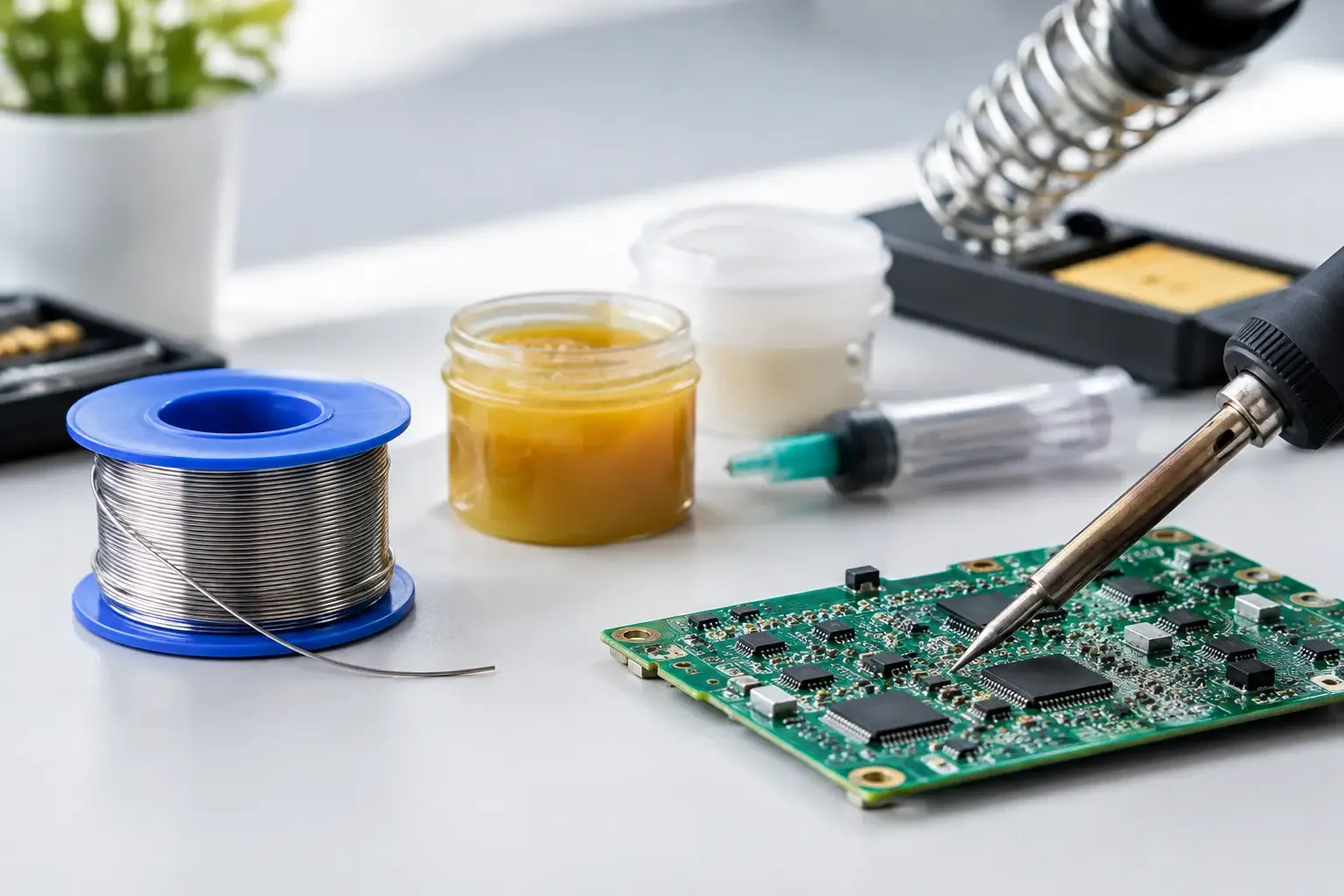
Understanding which flux to use for repairs is not a minor detail: it affects the quality of the soldering, the duration of the intervention, and the risk of damaging traces, pads, or nearby components. On the logic boards of iPhones, iPads, MacBooks, and Android smartphones, an unsuitable flux can leave hard-to-remove residues, produce excessive smoke, or destabilize the control of solder during microsoldering and rework.
The correct criterion is not to choose the densest product or the one that makes soldering easier. It is necessary to match the formulation, viscosity, and activity level to the type of processing, the component, and the cleaning method available in the laboratory.
What Flux Is Really For
During soldering, metal surfaces develop oxides that hinder the wettability of the solder. The flux removes or reduces these oxides, limits new oxidation caused by heat, and helps the solder alloy to spread evenly over pads, traces, and terminals.
The desired result is not simply a shiny solder joint. A reliable joint requires the solder to properly wet both surfaces, without bridges, voids, or buildups. This is particularly relevant in repairs on FPC connectors, charging circuits, microphones, battery connectors, ICs, and BGA components.
However, the flux does not repair a lifted pad, a broken trace, or a heat-deformed component. It reduces the difficulties of soldering, but does not replace careful board preparation, a clean tip, correct temperatures, and good heating techniques.
Which Flux to Use for Repairs: The Main Types
For most tasks on consumer electronics, the choice falls on rosin-based or synthetic fluxes, formulated to leave non-corrosive residues. The practical difference lies in the degree of activation, cleanability, and consistency.
No-Clean Flux
No-clean is one of the most commonly used options for smartphone and electronic board repairs. It leaves minimal residue, theoretically non-corrosive, and does not necessarily require washing. It is suitable for localized interventions, connector soldering, small SMD component replacement, and jobs where complete area cleaning is complex.
However, “no-clean” does not mean “never clean.” On a high-density board, residues can trap dirt, make inspection under a microscope more difficult, or compromise the professional appearance of the intervention. After a repair on Apple devices, especially near connectors and shielding, cleaning with high-purity isopropyl alcohol remains a good practice when accessible.
RMA or Medium-Activation Flux
RMA flux offers more pronounced action than many no-clean formulas and can be useful when pads and terminals are slightly oxidized, for example, on charging connectors, damaged flat cables, or boards with old solder. It promotes effective wetting without being as aggressive as a high-activity flux.
The trade-off is the management of residues. An RMA should generally be cleaned carefully because leaving it on the board is not the best choice in a professional job. It is a valid product when greater cleaning capacity is needed, but not a universal substitute for no-clean.
Water-Soluble or High-Activity Flux
Water-soluble formulations are effective on heavily oxidized surfaces and can facilitate some challenging processes. However, in mobile device repairs, they require discipline: active residues must be completely removed according to the manufacturer’s instructions, otherwise, they can promote corrosion or electrical leakage.
For this reason, they are not the first choice for a quick intervention on an iPhone or MacBook logic board. They are more suitable for laboratories with controlled washing processes and are capable of ensuring that no contaminants remain under components, connectors, or shields.
Gel, Paste, or Liquid Flux
The product form greatly affects the operational experience. Gel flux is the most controllable for microsoldering: it stays where applied, does not easily drip, and allows work on closely spaced connectors, ICs, and pads. For removing a chip or a BGA reballing, a good quality gel helps distribute heat and avoids oxidation during rework.
Liquid flux is useful for re-soldering wires, cleaning larger areas, soldering thin cables, or preparing terminals. It must be measured carefully: an excess can flow under components or connectors, making cleanup longer. Solder paste, on the other hand, is a mixture of powder alloy and flux: it should not be confused with flux alone and is mainly used for SMD assembly, stencils, and reballing.
Choosing Based on Processing
For soldering a battery connector, a display connector, or a small SMD component, a low or medium-activity no-clean gel is generally recommended. It offers control, limits solder movement, and allows intervention without unnecessarily wetting surrounding areas.
For removing an IC, a multipolar FPC connector, or a shielding, a gel with good thermal stability is preferable. The product must remain active long enough to accompany the flow of hot air, without burning immediately or producing charred residues. In this type of work, airflow, nozzle distance, and preheating matter just as much as the flux.
When recovering pads with oxidized solder or reprocessing old solder joints, an RMA can provide a tangible advantage. However, the area must be well cleaned after the intervention and inspected under a microscope. If the problem is caused by liquid corrosion, the flux alone is not enough: you must first remove the oxide, verify the continuity of the traces, and check the affected components.
Viscosity, Temperature, and Residue Quality
Too low viscosity makes dosing difficult, especially on vertical or very dense boards. Excessive viscosity can slow down heat distribution and leave more stubborn residues. For everyday work on smartphones, a medium-thick gel is often the best balance.
The smell and smoke are also practical indicators, but should not be interpreted alone. All fluxes subjected to heat can generate vapors: localized extraction and adequate ventilation are necessary. If the product darkens immediately, splatters, or forms a hard coating, it may have been applied excessively, heated too long, or be of insufficient quality.
The flux must operate within the thermal window of the alloy used. With lead-free solder, which melts at higher temperatures, a stable formulation and more precise thermal management are required. Raising the temperature indiscriminately to compensate for a weak flux exposes plastics, adhesives, flat cables, and sensitive components to unnecessary risks.
Errors That Slow Down Repair
The most common mistake is applying too much product. A thin coat on the solder joint is almost always sufficient. Excess does not proportionally improve wetting but increases smoke, residues, and cleanup times.
Another mistake is using generic electronic flux for any intervention. Products designed for plumbing, heavy soldering, or non-electronic work may contain substances too aggressive for fine traces and miniaturized components. For logic boards and electronic parts, only dedicated formulations are required.
Using syringes without caps, contaminated containers, or poorly stored products should also be avoided. If the flux changes color, separates the liquid part, has unusual granules, or has an abnormal smell, it is better not to use it on a valuable board. The traceability of consumables is part of laboratory quality.
Equipment That Complements the Work
The choice of flux should be considered alongside the tools. A soldering station with suitable tips, adjustable hot air, quality desoldering braid, compatible solder, microscope, and fume extractor make application more repeatable. Even the best gel cannot compensate for an oxidized tip or an uncalibrated temperature.
For those performing recurring repairs on iPhones, iPads, MacBooks, and other devices, it is advisable to keep at least one low or medium-activity no-clean gel on the bench for general work and an RMA for situations requiring greater action on surfaces. In the iPhoneHospital.it lab section, the selection of consumables and tools allows organizing the bench according to the type of intervention, without improvising with non-specific products.
The final choice always depends on the board, the processing, and the possibility of cleaning properly. A precisely dosed flux, combined with technique and adequate tools, leaves a controllable solder joint today and verifiable at the next intervention.