


AirPods Replacement Parts for Repair: What You Need
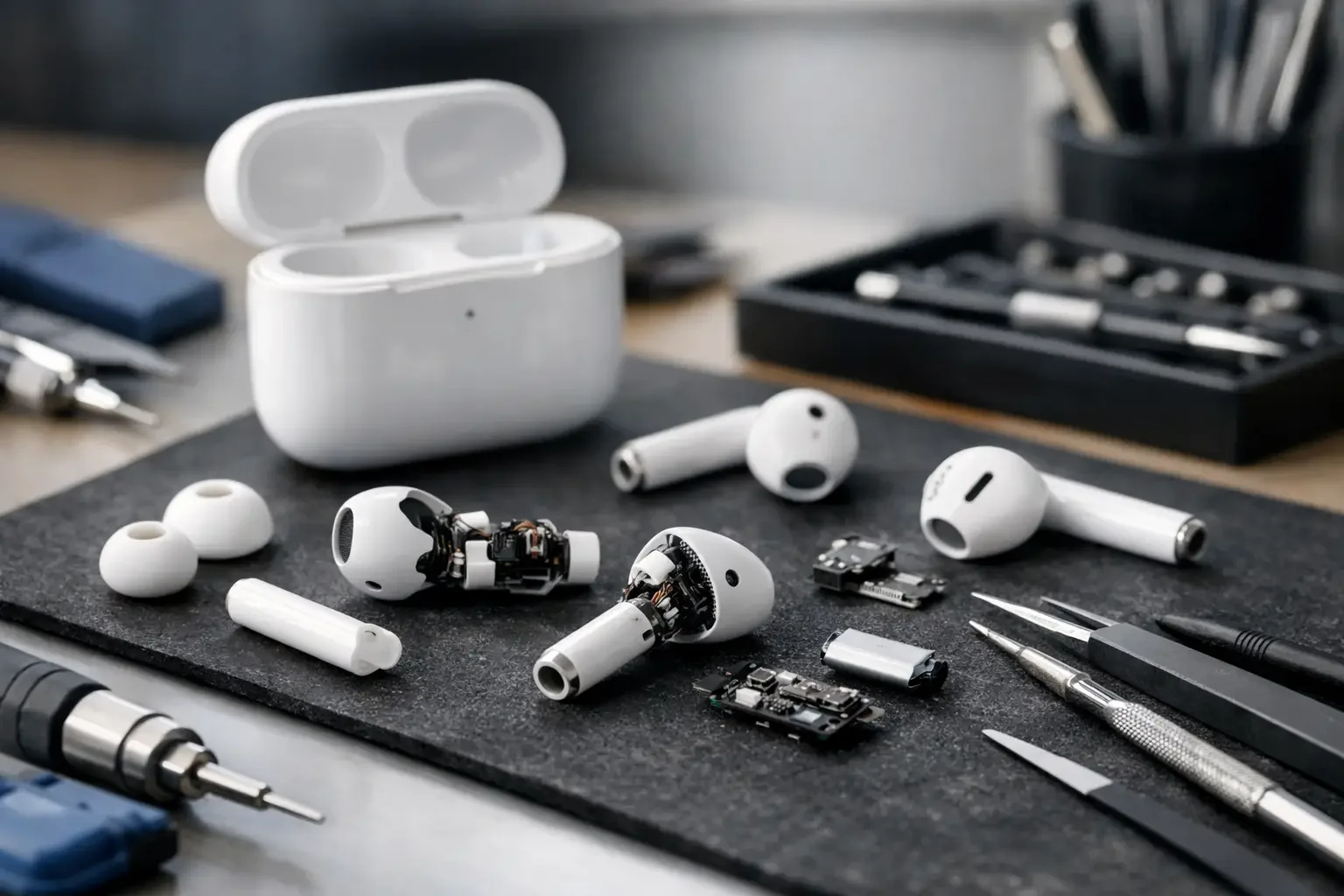
When AirPods arrive at the bench with reduced battery life, intermittent audio, or charging issues, the most common mistake is not replacing the part but misidentifying the component. Those looking for replacement parts for AirPods repairs often have a specific operational need: to minimize downtime, order the correct code, and proceed without wasting time on variants, generations, and construction differences that impact these devices much more than it seems.
AirPods Replacement Parts for Repair: Start with the Right Model
On AirPods, compatibility must not be handled roughly. Shapes, internal casings, connectors, batteries, charging cases, and pairings between the right and left earbuds can vary. Therefore, the first step is always to accurately identify the model.
AirPods 1st and 2nd generation may look similar, but not all replacement parts are interchangeable. AirPods 3 introduce a different structure, while the AirPods Pro family requires even more attention due to specific sensors, speakers, microphones, and cases. In practice, ordering a 'similar' component is rarely sufficient. You need a replacement compatible with the exact generation and, when necessary, with the correct side or the appropriate case.
For a workshop, this step is crucial from an economic standpoint. An incorrect part not only results in returns or replacements: it prolongs ticket closure times, blocks the workstation, and can generate further handling of an already delicate product.
Most Requested Replacement Parts
In everyday work, the most sought-after replacement parts are not necessarily the most complex but those that resolve recurring failures. Batteries remain one of the primary requests, especially for AirPods with advanced charge cycles, drops in battery life, or sudden shutdowns. Besides batteries, the charging case is often the second critical point, as it houses the connector, power logic, internal contacts, and charging management for the earbuds.
Another important category concerns individual components of the earbud. Depending on the model, interventions can be made on speakers, microphones, flex cables, sensors, or elements related to charging. Here, the distinction between right and left is not secondary. Even when the fault seems identical, the replacement must follow the structure of the correct side.
For some repairs, grids, rubber tips, technical adhesives, closure components, and small accessory elements come into play that may not grab attention but determine the final quality of the repair. An improperly sealed earbud or a battery installed without the correct material can turn a successful repair into a return.
AirPods Batteries: When to Intervene
Replacing the battery in AirPods is often required, but it's not always the most cost-effective intervention. It depends on the model, overall device condition, shell condition, and the overall value of the repair. For heavily worn products with low battery life and concurrent issues with the case, customers need to be clearly informed about the relationship between the cost of the replacement and expected performance.
From a technical standpoint, AirPods batteries require high precision. Space is limited, bonding is delicate, and the risk of damaging other components during opening is real. Therefore, it’s not enough to find the correct battery: you also need to have the proper materials and tools, as well as a consistent opening procedure for the model.
In structured labs, battery replacement makes sense when the device is still in good overall condition and the defect is localized. For products with infiltration, mechanical damage, or multiple issues, evaluations should be made on a case-by-case basis.
Charging Case and Power Issues
Many tickets classified as “AirPods not charging” do not immediately depend on the earbuds. In several cases, the fault lies in the case. The most frequent symptoms include lack of cable charging, abnormal LED, absence of power to internal pins, or unstable charging of the earbuds in the case.
Here, AirPods replacement parts for repair must be selected carefully because the case changes between standard, wireless, and MagSafe versions, in addition to differences between base and Pro lines. Even when the external aesthetics seem similar, internal compatibility may not be.
For technicians, the advantage of a good catalog classification is evident: it reduces the risk of associating the wrong case with a model that is only partially compatible. This is one of the situations where a supplier specialized in the Apple ecosystem, like iPhoneHospital.it, is particularly useful for those managing recurring purchases who need to quickly find the correct part for family and generation.
Internal Components: Speakers, Microphones, and Sensors
When the fault involves low audio, distorted voice during calls, irregular noise cancellation, or incorrect ear detection, the issue may involve more specific internal components. In these cases, diagnosis must be clear even before ordering the replacement part.
Weak audio, for example, does not always stem from a faulty speaker. There may be buildup in the grids, liquid damage, oxidation, circuit issues, or a microphone defect that alters the behavior perceived by the customer. The same applies to sensors. Replacing the component without technical confirmation easily leads to an incomplete repair.
This is why, in AirPods replacement parts for repair, the quality of the operational flow is as important as the availability of the part. First, identify the model, then test the symptom, then verify the compatibility of the component, and only after that order or withdraw from stock.
The Tools Matter as Much as the Replacement
For AirPods, the difference between a clean repair and collateral damage often lies in the equipment. Opening, separating bonds, thermal management, handling miniaturized batteries, and resealing require appropriate tools. Precision tweezers, fine opening tools, technical adhesives, cleaning materials, and workbenches are not secondary accessories.
An incorrect replacement mounted with unsuitable tools can lose value immediately. Just a marked shell, a compromised flex cable, or an uneven closure can compromise the result. For a service center, this translates to lost time and reduced margins. For an experienced user working independently, it often means having to reopen the device with an even greater risk.
How to Choose the Correct Replacement Without Mistakes
The choice of the right component is based on a few criteria that must be applied rigorously. The first is the exact model of the device. The second is the side of the component when working on individual earbuds. The third is the nature of the defect, which should be distinguished between power, battery life, audio, sensors, and physical damage.
Next comes the assessment of the level of intervention. It’s not always necessary to replace the “larger” component. In some cases, the problem is localized, and it’s better to intervene on the individual element. In others, especially when there are multiple defects, replacing the complete assembly reduces time and makes the repair more stable.
The operational context also matters. A high-volume workshop tends to prefer replacement parts with quick identification and immediate availability, even to optimize inventory. An advanced user buying for a single repair, on the other hand, is interested in checking every compatibility detail even more carefully because the margin for error is minimal.
When Repairing Makes Sense and When It Doesn’t
Not all AirPods repairs are the same in terms of cost-effectiveness. For recent models, with localized defects and good overall conditions, intervening on replacement parts is often a valid choice. For heavily worn devices, with damaged cases, exhausted batteries, and multiple compromised functions, the situation changes.
For those working in the industry, being transparent on this point is essential. A technically possible repair is not always the most efficient. It is necessary to consider the cost of the part, bench time, risk in opening, and the customer’s expectation for the final result. Saying no to a senseless intervention, in many cases, is a correct professional choice.
Organizing Purchases and Stock for Workshops
For service centers, the issue is not only finding AirPods replacement parts for repair but organizing their procurement. Keeping the right references in stock reduces downtime and allows more interventions without waiting. Here, the best logic is not to accumulate everything but to select the components with the highest turnover for the most widespread models.
A clear catalog structure, divided by generation and component type, facilitates both reordering and internal training of staff. It also helps standardize the diagnostic flow: model, symptom, component, necessary tool. When this scheme is organized, errors are reduced, and processing times improve.
On compact devices like AirPods, precision and speed are not in conflict. They can be achieved together, but only if the selection of the replacement part is done correctly from the start. Often, it’s not the individual piece that makes the difference but the method by which it is chosen.