


Apple Watch Parts: How to Choose the Right Ones
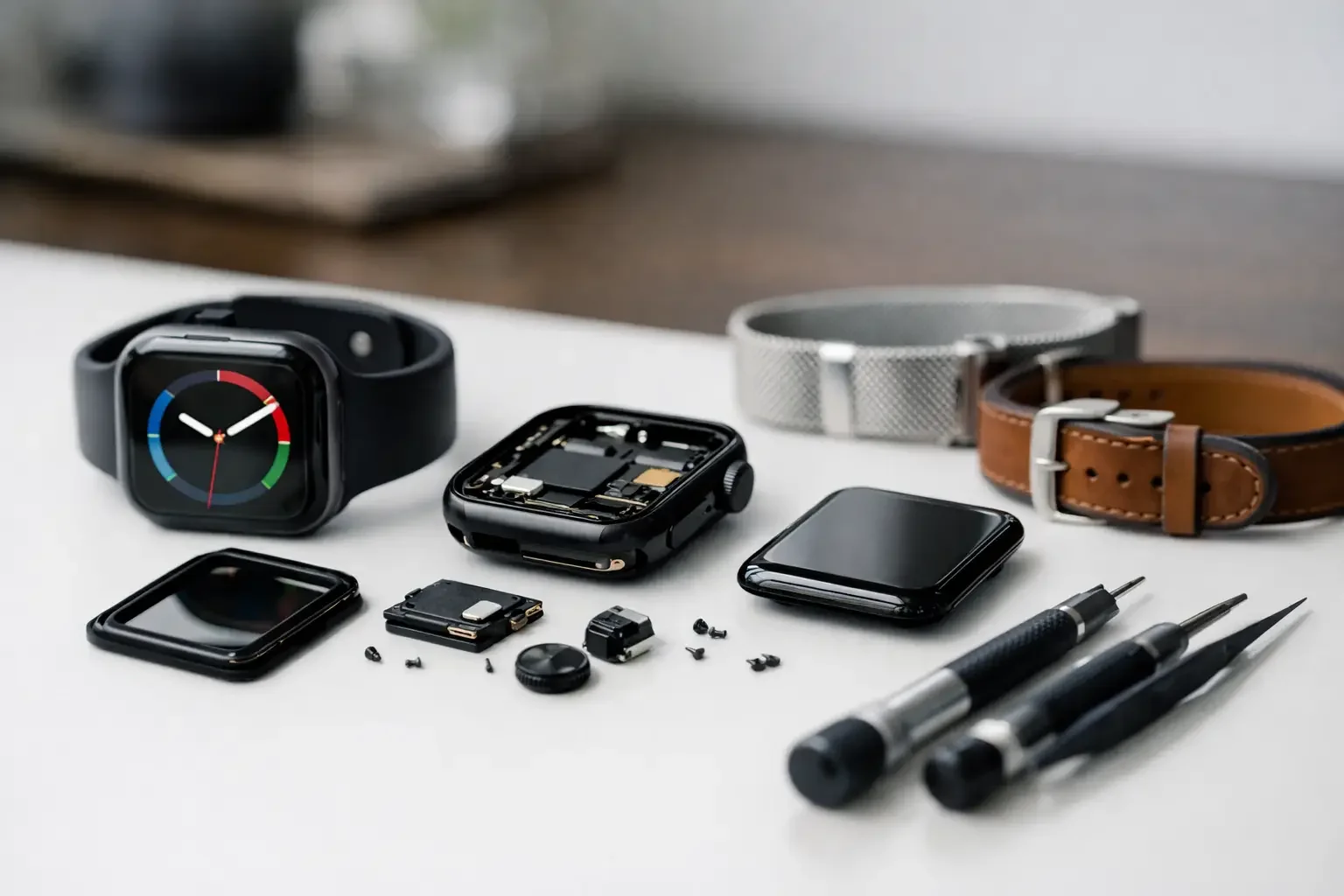
When looking for Apple Watch parts, the most common mistake is not the installation. It's the initial identification of the component. On this product, getting the series, case size, or GPS/LTE version wrong can lead to an incompatible piece, wasted lab time, and unnecessary device downtime.
The Apple Watch is a compact, layered device that has less tolerance for compatibility issues than other Apple products. Therefore, choosing the correct replacement part requires a precise method: the exact model, actual symptom, involved component, and required intervention level. Those purchasing for professional use or advanced self-repair know well that there is no universally valid "Apple Watch display." There are displays, batteries, sensors, flats, and casings compatible only with a specific generation and often with a precise variant.
Apple Watch Parts: Where to Really Start
The first step is to uniquely identify the model. "Series 5" or "SE" isn't always sufficient, as dimensions, connections, or internal layouts can vary within the same family. The correct reference is the complete device model, linked to the case size and hardware version.
Before ordering, it's wise to verify four elements: watch series, case dimensions, potential LTE or GPS version, and the exact nature of the issue. This verification reduces much of the error during purchase. A damaged glass, for example, doesn’t always mean the complete display group is needed, but in most cases, operationally, replacing the assembly remains the most efficient and controllable choice.
For a repair shop, the goal isn’t just to find the part. It's to choose the component that allows for a sustainable repair in terms of time, risk, and final yield. This is more crucial with the Apple Watch than with iPhones, as internal maneuvering space is minimal and the margin for error is low.
The Most Requested Parts for Apple Watch
The display group remains the most sought-after replacement. Breaks from impact, unresponsive touch, damaged OLED, or panel detachment are common issues. Here, it’s important to distinguish between aesthetic damage and functional damage, but especially between theoretically possible intervention and truly convenient intervention. If the end customer demands reliability and quick turnaround, the complete group is often the most straightforward solution.
Next is the battery. The Apple Watch tends to show reduced battery life much earlier than other devices, as the smaller format amplifies any cell degradation. Bulging battery, reduced autonomy, sudden shutdowns, or difficulty starting are typical signs. In these cases, a compatible battery specific to the exact series is needed, with particular attention to the connector, capacity, and mounting adhesives.
Then there are the side buttons, the Digital Crown, internal flats, and charging-related components. Not all have the same rotation, but for a service center, these are strategic parts. A non-functioning crown may depend on the mechanical component, the associated flat, or infiltrations that compromised the board. Hence, the initial diagnosis remains crucial: ordering the wrong part for the Apple Watch is very easy if one only thinks symptomatically.
Also, seals, pre-cut adhesives, and small closure elements should not be treated as secondary accessories. They are part of the intervention. On such a compact device, closing without the correct materials increases the risk of lifts, infiltrations, or mechanical stress in the short term.
How to Avoid Compatibility Errors
The most frequent issue with searching for Apple Watch parts is purchasing based on a generic description. "Display for Apple Watch 44 mm" is not a sufficient definition unless tied to a precise series. The same applies to a battery listed only for a commercial generation without complete technical verification.
Compatibility must be interpreted literally. If the replacement is declared for a specific series and size, it shouldn't be extended by analogy to other aesthetically similar models. Apple has maintained design continuity that can be misleading, but external similarity and internal compatibility do not automatically coincide.
For professionals, a good practice is to create an internal checklist for device acceptance. Photos of the back, checking the model code, testing the defect, inspecting the frame's condition, and checking for any battery swelling. This approach reduces returns and helps anticipate whether additional components will be needed alongside the main replacement part.
Display, Battery, or Flat: Which Intervention is Worth it?
Not always is the cheapest repair on paper the most efficient in the lab. An Apple Watch with a cracked display and a warped frame, for example, may require more processing time and pose a greater risk of imperfect closure. In these situations, the trade-off is clear: the part costs less than technical time only if the device context is favorable.
The same principle applies to the battery. If the watch shows reduced autonomy but also signs of moisture or internal corrosion, merely replacing the battery might not truly resolve the issue. It makes sense to pause for diagnosis and assess whether the intervention remains economically sensible.
With flats, convenience depends heavily on the operator's experience. Some repairs are perfectly manageable in a well-equipped lab, while others require higher skill and appropriate tools. Here, it’s not only about the availability of the replacement but also the relationship between operational complexity, risk of collateral damage, and the device's residual value.
Tools and Materials that Make a Difference
On the Apple Watch, the correct replacement alone isn't enough. Tools must align with the product's level of miniaturization. Controlled opening, heat management, precision tweezers, suitable levers, specific adhesives, and a clean workspace directly impact the quality of the intervention.
Those who work on these devices continuously know that even seemingly minor details can slow down operations. An incorrect adhesive or a battery installed without the right materials can turn a standard repair into a return. Therefore, it makes sense to source from a supplier who handles not only parts but also tools and consumables associated with the same workflow.
A structured catalog by model is particularly helpful here. If batteries, displays, double-sided adhesives, tools, and complementary components are found in the same place, technicians reduce split purchases and lower order management times. It’s an operational aspect, but for those who repair daily, it’s a tangible advantage.
When to Replace and When Not To
Not all Apple Watch repairs offer the same economic feasibility. A recent model with localized damage almost always justifies a well-executed professional intervention. In contrast, with older models, one must consider the cost of the component, labor time, and the final value of the restored device.
Then there’s the issue of multiple damage. If, in addition to the display, the battery, housing, and sensors are compromised, the repair may remain technically possible but less advantageous. In these cases, the serious professional does not force the sale of the replacement at all costs: they evaluate the complete picture and choose the intervention that makes the most sense for the customer and the lab.
This also holds true for those purchasing as experienced users. Self-repair makes sense if compatibility, tools, and assembly issues are understood. If even one of these three elements is missing, the risk of turning a single defect into a more extensive damage is real.
How to Organize the Purchase of Apple Watch Parts
To work efficiently in this category, a clear selection criterion is required. First, identify the device. Next, isolate the fault. Finally, check whether the replacement needs to be purchased alone or alongside complementary components. This method is simple but avoids most typical problems in managing Apple wearables.
For frequent buyers, it's also advisable to distinguish between high-turnover parts and parts to be sourced on demand. Displays and batteries of certain series have constant demand. More specific flats, small mechanical elements, or less recurring components can be managed more selectively. It’s a stock logic, but it directly impacts the lab’s margin.
In a professional context, value lies not only in the individual available part. It’s also in the precision of classification, depth of the catalog, and the ability to quickly find the correct component for the series and size. This is where a specialized supplier like iPhoneHospital.it becomes an operational tool, not just a sales point.
With Apple Watch parts, those who take one extra minute before ordering almost always win and save many hours after opening the device.