


Professional BGA Reballing Tools: What You Need
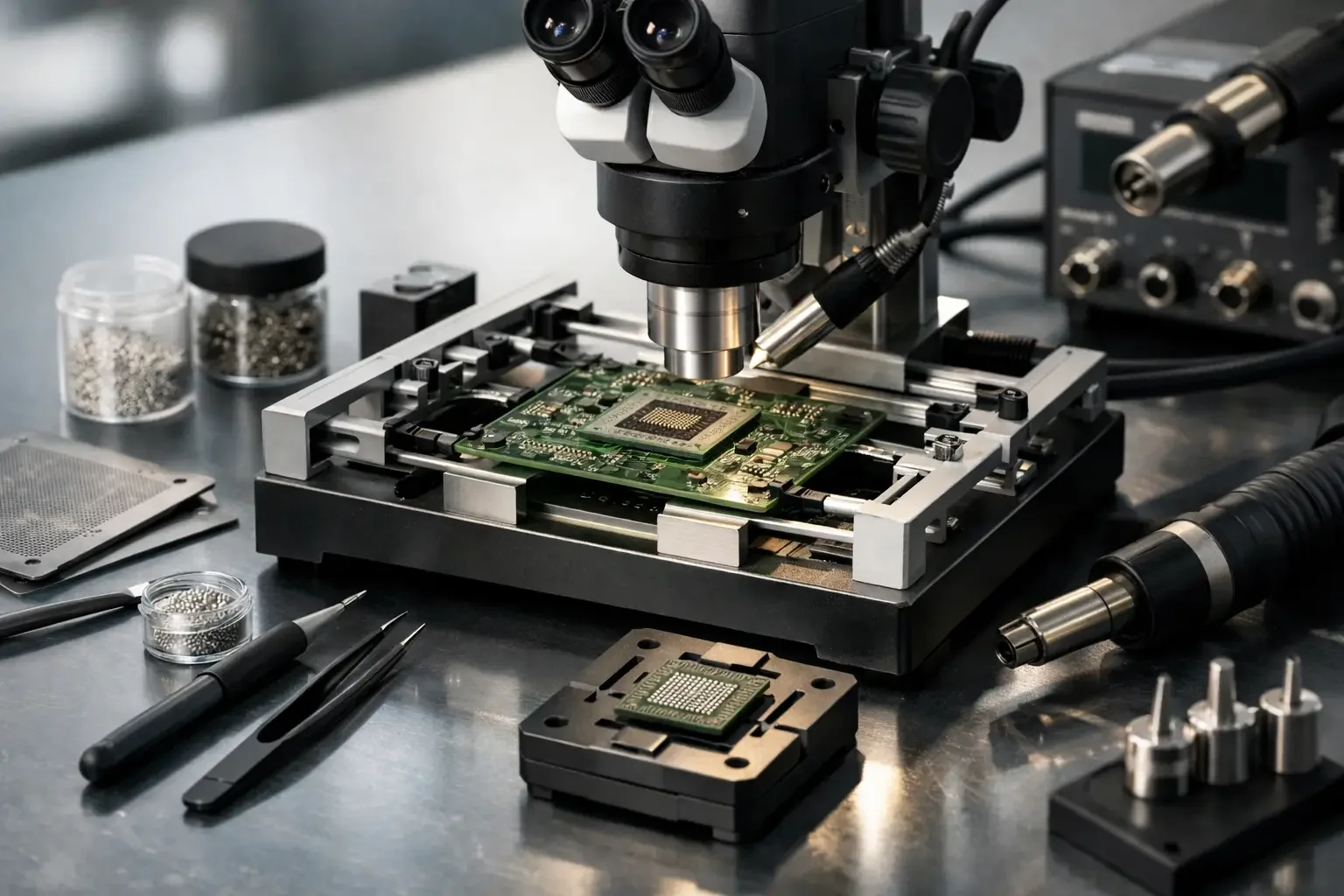
When a BGA chip needs to be removed, cleaned, and re-balled, the difference between a stable intervention and a return to the lab often depends not on the technician’s skill but on the professional BGA reballing tools used at each stage. In repairs on logic boards of iPhones, iPads, MacBooks, and notebooks in general, working with the right equipment ensures proper control of heat, alignment, consumables, and final verification without improvisation.
BGA reballing is not a task to undertake with generic tools. On small packages, multi-layer PCBs, and sensitive components, thermal margins and mechanical precision are tight. Therefore, equipment must be chosen based on the actual workload of the lab: frequency of interventions, types of boards handled, chip sizes, and the required level of traceability.
Professional BGA Reballing Tools: The True Foundation of the Workbench
The first element is the BGA station or, in more compact setups, a well-calibrated combination of preheating and professional hot air. Here, the point is not just to reach the temperature but to do so uniformly. A machine that heats poorly can easily lead to board warpage, pad lifting, or uneven reflow of spheres.
In labs that continuously work on Apple motherboards or high-density smartphone boards, a stable lower preheater is almost mandatory. It reduces thermal shock, shortens intervention times, and makes the chip's behavior during removal and repositioning more predictable. Hot air alone may suffice for some jobs, but it becomes more critical when the board’s thermal mass varies greatly from area to area.
In addition to the station, rigid and adjustable board supports are necessary. It may seem like a secondary accessory, but it is not. A board that is not secured properly moves during chip pickup or repositioning, risking misalignment by a few hundredths of a millimeter.
Thermal Control: More Important Than Power
When evaluating professional BGA reballing tools, many first look at wattage. In practice, the stability of the thermal profile matters more. A system capable of maintaining consistent and repeatable temperatures is preferable to a more powerful but erratic one.
Real control comes from three factors: reliable sensors, uniform heat distribution, and fine air flow adjustment. On boards with residual underfill, on thin boards, or on very sensitive components, excessive air flow can displace passive components and affect the work. The correct compromise depends on the type of board. The thermal behavior of a MacBook logic is not the same as that of an iPhone board, and using the same approach can easily lead to deviation from specifications.
For this reason, many labs complement their station with a thermocouple or reading systems to verify the actual profile on the PCB. It’s not necessary to turn every intervention into a production line procedure, but having objective references helps replicate good results and correct unstable ones.
Stencils, Spheres, and Chip Placement
The reballing phase requires more mechanical precision than one might think. Stencils must have the correct pitch, good flatness, and real compatibility with the package being treated. An inexpensive or deformed stencil slows down the process and increases the likelihood of bridging, incomplete spheres, or uneven distribution.
BGA spheres should be selected in diameter and alloy suitable for the chip and the procedure used. Using incorrect spheres affects final height, wetting, and quality of reflow. The flux also impacts the outcome. An overly aggressive or too fluid product can complicate placement; one that is too dry may not support the sphere formation well. There is no one-size-fits-all answer: small packages, NAND chips, PMICs, or controllers on different boards react differently.
Precision, non-magnetic tweezers and stable chip pickup tools that do not introduce torsion are also necessary. For finer work, the stereo microscope remains one of the true central tools of the process. It is essential not only for inspection but also for cleaning the pad, verifying the quality of the reball, and checking alignment before the final reflow.
Pad Cleaning and Preparation: The Phase That Determines the Outcome
Many problems attributed to the station actually stem from incomplete preparation. If the pad of the chip or the board remains contaminated with residues, oxidations, or unevenly removed solder, reballing starts off on the wrong foot. Thus, among the professional BGA reballing tools, precision soldering irons, appropriate tips, quality wicks, specific fluxes, and ESD-safe cleaning materials should also be considered.
The removal of residual solder must be controlled. Excessive pressure on the wick can lift pads or create uneven surfaces. Too little leaves thicknesses that distort chip repositioning. In practice, cleaning quality is evident under the microscope even before reflow.
The workbench also matters. An anti-static mat, proper lighting, and organized consumables reduce trivial but costly mistakes. In a lab managing spare parts and interventions across multiple product lines, a well-stocked laboratory accessory section helps maintain consistent standards between jobs.
Optics and Inspection: Without Visual Control, the Margin Decreases
On compact BGAs or boards with high density, working without adequate optics means relying too much on tactile experience. A stereo microscope with good depth of field allows for checking pad cleanliness, sphere uniformity, potential bridging, and the chip's behavior in contact.
It is not always necessary to have a top-of-the-line setup, but three specific things are required: a clear image, a comfortable working distance, and adjustable lighting. If the technician must constantly change posture or correct reflections, precision decreases. For those frequently reworking Apple logic boards, the ergonomics of the microscope also impacts productivity, not just quality.
Inspection does not end with reflow. A final check of the treated area, adjacent components, and any remaining residues is part of the job. Skipping it to save a few minutes often results in a second opening of the device.
How to Choose the Right Tools for Your Laboratory
The choice of professional BGA reballing tools should be based on the types of tickets that truly come in. If the lab primarily handles smartphones, micro-soldering, and board repairs for iPhones or Samsung devices, the priority is precision on small packages, flow control, and good optics. If the workflow includes many notebook logic boards, then a uniform preheating and wider board support become increasingly important.
Volume also matters. A bench that performs only a few reballings a month can function well with a selected and complete but not necessarily automated setup. A center that frequently performs rework requires more stable equipment, always available consumables, and more repeatable processes.
Compatibility is another concern. Those working daily in the Apple ecosystem often combine BGA work with interventions on connectors, power lines, storage, and model-specific components. Quick access not only to tools but also to spare parts for iPhones, iPads, MacBooks, and iMacs greatly simplifies the laboratory’s operational management.
Common Errors in Equipment Selection
The most common mistake is buying the station and neglecting everything else. Reballing is a system, not a single product. If correct stencils, compatible consumables, stable supports, and good inspection are missing, even an expensive machine operates below its potential.
Another mistake is seeking a one-size-fits-all solution for every scenario. There is no perfect set that works the same for smartphone PMICs, notebook CPUs, and memory chips. Some labs perform better with a modular configuration, where tools and consumables are adapted to the family of chips most frequently treated.
Saving on the quality of consumables is often counterproductive. Unstable flux, out-of-tolerance spheres, or unreliable wicks directly impact times, cleanliness, and the likelihood of rework. In this context, the lowest unit cost rarely aligns with the best operating cost.
A Professional BGA Workbench Works When Everything is Consistent
In real work, professional BGA reballing tools produce results when the station, optics, supports, stencils, and consumables all align to the same operational standard. There is no need to clutter the bench with unnecessary accessories, but eliminating weaknesses that make results random is essential.
For those working every day on complex boards, the correct logic is simple: less improvisation, more control. If the bench is built well, every rework starts from a more predictable foundation, and each subsequent diagnosis becomes quicker. Over time, this is what makes the difference between a successful intervention and a lab that can handle volumes without sacrificing quality.