


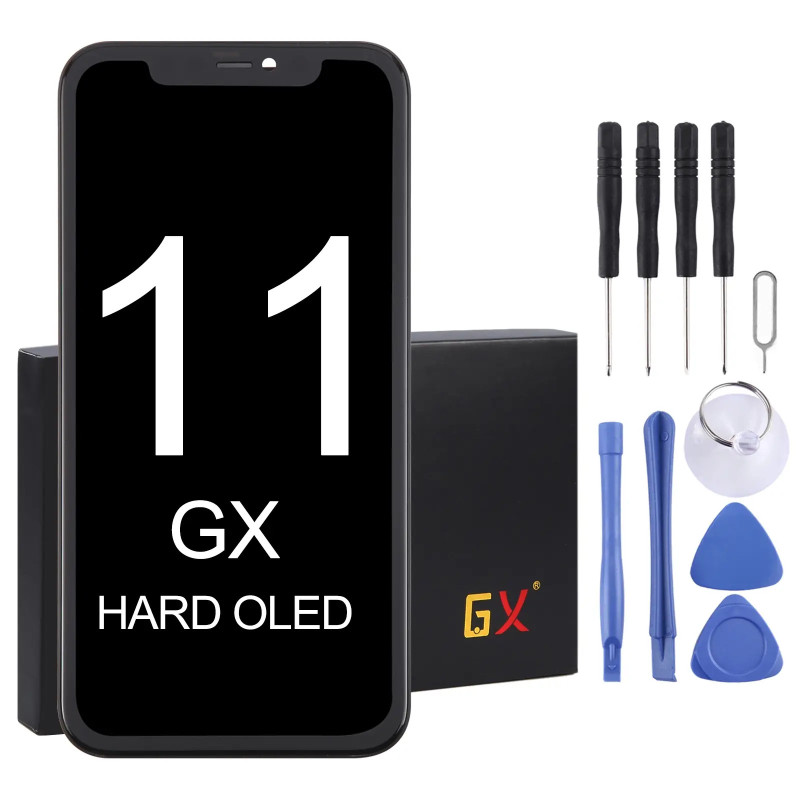


Display LCD for Apple iPhone 11 A2111 A2223 A2221 Parts Incell HD GX Original
 Security policies
 Shipping policies
 Return policies
The shipment includes:
- Display Touch Screen: Fully assembled with IC Chip.
- Compatibility: Specifically designed for Apple iPhone 11.
- Guaranteed Quality: 100% new LCD, tested and fully functional.
Make sure to get a high-quality product for your device!
Product Description
Product Type: Replacement screen for smartphones
Compatibility: Specific for Apple iPhone 11
Brand: GX Original
Technical Characteristics
- Screen:
- Type: INCELL OLED
- Advantages: INCELL OLED screens offer brighter colors, deep blacks, and excellent visibility even in bright light conditions.
- Color:
- Black: Elegant and refined, it integrates perfectly with the design of the iPhone 11.
- Digitization Flex:
- Perfect adherence: Ensures a precise and responsive touch response, enhancing the user experience.
- Backlighting:
- Adjustable: Allows you to set the brightness according to your preferences, improving usability in different lighting conditions.
Recommendations
- installation:
- Professional installation by an industry expert is recommended to ensure correct assembly and optimal operation of the device.
These specifications make this replacement screen an excellent choice for those who want to repair their iPhone 11 while maintaining high standards of quality and performance.
When choosing a compatible display for repairing an iPhone X or higher, it is essential to consider several factors to ensure good quality and device performance. Here are some key aspects to keep in mind:
1. Type of Display:
- Hard OLED: These displays have a rigid glass and a more resistant structure, but they might be heavier. They offer vivid colors and deep blacks, similar to original screens.
- Soft OLED: These displays are more flexible and lighter, but they can be more susceptible to scratches and damage. Although they can offer good colors, their quality can vary significantly depending on the manufacturer.
- In-Cell: This technology integrates touch and display into a single panel, resulting in increased touch sensitivity and a thinner profile. In-Cell screens tend to provide better visual quality compared to models with separate technology.
2. Quality of Materials: Make sure to buy from reliable suppliers that use high-quality materials. Cheap displays may have issues like faded colors, poor touch sensitivity, or shorter lifespan.
3. Compatibility and Model: Make sure that the display is specific to the iPhone model you intend to repair. Even small differences in models can affect the compatibility of the display.
4. Feedback and Reviews: Check other users' reviews and product ratings. A brand with a good reputation and positive feedback is often a safer choice.
5. Warranty: Opt for a supplier that offers a warranty on the product. This can provide some peace of mind in case the display does not work correctly after installation.
Customer Service: Good customer service is important in case of problems or questions regarding the installation and use of the display.
Price: While it's understandable to want to save money, don't compromise on quality just to save a few euros. A low-quality display could lead to further problems in the future.
8. Installation Tools: Check if the kit includes all the tools necessary for installation. Some suppliers offer complete packages that can simplify the repair process.
Taking these factors into consideration, you can make a more informed choice and increase the chances of a successful repair of your iPhone.
The OLED displays used in iPhones starting from the iPhone X feature different technologies, including Hard OLED, Soft OLED, and In-Cell OLED. Each of these technologies has its own distinctive characteristics. Here is an illustration of the differences between them:
Hard OLED
- Structure: Hard OLED displays use a rigid glass panel as a substrate. This type of display is generally more durable and less susceptible to scratches and damages.
- Image quality: Colors tend to be very vibrant and contrasts very high, thanks to OLED's ability to completely turn off black pixels.
- Durability: The hardness of the glass provides greater protection, but it can make the display heavier.
- Usage: Used in models such as iPhone X and XS.
Soft OLED
- Structure: Soft OLED displays, on the other hand, use a flexible substrate, allowing for greater lightness and potentially a curvature of the display.
- Image quality: These displays also offer vivid colors and excellent contrast, but they may present a slight difference in rendering compared to Hard OLED displays.
- Durability: Although they are lighter and more flexible, Soft OLED displays can be more vulnerable to scratches and damage compared to their rigid counterparts.
- Usage: Used in later models such as iPhone 11 Pro and 12.
In-Cell OLED
- Structure: In-Cell OLED screens integrate OLED pixels and the touchscreen in a single layer, eliminating the need for a separate panel for touch. This results in a thinner and lighter design.
- Image quality: They offer exceptional image quality, with vibrant colors and deep blacks. The technology also allows for greater touch sensitivity.
- Durability: Being thinner, In-Cell displays can be more susceptible to damage, but technology continues to progress to enhance their resistance.
- Usage: This technology has been adopted in more recent models, such as the iPhone 12 and later versions.
Conclusion
The differences between Hard OLED, Soft OLED, and In-Cell OLED mainly concern the structure, image quality, durability, and design. Each type of display has its own advantages and disadvantages, and choosing one technology over another can influence the overall user experience. Advances in OLED technologies continue to improve the quality and performance of displays in modern iPhones.
Hard OLED displays offer superior visual quality, with vivid colors and high brightness that make them ideal for use in bright environments. However, their rigid structure can make them more susceptible to damage in case of accidental impact. It is important to note that, although they are not necessarily fragile, they require more attention compared to Soft OLED models, which, despite being more expensive, are designed to be more impact-resistant. In summary, while Hard OLED displays offer excellent color rendering, it is advisable to handle them with care to avoid breakage.
Summarizing:
- Display cheaper than the Soft one;
- More fragile and slightly less impact-resistant;
- Excellent chromatic contrast;
- Optimal color rendering;
- Excellent brightness;
- The double black frame or border slightly reduces the size of the display, and therefore of the image displayed compared to the original.
- Slightly thicker;
- Battery consumption equal to the original;
The Soft OLED display represents an advanced solution for electronic devices, offering numerous advantages compared to traditional panels. Here is a summary of its main features:
1. More expensive display: The production cost and the high-quality materials used for the Soft OLED can make it more expensive compared to other options.
2. More impact-resistant: The panel's increased flexibility allows it to better absorb impacts, reducing the risk of breakage and malfunctions.
3. Original Quality: Soft OLEDs offer a visual quality that comes very close to that of the original panels, ensuring a satisfying user experience.
4. Excellent chromatic contrast: Thanks to OLED technology, colors are vivid and well-defined, with a high contrast that enhances visibility in various lighting conditions.
5. Optimal color rendering: The colors are reproduced accurately and realistically, offering an excellent visual experience for viewing photos and videos.
6. Good brightness: Soft OLED displays are capable of providing adequate brightness, useful for use in bright environments.
7. Same dimensions and thickness as the original: The technology allows to maintain dimensions similar to those of the original displays, making integration into devices easier.
8. Battery consumption equal to the original: Soft OLEDs are designed to optimize energy consumption, ensuring a battery life similar to that of the original devices.
In summary, Soft OLED combines innovation and high performance, making it an excellent choice for those looking for a high-quality and durable display.
InCell
In-Cell displays represent an innovation in smartphone panel design, as they integrate the touch module and the LCD panel into a single layer. This integration allows for better touch sensitivity, making interaction with the device more responsive and fluid. Furthermore, by reducing the number of layers, In-Cell displays contribute to an overall lower weight and thickness, making devices more compact and similar to original models.
In the specific case of iPhones, the iPhone 11 is currently the only recent model that uses this technology, while starting from the iPhone X, Apple It adopted OLED panels, which offer advantages in terms of image quality, but do not use In-Cell technology. The adoption of OLED display has allowed for brighter colors and deeper blacks, but it has also led to a change in the panel structure compared to traditional In-Cell LCDs.
Best iPhone Display Brands
Brands that offer an excellent quality/price ratio are constantly emerging. Today, in addition to using the usual term "TIANMA" to select displays with a quality close to the original or even identical, it's better to rely on the following brands to be more certain, as they present distinctive features listed above. These brands will have models with Hard OLED and Soft OLED displays. If you simply search for TIANMA displays, you won't find this distinction.
GX is one of the absolute best brands on the market for iPhone X or newer displays. Color rendering and excellent brightness make this company the one that comes closest to the original quality. In fact, there may be no more difference between a GX display and an original display. Apple. Sure, on the other hand, we will go towards a higher price, but we could save something by choosing the Hard OLED version. Don't worry about the danger that comes from it being more rigid, it is always better to avoid dropping your smartphone because, in addition to the display, it could also damage internal components.
Like the previous one, we are faced with a brand that, in any case, is of a level higher than the usual unknown components that you find online. We can say that following these labels helps us choose a quality product in some way, even if they are like the original ones assembled in China.
Nothing different from the previous ones, the only difference I can tell you is that the GX is the most well-known and reliable. Like the others, this one also features Hard OLED, Soft OLED, or In-Cell displays.
What happens after replacing the display of an iPhone X or a later model?
One aspect that many technicians do not mention is that, after replacing the display of an iPhone 8 or later models (such as the iPhone X, etc.), the True Tone functionality is lost. But what is True Tone exactly, and is there a way to restore it in any case?
True Tone is a technology developed by Apple which automatically adjusts the color temperature and brightness of the display based on the ambient lighting conditions. The goal of this function is to make the image displayed on the screen more natural and similar to what one would see in reality.
When we find ourselves in different environments, the light surrounding us can influence our perception of colors. For example, the natural sunlight has a different temperature compared to the artificial light of a light bulb. Without the compensation provided by True Tone, the white on a device's screen might appear yellow or blue depending on the surrounding light.
True Tone uses integrated sensors to analyze the ambient lighting and adjust the display accordingly. This way, the white of the display appears consistent and natural, regardless of the environment in which you are. This makes reading and interacting with the device more comfortable for the eyes and enhances the overall visual experience.
In summary, True Tone helps maintain visual consistency and reduce eye strain, providing a more realistic and pleasant viewing experience.
Is it possible to restore it?
Yes, it is possible to restore the True Tone option on a new display, but there are some important steps to follow. As you mentioned, it is essential to keep the old replaced display, as it will need to be connected to a special device, such as a Box or a programmer, that allows you to save and transfer the necessary data.
Here is a summary of the steps to restore the True Tone option:
1. Keep the old display: Do not throw away the original display, as it is essential for the rehabilitation process.
2. Connection to the Box: The old display must be connected to a Box or a compatible programmer that can extract the necessary data for True Tone.
3. Data transfer: Once the data has been saved from the old display, the new display must be connected to the same Box to "transfer" this data, enabling the True Tone option.
Request to a technician: Not all technicians have the necessary Box available, so if you want to re-enable True Tone, make sure to explicitly ask the technician if they are able to do so. If not, request to have the old display back.
5. Compatibility check: Make sure the new display is compatible with the device and that the technician has the necessary skills to carry out the process correctly.
If you follow these steps and find an equipped technician, you should be able to restore the True Tone option on the new display.
Data sheet
Specific References
No customer reviews for the moment.
