


Apple Watch Glass Replacement: How to Choose It
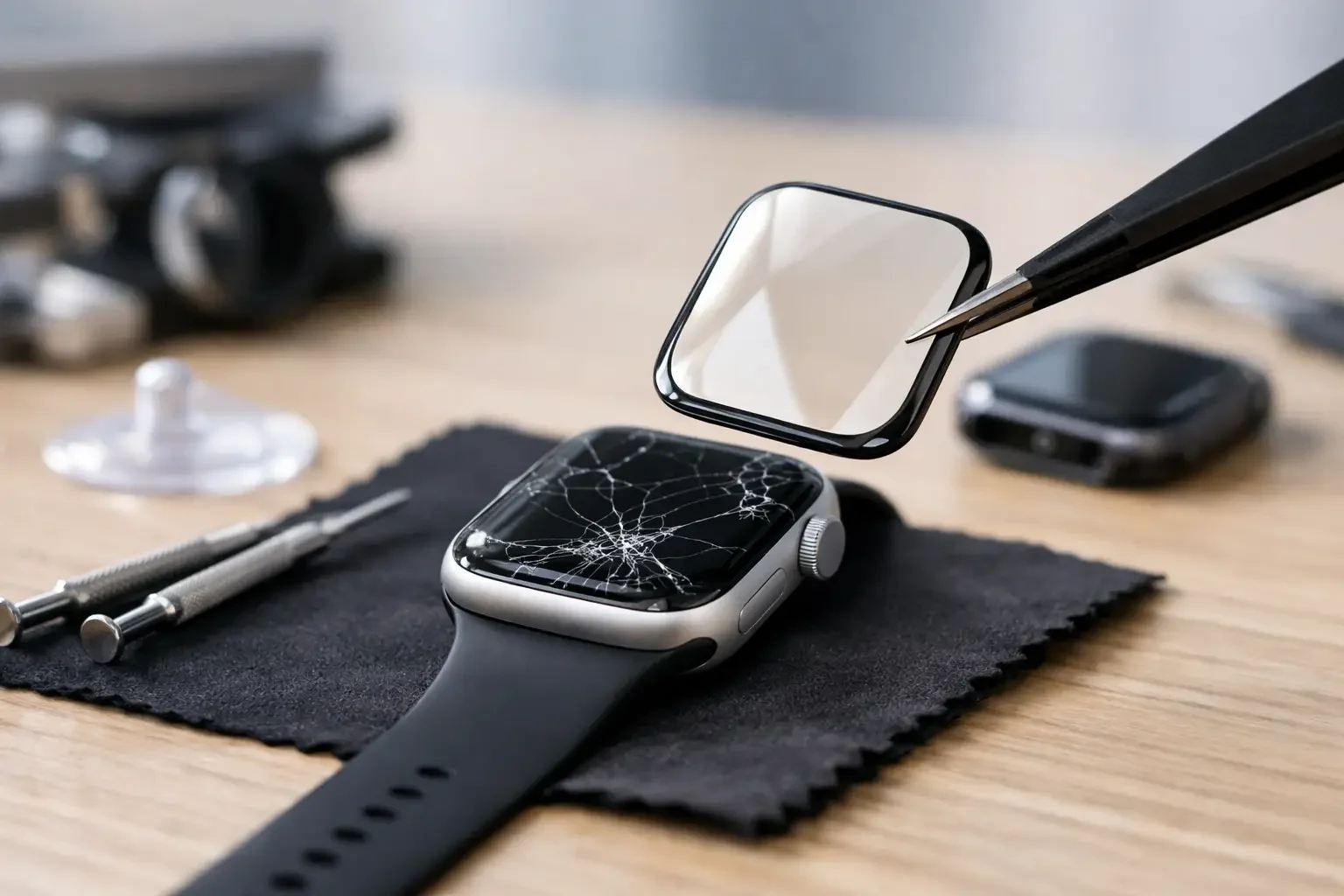
When an Apple Watch with a cracked glass arrives at the lab, the issue is not just aesthetic. An incorrect Apple Watch glass replacement can slow down repairs, create compatibility issues with the underlying display, or worsen the device's final seal. Therefore, choosing the component must be done carefully, starting with the series, case size, display assembly structure, and actual damage level.
Apple Watch Glass Replacement: Where to Start
Operationally, the first mistake to avoid is treating all Apple Watch glasses as equivalents. They are not. Dimensions, profiles, adhesives, compatibility between generations vary, and most importantly, the technical context of the intervention changes. In some cases, the glass can be replaced as a specific component; in others, it makes more sense to replace the complete assembly, especially when the OLED or touch display shows even minor defects.
To identify the correct replacement, three pieces of information are needed: device series, case size, and exact damage type. An Apple Watch Series 3 42 mm must not be treated as a Series 6 44 mm, and the distinction between GPS, Cellular, or special edition versions can affect the final verification of the available component.
Those who purchase for a lab know well: the time lost due to an incompatible replacement is heavier than the unit cost of the part. This is why it’s advisable to think in terms of verified compatibility rather than just simple visual similarity.
When is Only the Glass Enough?
The most common request is straightforward: broken glass, display on, touch working. On paper, this seems like a classic case for a simple glass replacement. In practice, it's essential to carefully check several elements before ordering the part.
If the panel shows streaks, lines, black areas, loss of brightness, or irregular touch sensitivity, merely replacing the glass becomes a riskier intervention. Even when the image is visible, a micro-crack on the display or uneven touch sensitivity may only surface after separation. In these cases, those who work for productivity often tend to evaluate the complete display assembly rather than just the glass.
Replacing only the glass makes sense particularly when the damage is superficial and the technician has adequate equipment for separation, cleaning, lamination, and polymerization. However, if the goal is to finalize the intervention quickly with less exposure to waste, the assembled group may be the more efficient choice. It depends on the lab's workflow, not just the initial defect.
Differences Between Models and Sizes
Apple Watch is a broad family with many variants. Case sizes change across generations, as does the Apple Watch glass replacement to select. The most common combinations revolve around 38 mm, 40 mm, 41 mm, 42 mm, 44 mm, 45 mm, and 49 mm, but the numerical data alone is not enough.
Two models with similar sizes can have different geometries, adhesives, and tolerances that make the replacement not interchangeable. The curvature of the glass and display construction also have a significant impact. Therefore, during the ordering phase, it’s always useful to verify the exact model listed on the casing or in the technical specifications of the device.
For labs that manage recurring volumes, classifying by series and size is the quickest method to reduce errors. For the experienced user purchasing independently, the advice is to not stop at the simple label “Apple Watch 44 mm” without first identifying the correct generation.
Quality of the Replacement: What to Really Evaluate
In the replacement market, the term “compatible” covers a wide range of quality levels. For Apple Watch glass, this aspect weighs even more, as we are talking about a visible, thin, and structurally delicate component. Quality is perceived not only upon delivery but especially during processing and after reassembly.
A glass of adequate level must have uniform processing, correct profile, clear transparency, and adhesion consistent with the intended structure. Out-of-standard tolerances can complicate alignment, increase assembly time, or compromise final performance at the edges. For those providing professional service, these differences translate into returns, rework, and lost bench time.
Then there’s the issue of optical performance. Poorly made glass can alter display perception, reflections, and visual clarity. The end customer may not notice the problem immediately upon delivery, but it often becomes evident during daily use. This is why choosing solely based on price is rarely the best path, especially for compact devices like the Apple Watch where every inaccuracy is immediately noticeable.
Required Equipment for Replacing Only the Glass
Replacing the Apple Watch glass is not an intervention to be improvised. Compared to other devices, the reduced spaces and very compact construction increase the sensitivity of the work. Those choosing only the glass must consider the complete process, not just the component.
Suitable equipment is needed for opening, controlled separation, removal of adhesive residues, lamination, and fixing. Skill makes a difference, but it's not enough alone. Without the correct tools, the risk is damaging the panel, altering the touch, or compromising the seal.
Thermal management should also be carefully evaluated. An inappropriate temperature or poorly distributed pressure can turn a functioning display into waste. This is why many operators clearly distinguish between economically viable in-house interventions and processes that should be avoided in the absence of a complete setup.
Frequent Purchase Errors
The first mistake is ordering based on external appearance. The Apple Watch has strong aesthetic continuity across different series, so the eye alone is not enough. The second mistake is underestimating the case size or confusing closely related generations. The third is ignoring the actual damage to the display and buying glass when the complete assembly would be the correct solution.
Another critical point concerns laboratory planning. Ordering a glass without checking the availability of adhesives, necessary tools, and consumable materials means breaking the workflow. An apparently simple intervention can halt due to a lack of the right detail. This is why many professionals prefer to source from suppliers with a broad technical catalog, where both the replacement and supporting material can be found in the same purchasing path.
How to Quickly Choose the Right Replacement
The most effective criterion is this: model identification, damage analysis, selecting the intervention level. First, confirm the exact series and size. Then, assess if the OLED and touch are actually intact. Finally, decide whether to purchase just the glass or the display assembly.
If the goal is to maximize margins on advanced processes, only the glass may make sense. However, if delivery speed matters, or if the device presents any minimal doubt about the panel, it’s advisable to consider a more complete solution. There is no one-size-fits-all answer.
From a purchasing perspective, a clear product sheet should immediately help with compatibility, supported model, and nature of the component. In a technical context like iPhoneHospital.it, this approach is essential as it reduces the margin for error and speeds up recurring reorder processes for labs and service centers.
The Relationship Between Part Cost and Time Cost
For Apple Watch glass replacement, the component cost is only part of the equation. The real crux for a professional is the relationship between the part price, processing risk, and bench time spent. A cheaper glass that is more difficult to install may ultimately cost more in the final result.
The same applies to the choice between fine repair and module replacement. If a job involving just the glass requires more steps, more chances of waste, and more immobilization of the technician, the initial savings can quickly vanish. Therefore, correct decisions stem from the lab's actual operational context, not from a fixed rule.
Those who purchase well do not just seek a compatible replacement. They look for predictability, quality consistency, and availability of the correct part when needed. In the Apple Watch world, where margins and timing are tight, this difference is felt immediately. The best choice is the one that allows you to close the job successfully, on the first pass, without turning a broken glass into a repair that takes longer than necessary. https://www.iphonehospital.it/en/spare-parts-for-apple-watch-3-serie/schermo-touch-screen-assemblato-con-vetro-lcd-per-apple-watch-42mm-serie-3
Useful parts and tools: iPhone Replacements · Lab Accessories