


B7000 Glue vs. Tesa: Repair Comparison
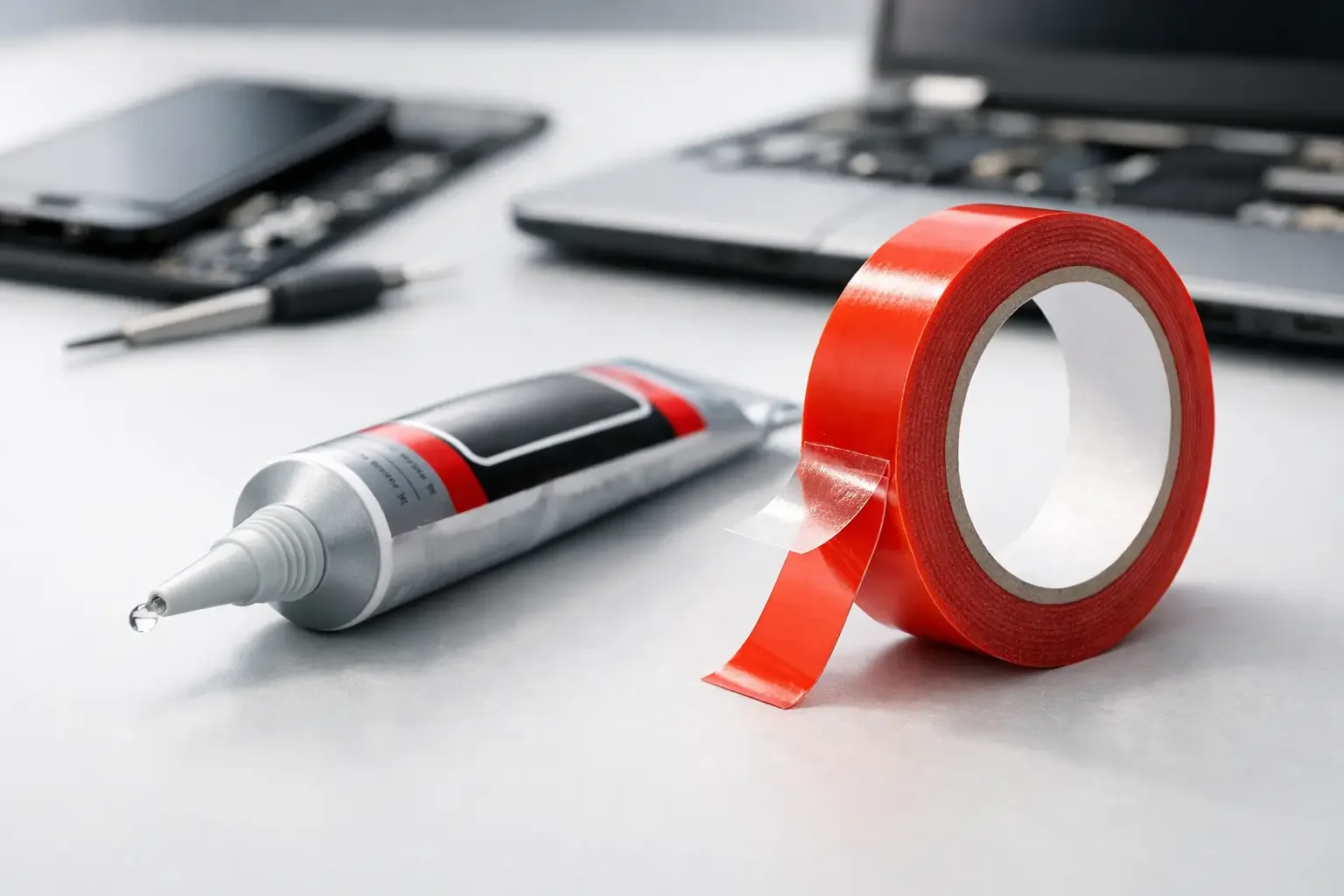
A display that lifts at the corners, a back cover that doesn’t adhere evenly, or a slightly bent frame can't be fixed just by choosing the strongest adhesive. In the comparison between B7000 glue and Tesa, the correct choice depends on the component, the precision of the seating, the need to reopen the device, and the finish level required after the repair.
B7000 is a liquid, single-component glue, widely used for perimeter bonding and uneven surfaces. The term Tesa generally refers to technical double-sided tapes, available in rolls or pre-cut, used to fix displays, batteries, covers, and small components. They are not equivalent products: they work differently and serve different needs.
B7000 Glue vs. Tesa: Operational Comparison
The first criterion is the type of contact between the parts. Tesa tape requires clean, relatively smooth surfaces and a precise fit. Its adhesion is immediate after pressure, doesn’t run, and allows for organized work. It’s the quickest solution when the component has a defined profile and the bonding surface is intact.
B7000 glue is more tolerant of slight irregularities, micro-gaps, and frame tolerances. Its bead can compensate for minor differences between glass, frame, and cover, which is useful for devices that have been opened multiple times or have no longer perfectly flat seating. However, it requires more control: excessive amounts can spill out, contaminate grids, cameras, buttons, or connectors, and extend bench times.
In practice, Tesa prioritizes precision, cleanliness, and speed. B7000 favors adaptability and continuity of contact. Neither solution is automatically "better": it all depends on the work to be done.
Initial Strength and Cure Time
A technical double-sided tape offers high initial grip. Once the component is positioned and uniform pressure is applied, the device can be moved more quickly compared to a liquid adhesive. However, adhesion tends to stabilize over time, especially if the tape has been applied to degreased surfaces and with adequate pressure.
B7000 requires a settling time. The piece must be carefully centered, secured with rubber bands, appropriate clips, or a press that won’t damage the display, and then left to sit. The initial grip may be enough to keep the component in place, but final strength typically requires several hours. For reliable deliveries, it’s wise to respect the times indicated by the manufacturer and not expose the device to twisting, heat, or mechanical stress immediately.
For a workshop with many daily repairs, this difference impacts organization. If the priority is to quickly close a display replacement with an intact frame, Tesa is often more efficient. If the job requires compensating for an imperfect seating, B7000 can reduce the risk of localized lifts after a few days.
When to Choose Tesa
The double-sided Tesa tape is recommended when the component is designed to adhere along a clean perimeter. Common cases include displays with frames in good condition, back covers with precise fits, battery modules with flat areas, and lightweight internal components. Pre-cut double-sided tapes for specific models, when available and properly compatible, further reduce time and margin for error.
Choosing the thickness is crucial. A tape that is too thick can create tension between the display and frame, leave a visible step, or compromise the alignment of buttons and seals. Conversely, a tape that is too thin may not compensate for the actual distance between surfaces. Before application, always perform a dry run, ensuring that flats, cameras, sensors, and brackets are already in their final position.
Tesa is also preferred when keeping the workspace as clean as possible is a priority. It doesn’t generate liquid residues during closure, and if applied with an applicator and cut precisely, it allows for a controlled aesthetic result. For work on iPhone parts, iPad, and Samsung, this cleanliness is particularly useful near ear mesh, microphones, and proximity sensors.
Limits of Double-Sided Tape
The tape does not correct a bent frame. If the frame is deformed, a cover or display may initially appear closed but lift at the bend over time. In such cases, it is necessary to first restore the flatness of the seating or consider an adhesive that fills micro-irregularities, without turning the glue into a solution for structural damage.
Moreover, not all tapes are suitable for every temperature or surface. For instance, a battery should be secured with products designed to guarantee stability and future removability, not with generic and overly aggressive tapes. Material compatibility is as crucial as adhesive strength.
When to Use B7000 Glue
B7000 is useful for bonding glass, assembled displays, covers, and frames when a continuous and slightly elastic bead is required. It is a common choice for repairs on smartphones with aftermarket parts, where the geometry of the replacement might differ by a few tenths of a millimeter from the original, or on shells that show minor wear signs.
Its elasticity after drying can absorb some normal thermal expansions and slight twists of the device. However, this does not mean it makes a phone waterproof or resistant to significant drops. The glue holds the components together but does not automatically recreate industrial seals, controlled assembly pressures, or the original degree of protection.
To apply it correctly, the nozzle should deposit a thin, continuous line, keeping it away from openings, holes, and functional areas. It’s preferable to distribute the product along the inner edge of the seating, never in such a quantity that it reaches the visible surface once the component is pressed. After positioning, uniform pressure is more effective than concentrated force on a single point.
Common Mistakes with B7000
The most frequent mistake is using too much glue to increase strength. The result is often the opposite: excess glue slows drying, dirties the edge, and can create uneven thicknesses. Closing the device before testing the display, touch, Face ID, cameras, charging, and buttons is also a costly error, as an early reopening compromises the recently completed bonding.
Applying it to surfaces with residues of old adhesive, dust, or grease should also be avoided. Before closing, completely remove deteriorated double-sided tape and clean with a suitable electronics cleaner, allowing any residue to evaporate. The quality of adhesion comes from preparing the seating, not from the amount of product used.
Displays, Back Covers, and Batteries: The Choice Varies
For securing a display on an intact frame, technical double-sided tape is usually the first option: it keeps the thickness under control, allows for a clean closure, and simplifies any future interventions. If the frame has slight imperfections or the replacement does not fit perfectly, a targeted use of B7000 may be justified, provided it does not interfere with seals and components.
For a back cover, the decision depends on the model's construction. A pre-cut or shaped double-sided tape offers a consistent perimeter and a more repeatable result. B7000 may be useful on uneven edges, but requires longer clamping times and more attentive aesthetic control, especially on glass shells.
For batteries, it is not advisable to automatically apply B7000. Future replacement must remain possible without deforming cells or damaging flex cables and surrounding components. Dedicated adhesive strips or selected double-sided tapes for this use, with stable but manageable adhesion during removal, are preferable.
Surface Preparation and Final Check
Whatever product is chosen, the procedure impacts more than the brand written on the roll or tube. Remove previous adhesives with non-metal tools where necessary, eliminate dust and glass fragments, check the flatness of the frame, and ensure the replacement is correct for model and revision. A compatible display mounted on a dirty seat remains a high-risk repair.
Before the final gluing, perform all possible functional tests with the device open. Only after verifying image, touch, brightness, charging, audio, sensors, and cameras should you proceed to closure. Once Tesa or B7000 is applied, reopening for an uncontrolled defect means redoing preparation, adhesion, and in some cases, replacing the part again.
For those managing recurring repairs, having various widths of tape, shaped double-sided adhesives, B7000, cleaning tools, and pressing systems allows for choice of the right method without adapting the work to only the available material. This is the practical point of the comparison: Tesa for precise and quick closure on smooth surfaces, B7000 for more tolerant bonding when the device's actual geometry requires it.