


Comparison of Screwdriver Sets for Technical Repairs
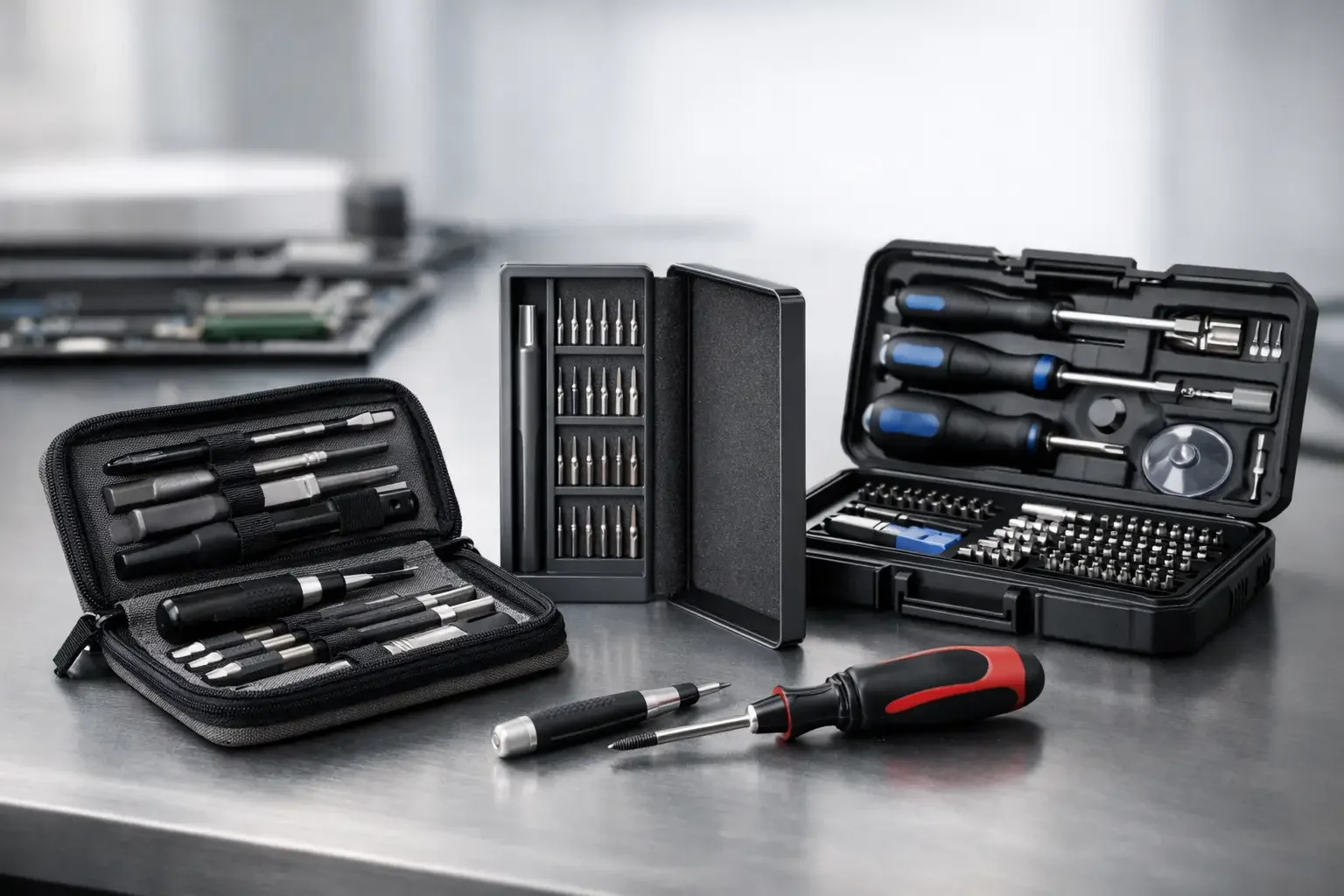
A stripped screw on the lower pentalobe of an iPhone, a Phillips tip slipping on a MacBook, or a Torx not perfectly matched to a shield: often the issue isn't the replacement part but the screwdriver used to dismantle it. This screwdriver set comparison helps select based on the type of intervention, frequency of use, and level of precision required, not merely the number of tips claimed in the package.
For a workshop that works daily on smartphones, tablets, and notebooks, the right set reduces damaged screws, opening times, and unnecessary replacements. For those doing occasional repairs, a compact kit with truly compatible profiles for the devices handled may be more convenient. The difference lies in the selection of tips, the quality of the coupling, and practical handling on the bench.
Comparison of Screwdriver Sets for Repair: What to Evaluate
An electronic repair set shouldn't be compared to a common DIY assortment. The screws on iPhones, iPads, Apple Watches, MacBooks, and many Android devices are small, shallow, and often tightly secured near glass, flat cables, or sensitive components. An incorrect tip can damage the screw head before the intervention begins.
The first parameter is the tip profile. The most common formats in mobile are Pentalobe, Tri-point, Phillips, Torx, and Torx Security. Sometimes, hexagonal, flat, and less common profiles for notebooks, consoles, and peripherals are added. It's not enough for the kit to feature a "compatible" tip; its diameter must correspond to the specific screw. An overly wide Pentalobe marks the edge of the screw; an overly narrow one fails to transfer torque correctly.
Material also matters. S2 steel tips are normally preferred for repeated use because they maintain their profile better than softer alternatives. Again, there’s no universal choice: for occasional openings, an economical set may suffice, but in a professional workflow, premature wear produces inaccurate tolerances and makes the initial savings less relevant.
The handle is the third key element. A handle with a rotating cap allows you to control vertical pressure with your palm while your fingers rotate the screwdriver’s body. It's particularly useful on the small screws of logic boards and internal brackets. A handle that's too light may not provide enough stability, while one that's too bulky becomes less precise in tight areas. The choice depends on the technician's hand and the required torque, but smooth rotation should always be a priority.
Fixed Screwdriver Kits vs. Interchangeable Tip Sets
Sets with dedicated fixed screwdrivers assign a handle to each format. They are faster when similar openings are repeated throughout the day: the technician switches from Pentalobe to Tri-point or Phillips without needing to extract and replace bits. Additionally, a good-quality fixed tip tends to have less play than a modular system.
The downside is the bulkiness. A complete assortment takes up space in the drawer or on the magnetic mat and may include rarely used formats. It is the best solution for service centers frequently working on Apple, Samsung devices, and notebooks, where speed and repeatability have concrete operational value.
On the other hand, sets with interchangeable tips concentrate many profiles in a compact case. They are suitable for traveling technicians, benches with limited space, or those dealing with different devices without knowing the screw format in advance. The comparison should focus on the precision of the magnetic bit holder: if the tip wobbles, the coupling with the screw deteriorates even when the profile is correct.
A modular kit is not automatically inferior. It becomes an effective choice if it includes the most used bits and if the engagement mechanism remains stable over time. For a workshop, a practical setup can be a fixed set for daily used formats and a precision bit kit as support for less frequent models.
Essential Formats for the Apple Ecosystem
Those working on iPhones primarily encounter Pentalobe for external screws, Tri-point for brackets and internal components, Phillips for many shields, and specific standoffs depending on the model. On MacBooks, Torx, Pentalobe, and Phillips in various sizes are also included, while Apple Watch and AirPods require special attention for their small sizes and delicate components.
It’s not advisable to choose a kit based solely on the label "for iPhone." Formats vary between generations and even within different areas of the same device. Before purchasing, linking the set to the type of repairs performed is useful: battery and display replacements, camera interventions, MacBook openings, AirPods maintenance, or smartwatch work.
For those also purchasing components, model checking remains essential. A set suitable for repairing an iPhone 11 does not automatically replace the tools needed for a MacBook Pro or an iPad with different screws and brackets. Organizing the bench, spare parts, and equipment by device family minimizes interruptions and openings performed with improper tools.
Tip Precision and Screw Protection
The tip should fit into the screw without force, maintaining full contact with the internal surfaces of the profile. If it wobbles or remains elevated, stopping is often the most efficient decision. Continuing to screw increases the risk of stripping, especially on screws with thread-locking compounds or already marked from previous interventions.
Magnetization is useful for holding small screws and speeding up reassembly, but it shouldn't be the only criterion. An excessively strong magnet can make work messy near metal components or screws positioned deep. In these cases, precision tweezers and a well-organized magnetic mat are more manageable.
The length of the shaft influences access. A short shaft improves control on smartphones and tablets opened on the bench; a longer shaft may be necessary for screws recessed in notebooks. In professional sets, it's advisable to check that the tips are easily identifiable, with a readable size even after many cleanings. Searching for a bit among dozens of nearly identical items slows down the technician more than it seems.
When to Choose an Economical Set and When to Upgrade
An entry-level set is appropriate for an experienced user who needs to perform limited interventions, such as replacing a battery or display on a few known models. In this scenario, an essential assortment with Pentalobe, Tri-point, Phillips, and Torx in the correct sizes avoids an expense disproportionate to the volume of work.
For a service shop or workshop, the comparison changes. Tips are used several times daily, encounter already manipulated screws, and must maintain precision in repeated repair series. Here, it's preferable to focus on reliable materials, comfortable handles, readily available spare parts or additional bits, and a case that makes the assortment immediately controllable.
There's no need to purchase the set with the highest number of accessories if half of the bits will never be used. An assortment targeted at the devices actually handled is more functional than a sprawling toolkit. Conversely, those managing multibrand repairs may benefit from a wider range, especially for Android, action cameras, GPS devices, and small electronics.
Common Mistakes to Avoid on the Bench
The most common mistake is using a "almost right" tip to avoid interrupting work. This poses a high risk with Pentalobe and Tri-point, where minimal measurement differences immediately compromise the screw. The second mistake is applying too much force without stable vertical pressure: the tip slips out of the profile and damages both the screw and nearby surfaces.
Extended use of worn tips should also be avoided. When the edges are no longer sharp, the torque is poorly distributed, and the screw deteriorates. Keeping worn bits separate, regularly cleaning tips, and replacing those that have lost precision is a simple procedure that protects the subsequent work.
For a complete workstation, the screwdriver set must work alongside tweezers, spatulas, suction cups, magnetic mats, and appropriate opening tools. iPhoneHospital.it can be an operational reference for organizing tools and spare parts according to the model being worked on, avoiding generic purchases not suitable for the expected processing.
The most beneficial choice remains the verified one before opening: identify the device, the screw's location, and the required size, then use an intact tip with the correct coupling. One minute dedicated to this check can prevent a jammed screw, a marked frame, and an intervention that takes longer than expected.