


Compatible vs Original MacBook Batteries
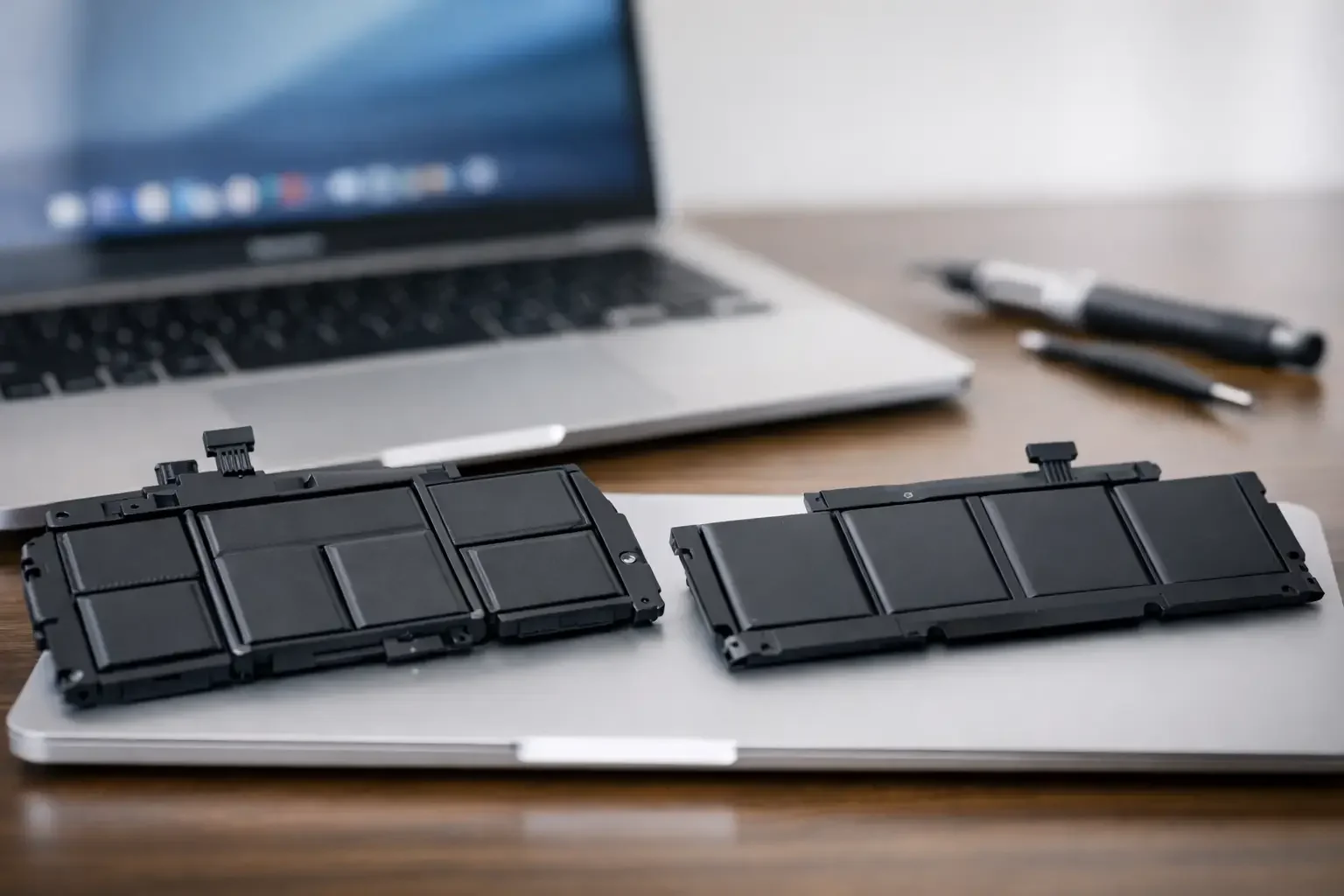
When a MacBook battery starts to swell, loses autonomy, or causes sudden shutdowns, the question isn't theoretical: compatible vs original MacBook batteries, which choice truly makes sense? For a workshop, for a spare parts retailer, or for an experienced user, the correct answer depends on the model, budget, component availability, and the quality standards required for the intervention.
There's still a lot of oversimplification surrounding this topic. The idea that 'original' always means 'better' and 'compatible' always means 'cheap and risky' does not hold true in every scenario. Similarly, thinking that all compatible batteries are equivalent is a technical mistake that leads to returns, complaints, and new device openings after just a few weeks.
Compatible vs Original MacBook Batteries: What's the Real Difference
The main difference isn't just in price. Origin, cell types used, quality control, electronic integration, and consistent performance between batches change. An original battery is made according to specifications defined by the device manufacturer and, in theory, offers the best coherence with the hardware design and the power management system of the logic board.
A compatible battery, on the other hand, is a replacement produced by third parties to substitute the original component while respecting its shape, voltage, connectors, and functional parameters. Here lies the key technical point: 'compatible' is not a qualitative category but a commercial one. There are good compatible batteries as well as those to avoid. The difference lies in cells, BMS, soldering, adhesives, dimensional tolerances, and charging behavior stability.
For those working in repairs, the correct criterion is not original vs compatible in the abstract, but original vs compatible of adequate quality for the type of intervention.
When an Original MacBook Battery Makes More Sense
The original battery remains the most straightforward choice when the customer requests the highest possible alignment with the initial specifications, when the device is new, or when the residual value of the MacBook justifies a higher investment. In these cases, the predictability of the charging cycle, the accurate reading of health parameters, and a thermal response consistent with Apple hardware are very important.
There's also a practical aspect that technicians know well: on some more sensitive machines, especially with sophisticated power management and more restrictive firmware, a battery of less-than-excellent quality can generate abnormal behaviors. Not all issues are immediately evident. Sometimes the problem is subtler: unstable percentages, non-linear autonomy, more active fans than expected, shutdowns under load, or battery service messages.
If the target is a business customer, a professional who uses the MacBook for continuous work, or in a context where downtime has a high cost, the original or high-quality equivalent battery tends to be the most prudent solution.
When a Compatible Battery is the Right Choice
A good compatible battery makes sense in many real cases. For older MacBooks, where the availability of original replacements is limited or the cost is disproportionate compared to the value of the notebook, a compatible battery allows the device to be brought back into service with a more rational investment.
For workshops, it's often the solution that allows repairs on machines outside the first commercial cycle, while maintaining acceptable margins and processing times. Even for experienced users who want to extend the life of a used MacBook, a well-selected compatible replacement can offer a fully satisfactory result.
The key is that “well-selected” part. A serious compatible battery must have capacity consistent with the model, stable electronics, correct dimensions, and charging behavior that doesn't create anomalies in the system. If the supplier works structurally in the Apple world and categorizes replacements by precise model, the margin for error is greatly reduced. In this context, the MacBook spare parts section is the natural reference for identifying the correct component based on the specific machine.
The Quality Factor: Where the Real Difference Lies
On the test bench, the difference between a valid battery and a problematic one emerges in very concrete points. The first is the quality of the cells. Unstable or non-uniform cells worsen autonomy, operating temperature, and the actual number of sustainable cycles. The second is the management circuit. If the BMS doesn’t work correctly, charging values can become inaccurate, and the system may interpret the battery anomalously.
Then there's the mechanical part, often underestimated. On many MacBooks, the correct positioning of the battery pack is essential. Incorrect thicknesses, poor adhesives, or approximate tolerances complicate assembly and can affect the trackpad, casing, and internal dissipation. For a technician, it’s not just an aesthetic issue: it means more time, more risk, and less long-term reliability.
A cheap compatible battery may seem convenient at purchase, but if it generates a return or complaint, the real cost increases immediately. Bench hours, new device openings, testing, customer assistance, and possible warranty replacement erode any initial advantage.
Autonomy, Cycles, and Performance: Realistic Expectations
Those comparing compatible vs original MacBook batteries usually look first at autonomy. This is understandable, but it's not enough. A battery may offer good autonomy in the first few days and degrade quickly if the cell quality is not consistent. For this reason, endurance over time is more valuable than the initial perceived data after installation.
With an original battery, one expects a more predictable curve. With a quality compatible battery, the behavior can be very close, but not always identical. The difference is most noticeable under variable loads, long sessions, high temperatures, or intensive charging and discharging cycles.
For the workshop, the right approach is to avoid absolute promises. It's better to think in terms of quality range of the replacement and the customer’s usage profile. A MacBook used for browsing, office work, and streaming tolerates small differences better than a machine used for rendering, development, or work in mobility for many consecutive hours.
Safety and Reliability: A Point That Should Not Be Treated as a Detail
On the battery, aggressive savings are often a false economy. The risk doesn't just concern low autonomy. It involves early swelling, overheating, electrical instability, and stress on other components. On a MacBook, where internal spaces are compact and mechanical integration is tight, a defective battery can create significant collateral damage.
That's why supplier control matters almost as much as the product itself. Those who purchase spare parts professionally need precise cataloging, model availability, and consistent standards between batches. An assortment built for the repair sector, like that of iPhoneHospital.it, makes sense precisely because it reduces improvisation in component selection.
An additional operational aspect is also worth considering: a good battery does not solve problems that are not battery related. If the MacBook has abnormal consumption, intermittent charging, PPBUS lines out of specification, or board issues, replacing the battery pack without diagnosis leads to partial intervention and an unsatisfied customer.
How to Choose Between Original and Compatible Without Making Mistakes
The right choice always starts with the exact model of the MacBook and the compatible code. After that, one must evaluate the age of the device, residual value, availability of the replacement, customer budget, and the type of expected use. On a recent or high-end machine, it’s worth maintaining a high-quality standard. On an older MacBook, a compatible battery can be the most efficient solution if the replacement is well-selected.
For a workshop, a simple rule of thumb is this: if the intervention must minimize post-sale risk, upgrade the quality of the replacement. If the customer wants to keep costs down on a machine no longer central to their device lineup, a good compatible battery remains perfectly defensible.
It’s also useful to always check the condition of the connector, cable integrity, any signs of liquid, internal pressure on the casing, and system behavior after installation. A correct replacement is not concluded with the MacBook’s power-on but with charging tests, controlled discharging, and stability verification.
The True Comparison Between Compatible vs Original MacBook Batteries
The real comparison isn't between two labels, but between two levels of risk and two purchasing logics. The original aims at maximum coherence with the initial project and reduces variables. The compatible, if well chosen, aims for the best balance between cost, availability, and practical yield.
Those who purchase solely based on price are focusing on the least useful datum. Those who buy only based on the notion of 'original', without considering the age of the machine and the value of the intervention, risk oversizing their expenses. The professional choice is one contextualized, made on real compatibility, the quality of the replacement, and the expected result.
If the goal is to make a MacBook operational again with a sustainable and technically sound intervention, it’s best to reason like the best workshops do: fewer slogans, more specifications, more tests, more attention to the correct piece.
Spare parts and useful tools: iPhone Spare Parts · Batteries