


Example Spare Parts Supply for Service Centers
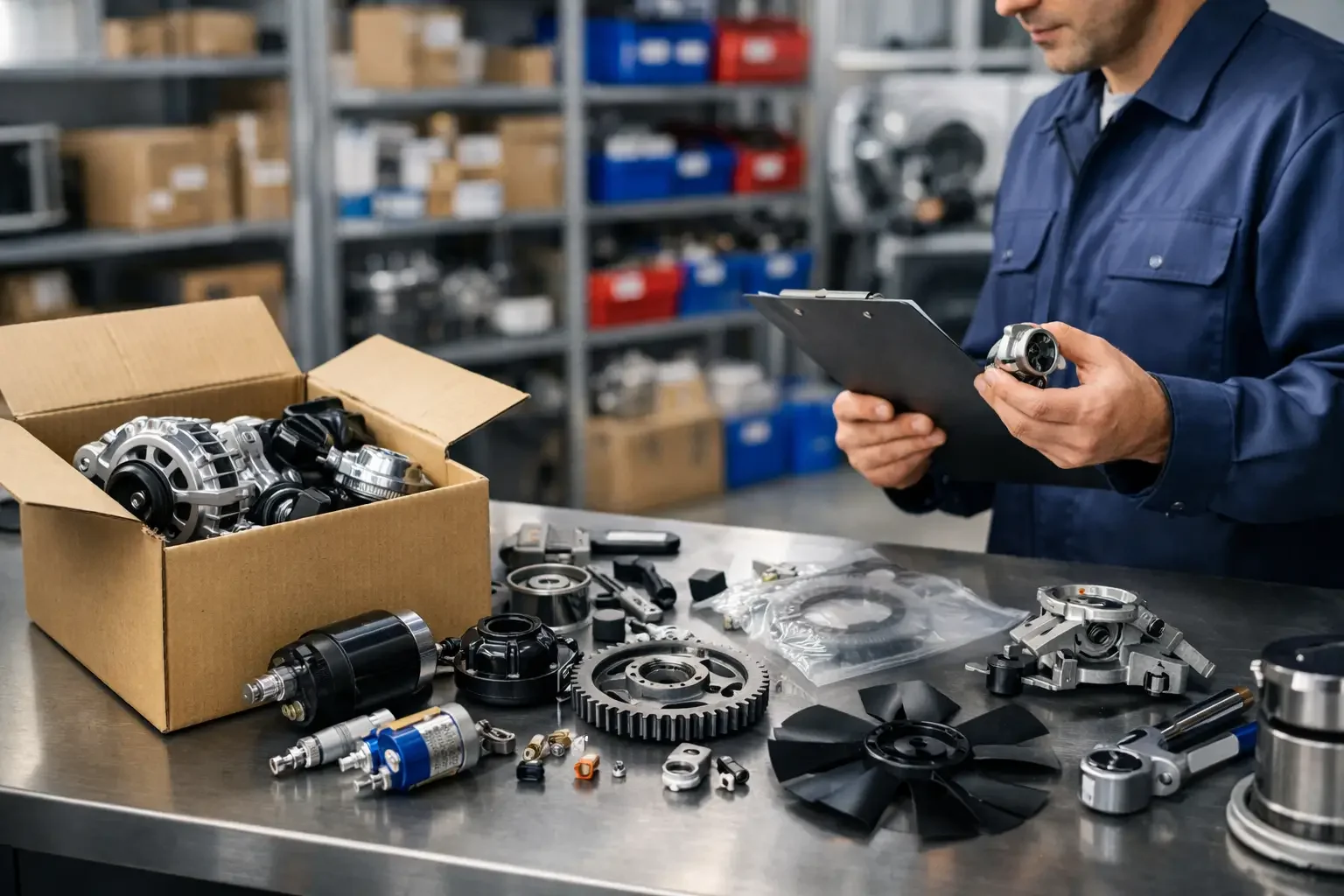
When a workshop looks for an example of spare parts supply for service centers, it usually doesn't need theory. It needs to understand how to structure purchases, stock, and reorders without tying up capital and without missing the part that comes in three times a day. The point isn't to buy a lot. The point is to buy well, based on model, failure frequency, and actual repair margin.
A service center that works on smartphones, tablets, and notebooks does not have the same needs as a shop that only does replacements of iPhone displays. This is why an effective supply model starts from three concrete variables: types of devices handled, intervention history, and depth of the necessary catalog. Without these three data points, even the most assorted supplier will be used ineffectively.
How to Read an Example Spare Parts Supply for Service Centers
A good example of spare parts supply for service centers is not just a simple list of components. It is an operational structure. It must distinguish between high-rotation parts, critical but slow parts, and lab materials that impact daily productivity.
The first group typically includes displays, batteries, charging docks, cameras, flex sensors, and small components that are frequently damaged. The second group consists of less requested but decisive parts, such as components for secondary boards, specific parts for tablets, or spare parts for Apple laptops. The third group includes adhesives, glue, tools, workstations, mats, screwdrivers, pliers, ESD tools, and consumables.
The difference is made by segmentation by model. If a workshop continuously handles Apple, the correct logic is not "iPhone display" in general, but precise compatibility by series and variant. This also applies to iPad, MacBook, Apple Watch, and AirPods, where a selection error can halt a repair and turn an urgent order into an extra cost.
The Foundation of Inventory: High-Rotation Spare Parts
For most Italian service centers, the minimum stock starts with smartphones. Here the criterion is simple: maintain stock on models that generate the most repairs and purchase as needed for marginal or very old models.
For those who primarily work on Apple, the most common categories are displays, batteries, charging connectors, earphones, speakers, front and rear cameras, volume and power buttons, flex sensors, and back covers compatible with the actual repair flow. Operationally, it's advisable to build a recurring base starting with iPhone spare parts and then expand based on the tickets received.
The same principle applies to tablets. Many labs underestimate iPad spare parts because they have lower turnover compared to smartphones, but they often guarantee interventions with a higher average ticket. Keeping stock of some displays, batteries, and connectors for the most requested models can reduce downtime and improve profitability.
If the lab also handles Android devices regularly, Samsung spare parts deserve a dedicated line. There's no need to replicate the entire catalog. It's essential to select the models that actually come in, otherwise, the stock disperses and the unsold rate rises quickly.
When to Expand Supply Beyond Smartphones and Tablets
A service center that wants to grow cannot remain focused only on quick repairs. Expanding into notebooks, desktops, and wearables requires a more reasoned supply but increases the average ticket and differentiates the service.
For the Apple world, MacBook spare parts require greater attention to compatibility, as keyboards, batteries, fans, speakers, flex cables, and screens change based on year, model, and configuration. Here, an error isn't just a return: often it means postponing the intervention and occupying technical space in the lab.
Also, iMac and Mac Mini spare parts can make sense in an advanced service center, especially if working with business clients or professional studios. These are less impulsive categories but useful for positioning as a complete technical reference.
Then there are highly specialized niches. Apple Watch and AirPods spare parts do not generate the same volumes for everyone, but in some areas, they can represent an interesting share of work. The choice here depends on the available equipment, the technician's dexterity, and the acceptable margin for intervention. Not all labs find it worthwhile to keep deep stock on these lines. But ignoring them entirely can mean leaving the market to more equipped competitors.
The Most Common Mistake: Buying Spare Parts Without Tools
Many supply examples focus solely on replacement components. This is an incomplete setting. A service center doesn't just buy spare parts; it buys operational capacity.
If the right workbench equipment is missing, even the correct component doesn't solve the problem. Inconsistent quality adhesives, worn blades, inadequate stations, absent ESD tools, or improvised cleaning materials slow down work, increase the risk of secondary damage, and reduce the margin of individual repairs.
For this reason, a sensible supply must also include Lab Accessories. Not as an ancillary item, but as part of the process. A lab that replaces glasses, batteries, connectors, and display modules every day constantly consumes materials. If these items are not included in the reorder plan, the bottleneck will arrive anyway, even with the main spare parts available.
A Practical Example of Supply for Service Centers
Let’s take a case of a lab that manages 80-120 interventions monthly, with a primary focus on Apple and a secondary share on Samsung. In this scenario, the supply needs to be built on three levels.
The first level is immediate base stock. This includes displays and batteries for the most requested iPhone models, some charging components, speakers, earphones, cameras, and mounting adhesives. This is complemented by a few iPad codes with a high probability of moving and a coherent selection of Samsung based on actual entries.
The second level is scheduled technical stock. This includes slower but strategic spare parts: MacBook components for frequently handled models, some notebook batteries, fans, cables, small modules, and parts for repairs with higher average tickets. These products do not necessarily have to be kept in maximum range but should be included in tighter reorder planning.
The third level is the lab line. This includes tools, consumables, and workbench equipment. This group often weighs less than spare parts in initial reasoning, but it significantly impacts technical times and the final quality of the work.
If the lab also serves customers on less common devices, it may make sense to include additional categories such as iPod spare parts, especially when the goal is to cover specific requests that other operators discard. This is not a mandatory choice. It’s a positioning choice.
How to Decide Quantity and Reorder Frequency
The issue is not just what to purchase, but how much to purchase. Keeping two pieces of stock for a display that sells twenty times a month is insufficient. Keeping ten pieces of a spare part that sells once every four months is avoidable inventory immobilization.
The most helpful method is to cross-reference repair history, average procurement time, and margins. If a component generates rapid, high-frequency interventions, it is advisable to raise the minimum stock level. If the spare part has sporadic demand but an interesting margin, an ordering approach or a very controlled stock may suffice.
The variability of the market also matters. Some models stop selling within months, while others remain in demand longer than expected. For this reason, the supply should not just be set once. It should be corrected periodically, reading the acceptance desk data and not relying on impressions.
Why a Deep Catalog Simplifies Work
For a technician, finding everything from the same supplier means reducing downtime, compatibility errors, and order fragmentation. This is especially true when working across different ecosystems but with a strong Apple prevalence.
A specialized catalog allows for transitioning from iPhone spare parts to MacBook spare parts, up to categories like Apple Watch spare parts or AirPods spare parts, while maintaining a coherent search logic by product family and model. For those managing frequent reorders, this translates into fewer redundant checks and greater speed in order construction.
In a professional context, the difference isn't just made by the unit price. It's made by the overall cost of error: waiting table, customer waiting, double orders, eroded margins, and a compressed technical agenda. This is where an operational supplier like iPhoneHospital.it becomes useful, especially for those who need broad coverage and repeated purchases.
An efficient service center does not randomly order spare parts or fill the warehouse out of habit. It builds a supply consistent with the faults it sees every week, with the tools it truly uses, and with the level of service it wants to maintain toward the end customer.