


How to Truly Recognize Original Parts
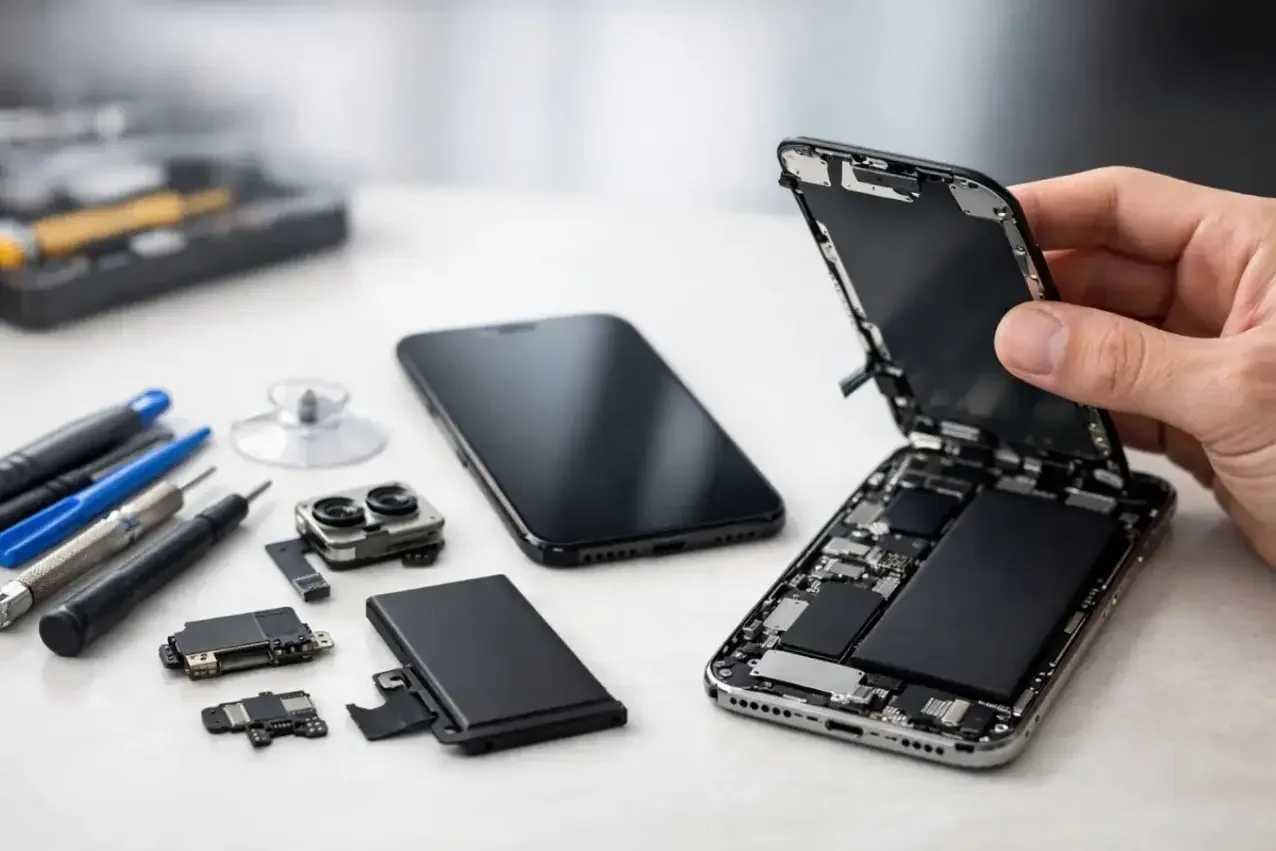
A display that lights up isn’t automatically a good display. A battery that fits in the compartment isn’t necessarily the right battery. When searching for original parts, especially for iPhone, iPad, MacBook, and Apple Watch, the goal isn’t just to find a component that fits: it’s crucial to assess its origin, identification, actual condition, and compatibility with that specific device.
For a repair shop, choosing the wrong part means increased diagnosis times, returns, and after-repair interventions. For those repairing independently, it may mean reopening the device after just a few weeks. The term “original” is often used generically, but in the electronics market, it has different meanings that must be distinguished before purchase.
What is Meant by Original Parts
In technical terms, an original part is a component produced for the device by the device manufacturer or sourced from its authorized supply chain. However, in the repair market, the definition can also refer to a part extracted from a working device, a refurbished part, or a component with specifications equivalent to factory standards.
These categories are not interchangeable. A component recovered from an original device may be authentic but have already undergone a usage cycle. A refurbished element may retain some original parts while replacing others. A quality compatible part can deliver good performance but cannot be defined as original. The correct choice depends on the type of intervention, budget, customer expectations, and the functions that need to be preserved.
The first operational rule is simple: do not rely solely on the commercial name. Always check the description, supported model, condition of the component, and declared characteristics to avoid confusion between original, recovered, refurbished, and compatible.
Why Origin Matters More Than the Label
The origin determines what a part can guarantee over time. On an iPhone, for instance, displays, batteries, cameras, and biometric modules are not just passive elements. They interact with the logic board, sensors, the operating system, and, in newer models, with configuration and calibration procedures.
A part may be mechanically installable but fail to maintain all intended functions. The most well-known case refers to messages related to unrecognized displays, batteries, or cameras. Even when the device remains usable, some diagnostic information may be unavailable, or certain functions may require additional operations after installation.
This is why a technician must evaluate the component based on the required intervention. If it’s necessary to restore a device intended for standard daily use, a selected compatible part may be a rational solution. If the customer demands maximum consistency with the initial configuration or if sensitive components are involved, priority should be given to traceability and real functional compatibility.
Checks to Make Before Ordering
The precise identification of the device comes before the choice of the part. The commercial code isn’t always sufficient: two variants with similar names may have different connectors, sizes, flexes, or specifications. For iPhones and iPads, it’s useful to verify the model number, while on MacBooks and iMacs, the year, diagonal, A code, and internal configuration become essential.
Check Model and Hardware Revision
Before ordering, compare the device code with the compatibility indicated for the part. In Apple laptops, a keyboard, battery, or display can vary between generations that are aesthetically nearly identical. In tablets, the difference between Wi-Fi and Cellular versions or between regional variants can affect antennas, flat cables, and assemblies.
For displays and complete modules, also check whether the part includes frame, pre-assembled components, or just the panel. A display with a frame reduces transfer operations and the risk of damaging small components, but it isn’t always the most economical solution when the original housing is intact.
Assess the Component's Condition
A recovered original part must be carefully checked. Signs of oxidation, altered adhesives, bent connectors, scratched glass, and compromised seals are elements to consider, even if the module lights up during a quick test.
In the case of batteries, condition is not assessed solely by the absence of bulging. Actual capacity, voltage, integrity of the protection circuit, quality of the flat cable, and production date matter. A battery that has been stored for a long time under inadequate conditions may provide lower autonomy even if it appears externally perfect.
Consider Calibration and Component Transfer
Some repairs require the accurate recovery of parts from the original component. Earpiece speakers, front sensors, buttons, brackets, seals, and biometric modules must be managed according to a precise procedure. A transfer performed without suitable equipment can lead to the loss of essential functions or permanent damage to the component.
In recent devices, one must also anticipate potential post-repair configurations. This is not a detail to leave until the end of the intervention: it should be checked beforehand to convey accurately the time, cost, and expected result.
Original and Compatible Parts: When to Choose One Over the Other
No single choice is valid for every repair. Original or recovered parts may be preferable when dealing with complex modules, when perceived quality should remain as close as possible to the original, or when the customer expressly requests a specific origin.
Compatible components, on the other hand, may be suitable for out-of-warranty repairs, devices with limited residual value, or interventions where the cost-to-result ratio is the decisive factor. The quality level of the part makes the difference, not just its category. A properly selected compatible part is often more reliable than a supposed original without verifiable origin.
For example, when replacing a display, it’s advisable to compare color rendering, brightness, touch sensitivity, energy consumption, and assembly quality. For a battery, prioritize actual capacity, stability, protections, and dimensional accuracy. For cameras, speakers, charging connectors, and flat cables, functional tests and mounting tolerances become crucial.
The Right Part Also Requires the Right Tools
The quality of the component does not make up for a procedure executed with unsuitable tools. Suction cups, picks, precision screwdrivers, magnetic mats, soldering stations, microscopes, and testing tools are part of the same replacement process. A connector damaged during disconnection or a screw mounted in the wrong position can turn a routine replacement into a more expensive repair.
For a repair shop, it’s beneficial to standardize procedures: model identification, initial diagnosis, visual verification of the part, testing before closure, function checking, and orderly management of screws and shields. This reduces repeatable errors and also makes communication with the customer clearer.
Organizing parts by device families helps to work with greater precision: parts for iPhone, iPad, MacBook, iMac, Apple Watch, AirPods, and Mac mini require different skills and materials. Even for those handling multi-brand repairs, keeping components, codes, and tools separate prevents incompatible purchases and downtime at the bench.
Transparency is Part of the Repair
Presenting a component as original without specifying its condition and origin creates expectations that are difficult to manage. A well-prepared technical estimate should clearly indicate whether the part is original, recovered, refurbished, or compatible, as well as describe any known functional limitations.
This transparency protects both the repair technician and the end customer. It allows for informed choices between cost, performance, and expected durability, without turning a difference in category into a dispute after the intervention.
The right component isn’t the one best defined in a product sheet but the one accurately identified, checked before installation, and consistent with the requested outcome. This is where a reliable repair begins.