


Trends in Repairable Foldable Displays
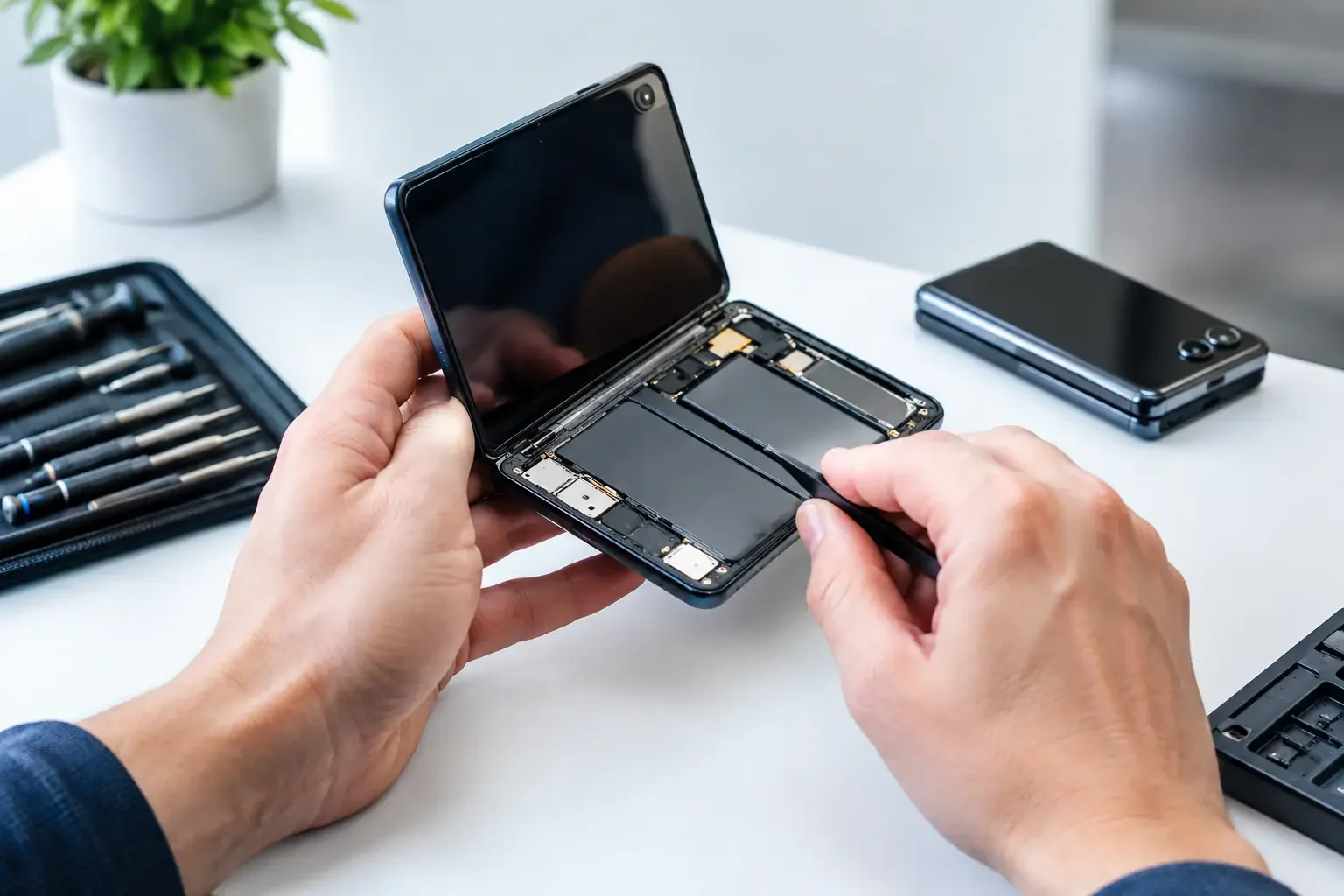
A damaged foldable display is not assessed like a regular OLED: a line along the hinge, a crease that stiffens, or intermittent touch may be due to the panel, protective layers, or mechanics. The trends in repairable foldable displays are shifting the lab's focus from solely replacing the module to diagnosing the entire display-hinge-frame system.
For technicians, shops, and service centers, this means working with more selective procedures, more accurately identified spare parts, and equipment suitable for thin and flexible components. The reparability of foldables is improving but remains conditional on the design of individual models and the actual availability of spare parts.
Why the Foldable Display is a System, Not Just a Component
In traditional devices, the display, touch, and front glass are often integrated into an assembly replaced as a unit. In foldables, the internal panel introduces specific challenges: flexible substrate, folding area, protective film, perimeter adhesives, internal frame, and hinge work in close relation.
A visual defect along the crease may indicate microfractures in the OLED panel or the touch layer. If the display lifts from the frame, the cause could be a deformed frame, deteriorated adhesive, or an expanding battery. Replacing only what appears damaged, without checking adjacent parts, increases the risk of a return for service.
The first significant trend is precisely this: spare parts are increasingly offered in differentiated configurations. Complete internal displays with frame, frame-less panels, and separate external modules are available. The correct choice depends on the condition of the frame, the technician's experience, and the relationship between bench time, margin, and final reliability.
Assembly with Frame or Bare Panel
A complete assembly with frame reduces the need to transfer the motherboard, hinge, and small components. In the presence of impacts, twists, or deformed edges, it is often the most straightforward solution because it eliminates the uncertainty of mounting a new panel onto a not perfectly planar structure.
A frame-less panel may be cost-effective when the casing is intact and the lab has adequate tools and experience for controlled opening and bonding. However, it is not an automatic choice: on foldable models, localized pressure, excessive bending, or improperly applied adhesive can compromise a perfectly functional display.
Trends in Repairable Foldable Displays: Real Modularity
Modularity is the criterion by which manufacturers are most often evaluated, but it must be read carefully. A device may have a removable back cover and a replaceable external display while keeping the internal panel bound to the hinge or frame. In such cases, repair is possible but requires a different technical level and spare parts cost depending on the fault.
In the most maintenance-friendly designs, the external display, battery, charging port, and shell components are accessible without directly intervening on the flexible section of the internal panel. This is a significant advantage for more frequent repairs as it limits high-risk steps.
The replacability of the hinge is another concrete indicator. A hinge with abnormal play, noise, incomplete opening, or irregular resistance should not be considered a mere aesthetic issue. It can alter the tension of the internal display and accelerate wear on the layers in the folding area. When the design allows intervention on the mechanics with dedicated spare parts, the device has a potentially longer useful life.
Not all models offer the same level of access, however. Some require the transfer of magnets, antennas, speakers, flat cables, and very thin shielding components. The quote must reflect this complexity: it is not just the price of the module that matters, but also the operational risk, testing time, and the need to correctly restore adhesives and protections.
Internal Film: Small Replacement, Critical Function
The protective film of the internal display is often mistaken for a common aftermarket protection. In foldables, it is not. Its elasticity, thickness, pressure response, and behavior in the folding area have a direct impact on the user experience and, in some cases, the screen's durability.
A film that lifts at the edges does not always mean the display needs replacement. If the panel does not show lines, black areas, touch loss, or signs of internal delamination, the intervention may be limited to the controlled removal of the protection and the application of a compatible replacement. Before proceeding, it is essential to verify that the defect is not caused by a deformed frame or a hinge that closes irregularly.
The trend for labs is to clearly distinguish between film maintenance and panel damage. This assessment avoids unnecessary replacements and allows for a solution proportionate to the detected defect.
Diagnosis Before Opening
In foldables, the diagnostic phase must be broader than for a monocoque smartphone. Before heating the cover or disconnecting the battery, it is helpful to check the functionality of both screens, the touch across the entire surface, cameras, Wi-Fi, wired and wireless charging, speakers, and sensors.
The mechanical dynamics should also be observed. The device must open and close without friction, snapping, misalignments, or abnormal angles. It is advisable to document the aesthetic condition with photos, especially when there are dents near the hinge or cracks on the external panel. This step protects the lab and improves work traceability.
During the diagnosis, the most indicative symptoms of a compromised internal panel are the appearance of a persistent vertical or horizontal line, expanding black spots, flickering, non-responsive touch areas, and shutdowns when the phone is opened beyond a certain angle. In such cases, insisting on repeated pressures or openings may aggravate the damage.
Equipment and Consumables that Impact Results
Repairing foldables requires control, not force. Opening the casing requires uniform heat and thin tools, while handling flat cables needs accurate tweezers and attention to connectors. A tidy work surface is essential: screws, shields, and brackets may vary in position and length within the same group.
Using screwdrivers with the correct fit reduces the risk of damaging very small screws or distorting the seats. For electrical checks, a bench power supply or multimeter helps distinguish a display defect from a power, flat cable, or motherboard issue. In cases of oxidation or damage on the connector, evaluation may require optical magnification and microsoldering work.
Adhesives also deserve attention. An unsuitable double-sided adhesive can create abnormal thickness, hinder casing closure, or reduce sealing against dust and moisture. After each opening, the promise of original waterproofing should not be taken for granted: the quality of reassembly can improve protection, but it does not replace factory tests.
Spare Parts: Compatibility, Quality, and Configuration
The spare parts market for foldables is growing alongside the proliferation of devices, but not all offers have the same configuration. The technician must verify the exact model, variant code, frame color, presence of a fingerprint reader, pre-installed components, and the module's origin. An external display that appears compatible may differ in connector, sensor position, or required firmware.
In Samsung foldable devices, model-specific searches are particularly useful as successive generations may have similar sizes but non-interchangeable parts. For those managing a warehouse, it is advisable to clearly separate internal displays, cover displays, frames, batteries, flats, hinges, and adhesive kits. The correct spare part is not the one that looks like the removed piece, but the one verified for code and configuration.
Quality should also be assessed based on the warranty offered to the customer. A component may function on the bench and show issues only after cycles of opening and closing. For this reason, final testing should include multiple complete openings, touch tests across the entire area, checking brightness at various levels, and verifying the correct alignment of the casings.
Repairability and Quotes: The Criterion is Technical Value
A repairable foldable does not necessarily mean cheap to repair. The internal display remains one of the most expensive components, while labor includes delicate operations and extensive testing. Conversely, an issue with the film, external cover, charging port, or battery may be resolved with a much more contained investment if no structural damage is present.
The professional quote should therefore indicate the involved component, the configuration of the spare part, and any necessary auxiliary processes. If the hinge shows anomalies, it is correct to point them out even when the customer requests just the display change: ignoring them could reduce the duration of the intervention.
For those who work every day on repairs, the direction is clear: knowing the model, accurately classifying the defect, and choosing the appropriate level of intervention is worth more than a quick replacement. In foldable displays, accurate diagnosis is already a substantial part of the repair.